

Canada just had its first two consecutive quarterly population declines. In Q4, 2025, the population decreased by 103,504 people. The main reason for this decline is the decrease in temporary residents after years of uncontrolled mass immigration.
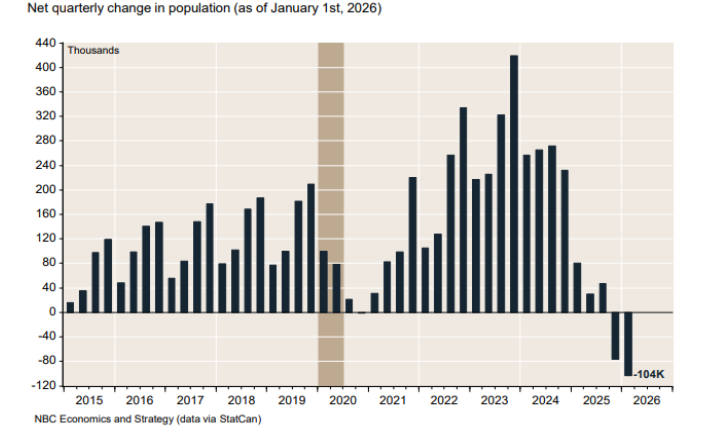
At its peak, the share of temporary residents in the population reached 7.6%. This number is slowly dropping as some are granted permanent residency, and the overall number of temporary visa issues, such as student visas, decreases. I won’t be surprised to see more population declines as Canada’s natural growth has been lagging for some time.
Canada has joined the ultra-low fertility classification status. It is a classification given when a country declines below a total fertility rate (TFR) of 1.25. It has been dropping for decades, and is lower than our replacement rate of 2.1.
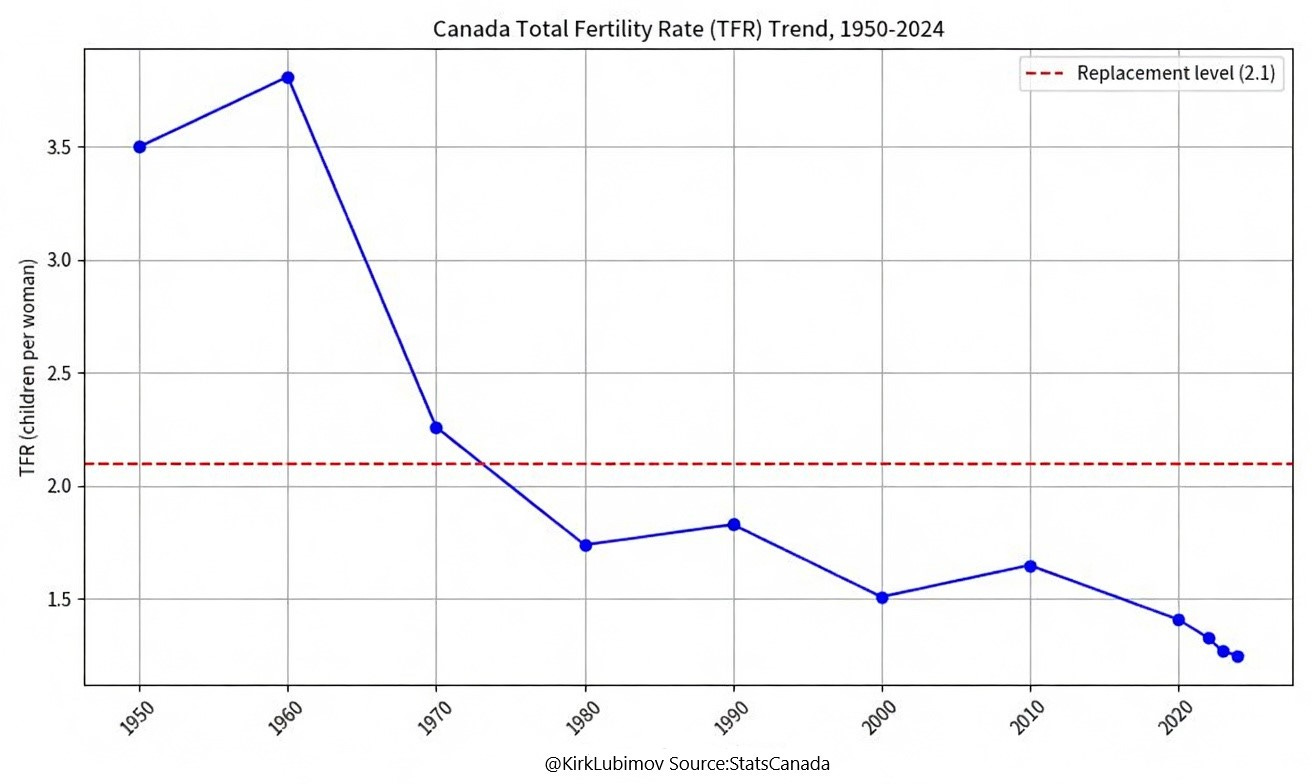
These numbers are often quoted but what they mean is not understood by most people, so let’s dissect. For the population to grow, a female must have a daughter who will replace her in the next generation. That’s a minimum. According to the biological constant, there will be roughly 105 boys born for every 100 girls. Thus, mathematically, you need more than 2.0 children to ensure 1.0 of them is a female on average.
The “0.1” in the 2.1 is a survival buffer that accounts for infant and child mortality rates, and in Canada’s case, thankfully, it is low. Let’s remember that the girls need to reach motherhood.
The 2.1 replacement level can be considered as the stagnation level for the population. A mathematical status quo. Canada hasn’t been at this number since roughly 1971. We haven’t felt the consequences of this yet, but as the silver wave begins, we will. There is no running away from math.
The substantial increase in life expectancy over the years gave the timeline a skew. Life expectancy increase ‘bought’ us some years. The Baby Boom, which had 8.2M babies born during its years, gave Canada its population momentum for the next decades.
During the baby boom years of the 1950s and 60s Canada’s total fertility rate spiked above 3.0 and even hit 3.9. Families were huge, especially by today’s standards, and that gave us a population bulge. Canada’s population went from just over 12 million people before the Baby Boom to just over 20 million by the end of it. It’s not only a huge percentage increase but also one that distorts every economic and social metric.
Around 1972, Canada started to drop below the replacement rate. That is the year when the first wave of Boomers hit their mid 20s, which is when women started to have kids back then.
Even when the fertility rate started to drop, the sheer number of women who were now having kids has drastically increased. It added to the population pyramid but not enough. Although the Boomer generation was the largest, they themselves had fewer children. Less than the replacement rate, and had only enough to replace about 75% of their own numbers. The Baby Boomers’ kids are having even fewer kids, so far.
This math cascades down. This is what gives us the population pyramid that is wide at the top and narrows down towards the bottom. The Boomer echo is fading, and what gave us a population boom will now turn into a bust as that generation ages out. That bust will be just as rapid as was the boom, and that is the main concern.
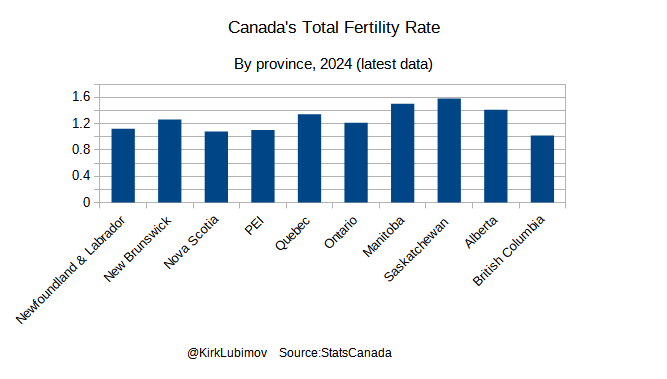
The fertility rate across Canada is different from province to province, and that bust will hit some provinces harder and sooner. British Columbia has the lowest fertility rate in the country of just 1.02. British Columbia’s population declined by 41,000 people in 2025. Nova Scotia’s fertility rate isn’t that far behind, at 1.08, being the second lowest in the country.
This should really tell you how much of the unaffordability crisis and infrastructure strain has been caused by the reckless influx of people into Canada. There was nothing ready for it. The solution for better affordability and better services is a population reduction and returning it to organic and sustainable levels.
The Liberal government is planning to cap permanent residency admissions to just under 1% of Canada’s population per year. 380,000 for 2026 and 365,000 for 2027. As things are, Canada’s population will not grow naturally. We are in a pure replacement phase.
There are a few things we need to contemplate, however. Can Canada’s population grow naturally? And why are we trying to keep bloating this country with people artificially? Let’s start with the latter.
Economic stability throughout human history was based on having more people. Families were bigger to work the farm, for example. Then, as means of production and goods evolved, fewer people were required for the same labour, and industrialization created whole new industries and more goods to consume.
All this productivity without a market, aka consumption, is a dead end, and so we became consumption economies in the early 20th century. The Liberals’ excuse for all this mass immigration is to grow Canada’s economy and avoid a recession. They were trying to bring in millions of consumers.
It failed, of course, as any kind of stimulus is still a stimulus, and when we are talking about humans, we have substantial obligations to them, such as services which cost billions. We also need to house them, and we obviously don’t build enough houses for such an increase, and as a consequence, the prices went up and became unaffordable.
To pay for all of the above, you need a robust economy with highly productive jobs, which Canada doesn’t have. The Liberals couldn’t possibly pick a worse time for their immigration policy, under horrible advice and lobbying, which grew the population much faster than the Baby Boom era, with barely any economic offering.
As a result, Canada’s economy turned into a declining productivity, and debt-driven economy. Money needed to be printed to hire for all the services obligations, which is why we have the bloat in the public sector employment surpassing 25% of the total employed in Canada. Hundreds of billions of debt needed to be borrowed to build the bubble housing industry, which grew out of demand that isn’t sustainable.
The biggest problem with this whole endeavour is that it is based on outdated premises. For a country like Canada, consumption should have been the afterthought. We don’t need cheap labour to move things from point A to B, nor do we need the bottom of our output industries to grow. This puts Canada’s economy at further risk as these jobs are the most likely to go obsolete. We are in the midst of an evolution to Industry 4.0.
To turn this around, Canada has no choice but to reduce our population, especially the one that is growing in low-skilled industries, and focus economic transformation to radical automation and hyper productivity. It will reduce inflated costs for Canadians, lower costs for governments, create high-paying jobs, and position our economy to be prepared for the future. There will also be a substantial opportunity to reduce taxes.
Instead of playing catch-up with services that are bankrupting Canada, and inventing new ones because of the economic deterioration, it will allow us to create the conditions and policies that will encourage Canadians to have kids, and more Canadians want to have kids.
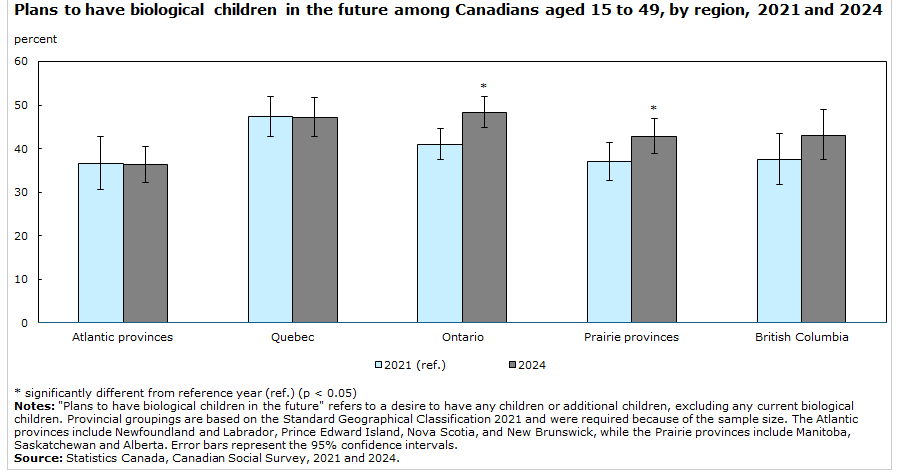
According to research by Statistics Canada and the Canadian Social Survey, more young people want to have kids now than in years before. The only slight declines are in Atlantic Provinces and in Quebec.
We will see a decline in Canada’s natural population numbers starting this year and in the next couple of years, with a rapid decrease from 2030 to 2045, particularly in the labour market.
This gives us very little but crucial time to act. We need to promote families and people having kids with policies and campaigns. Use this time to clear red tape from high-productivity industries and get our manufacturing sector growing again, powered by automation. What Canada does in the next few years will dictate our trajectory: replacement and decline or growth.