

When it comes to trade, Canada got lucky to share borders with the largest economy in the world. Due to this proximity, most of our trade is done overland. With truck and rail. Of course, to trade with anyone else, we are dependent on seaports, and our ports handle about three-quarters of total trade tonnage and around 25% of the total value.
We have 17 ports that are managed by Canada Port Authorities. The top five major seaports are: Port of Saint John, Port of Halifax, Port of Prince Rupert, Port of Montreal, and Port of Vancouver, which handles around 40% of all cargo tonnage. In 2025, the Port of Vancouver handled 170.4 million metric tonnes. That is an 8% growth from 2024, which was a record year. Our ports will only get busier.
Canada’s goal is to double non-US exports by 2035. That is only possible with investing, growing, and modernizing our seaports. There are a number of challenges here, including the US itself. Let’s remember that exports aren’t the only function of seaports; imports are as well. Ship calls to North American ports rely on the strength of the US trade. Canada’s market is too small to operate in isolation.
The Bank of Canada, using satellite data, has calculated the degree centrality – how many unique destinations each port is directly connected to. A proxy for a port’s importance in global shipping. Canada’s ports have seen a significant decline in connectivity to global shipping networks, and this decline is happening faster than elsewhere.
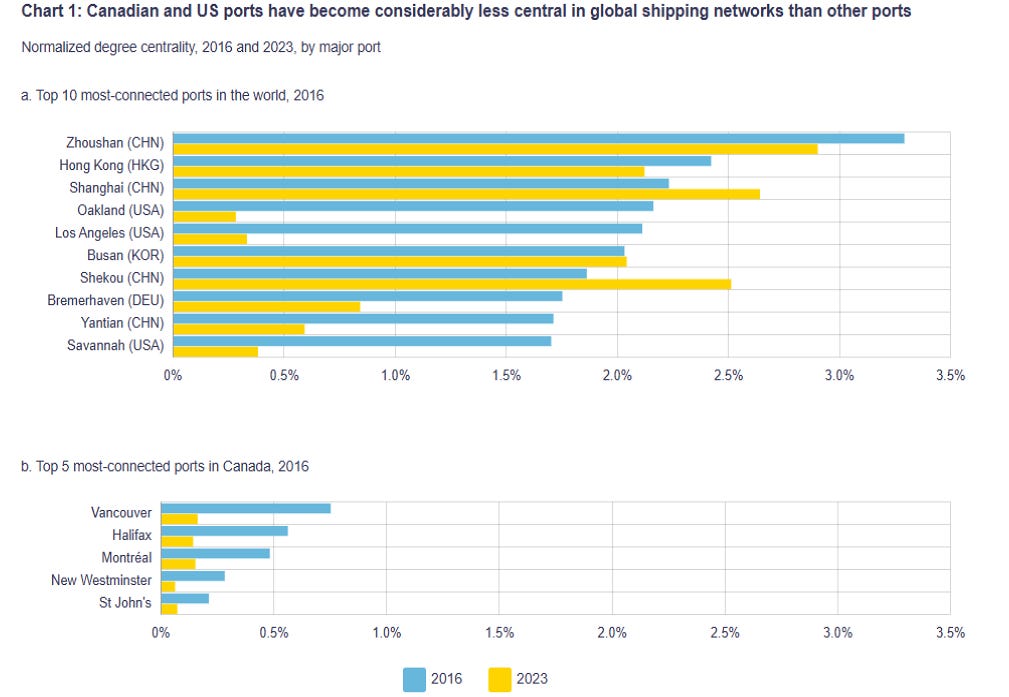
The total deadweight tonnage of all vessels departing from or arriving at Canadian ports fell from 167 million metric tons in 2016 to 119 million metric tons in 2023, a decline of 28 percent of maritime trade capacity. The problem is that as smaller vessels retire, they are replaced with ultra-large container ships that can carry over 20,000 standard-sized containers. Canadian ports can’t accommodate those.
These newer and larger vessels have to go elsewhere, and as a result, Canada’s industries have to get these products from these farther away ports; Los Angeles. The extra time and shipping distance by land adds up to extra costs. This is part of the reason why Canada’s inflation is higher, and things cost more.
The other problem is inefficiencies. The World’s Bank Port Performance Index has the Port of Vancouver ranked 389th out of 403 in terms of the time container ships spend in a port. Prince Rupert at 362nd, and the Port of Montreal was ranked 344th. When ships have to wait longer to unload, and loading takes longer this also drives costs up.
The main impact in 2025 on food inflation upswing was the cost of imports, mostly direct imports of processed food. Every link in the supply chain adds cost. More links mean more costs that the Canadian consumers end up paying for.
Our ports are just another area that has been underinvested in. I give Mark Carney credit for recognizing it: “We have fallen way behind in terms of the productivity of our ports and our trade corridors as a whole”. There have been some good investment announcements with the $2.3B expansion at the Port of Montreal, and the planned Roberts Bank Terminal 2 which will increase west coast container capacity by more than 30%. Just these two projects will add billions to Canada’s economy.
It’s a great start, but it’s not enough. Canada needs over $20B in port upgrades and modernization by 2040. We don’t have 10 years to spend on regulatory paper work, and red tape. The neglect has significant cost to our economy and as Canada becomes more dependent on distant hubs, it becomes more exposed to global freight rate spikes it has little ability to influence.
This structural drag we see in the degradation across our infrastructure acts as an inefficiency tax on every export and import. It cascades into inflation, competitiveness, and the broader economy. This will impact us for decades because we did nothing in the previous decades.
Perfecting and maximizing the efficiency of our supply chain infrastructure is our main utility for growth, price control, and strengthening our bargaining power. We need to build up and modernize our ports with wartime-like urgency, including streamlining customs and digital logistics systems. Ship to store needs to become world-class. This our foundation to build on, let’s build.