

Sooner or later, everything old is new again. The Golden Triangle, which already has a rich mining history, is now becoming one of the most important areas in Canada again. And it is much more than gold this time.
The Golden Triangle is an area in northwest British Columbia that stretches from roughly Stewart at the southern end to Telegraph Creek and the Stikine River in the north and over to the Alaskan border. It is breathtaking terrain, and the drive into Stewart, which is Canada’s most northerly ice-free port, has one of the most stunning settings. You will lose count of the waterfalls.
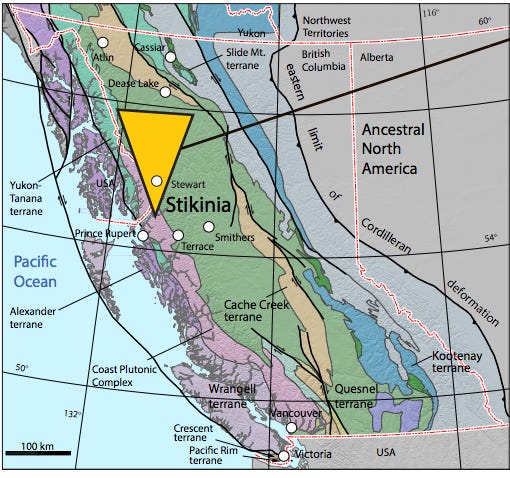
The area’s richness was discovered before Canada even became a country with the prospector Alexander “Buck” Choquette adventure up north. Born Taddée Choquette to a family with a rich and important history predating Canada, at 19, he set out to Montreal and then across what is today America.
He missed the California Gold Rush but made his way working up north to the Oregon Territory and Fraser goldfields. While on a trip to Victoria, he met a group of Tlingit First Nations and convinced them to ride in their canoes north to Fort Stikine, which is Wrangell, Alaska today and was Russia’s back then. It was a 1,300 km trip that took weeks to complete. He believed the rivers farther north were richer in gold the further north one went. He was right.
Fort Stikine was a former Hudson’s Bay fur trading post that was under the control of Tlingit Chief Shakes, whose daughter Buck married. It was also known as Shakesville before America’s takeover, and became the base for the exploration. Buck with his wife and Stikine men didn’t have to travel far up the river to discover gold. The year was 1861. Buck’s finding wasn’t profitable, but he did open a trading post and moved operations to the British territory after Alaska’s purchase. The news of the discovery, however, set in motion what is the foundation of that whole part of British Columbia today.
Hundreds of prospectors rushed into the region creating waves of gold rushes: the Stikine Gold Rush, Cassiar Gold Rush, and the broader Klondike exploration. Over 150 mines have operated in the area over the last 160 years. Today, over half of the exploration spending in British Columbia is spent in the Triangle.
The Golden Triangle is situated within the Sulphurets Hydrothermal System, and most of its mineralization occurred 220 to 175 million years ago during the Late Triassic and Early Jurassic ages. Volcanic activity carried molten rock concentrated with many minerals upwards until they reached air or water. The mineral deposits formed in the Golden Triangle have similar characteristics.
Many discoveries are near surface, with high-grade veins sitting on mountain ridges exposed by glacial retreat. Most of the major deposit discoveries occur within 2km of a stratigraphic contact. Technology such as directional drilling and AI satellite mapping are a game-changer for this area. Exploring below 300 meters is a relatively recent possibility.
Besides technology, what we consider a stunning landscape is extremely hard to operate in, and the recent infrastructure development has made the area much more accessible. The Northwest Transmission line means hauling diesel for drill rigs wasn’t necessary as much anymore, and roads drastically reduced supply chain and overall operational costs. It extended the working season in an alpine environment.
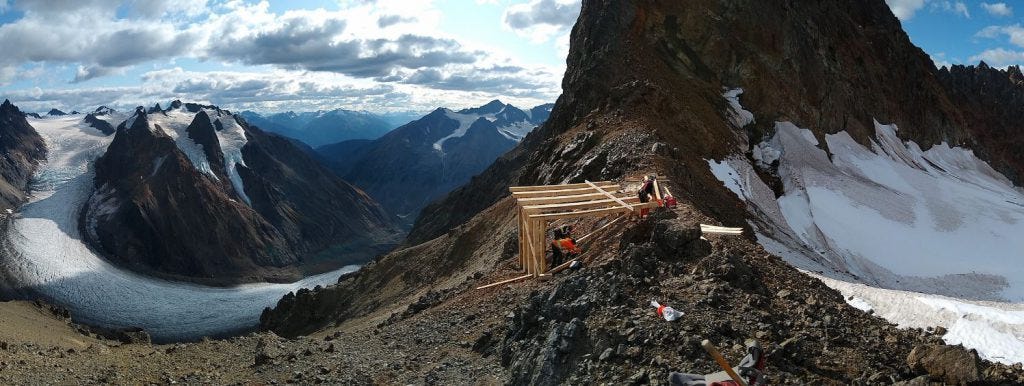
Less than 1% of the Golden Triangle has been mined to date. Mines like the KSM, which is considered the world's largest undeveloped copper-gold porphyry deposit, are just being built. In addition to the extraordinary gold, zinc and silver wealth, it also holds 75% of Canada’s known copper reserves.
There has never been a better time to go at it. The prices for the resources make mining there extremely profitable and all these resources are in high demand which will position Canada as a key player in emerging technologies hardware supply chain. If we can add value added manufacturing on top, Canada will have booming $100B+ yearly industries growing in no time.
What’s brewing here isn’t short term. It isn’t another gold rush. This is a multi-decade, if not a 100 year plus, industrial scale up. Multiple generations of workers will be able to retire of what is happening here and the smaller towns around have a fruitful future ahead of them. We must continue to build infrastructure and power generation to keep the momentum going.