

Canada appears to be finally getting another oil pipeline, and it needs to reach the West Coast. This is just the reality of things if we want to export our oil to Asia and diversify. As usual, our own policies get in the way. The Oil Tanker Moratorium Act, Bill C-48, is it. There are many misconceptions about it, and as Mark Carney confirmed, it remains; we need to talk about it.
The new pipeline, if it is built, will follow the TMX route because it is just too hard to get it to Prince Rupert, where it is wished to go. Hard politically. We will still need another oil pipeline to the West Coast sooner or later, so our issues aren’t going away. They are just delayed.
Bill C-48 bans oil tankers carrying more than 12,500 metric tonnes of persistent oil; heavy crude, synthetic, bitumen, heavy oil and diesel from stopping, loading or unloading at ports along BC’s northern coastline. The stopping, loading or unloading is the part most people are missing in the discussion on the topic.
This is exactly why no one would even put a cent towards the pipeline. If you can’t load tankers, there is no point building an export facility or a pipeline to one. That uncertainty is too much; it’s not even about the route itself to Prince Rupert.
The tanker ban spans from the northern tip of Vancouver Island to Alaska’s border and encompasses Haida Gwaii, Kitimat and Prince Rupert, which is referred to as the Great Bear Rainforest region. It’s important to note that the ban also covers Stewart, which is Canada’s most northerly ice-free port. It has a crucial part to play in Canada’s resource future as it is at the base of the Golden Triangle and connected to the provincial highways.
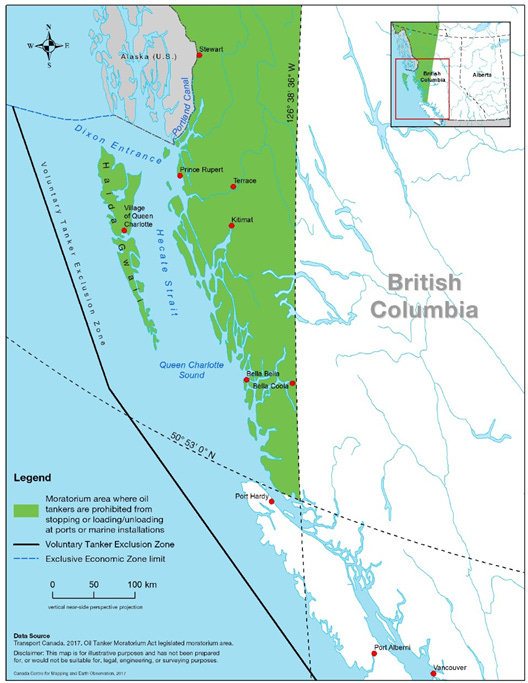
If you notice, there is the Voluntary Tanker Exclusion Zone (TEZ), which was established in 1985 and formalized in 1988 with the US Coast Guard, Canadian Coast Guard, and US tanker industry. It spans from 25 nautical miles near the southern end of Vancouver Island and extends around 70 nautical miles off the coast going north. The Zone is applied to loaded US oil tankers going from Alaska to the continental US.
The TEZ was designed and calculated based on the worst possible drift of a disabled, loaded oil tanker during unfavourable weather conditions. Basically, it gives time for salvage tugs to arrive at a tanker for assistance before it reaches the BC coast. You can think of it as the ancestor to Bill C-48. The history goes further back.
When oil reserves at Prudhoe Bay were discovered, the plan was for the Trans-Alaska Pipeline to run to Valdez Marine Terminal in Prince William Sound. It is Alaska’s northernmost ice-free port. From there, the crude - Alaska North Slope, would be taken by tankers with the refineries in Washington as the main destination.
Canada objected right away with the moratorium on crude traffic through Dixon Entrance, Hecate Strait, and Queen Charlotte Sound in 1972. It was never implemented through legislation but negotiated with the US for the tankers to travel West of Haida Gwaii and Vancouver Island. This is pretty much what we have today.
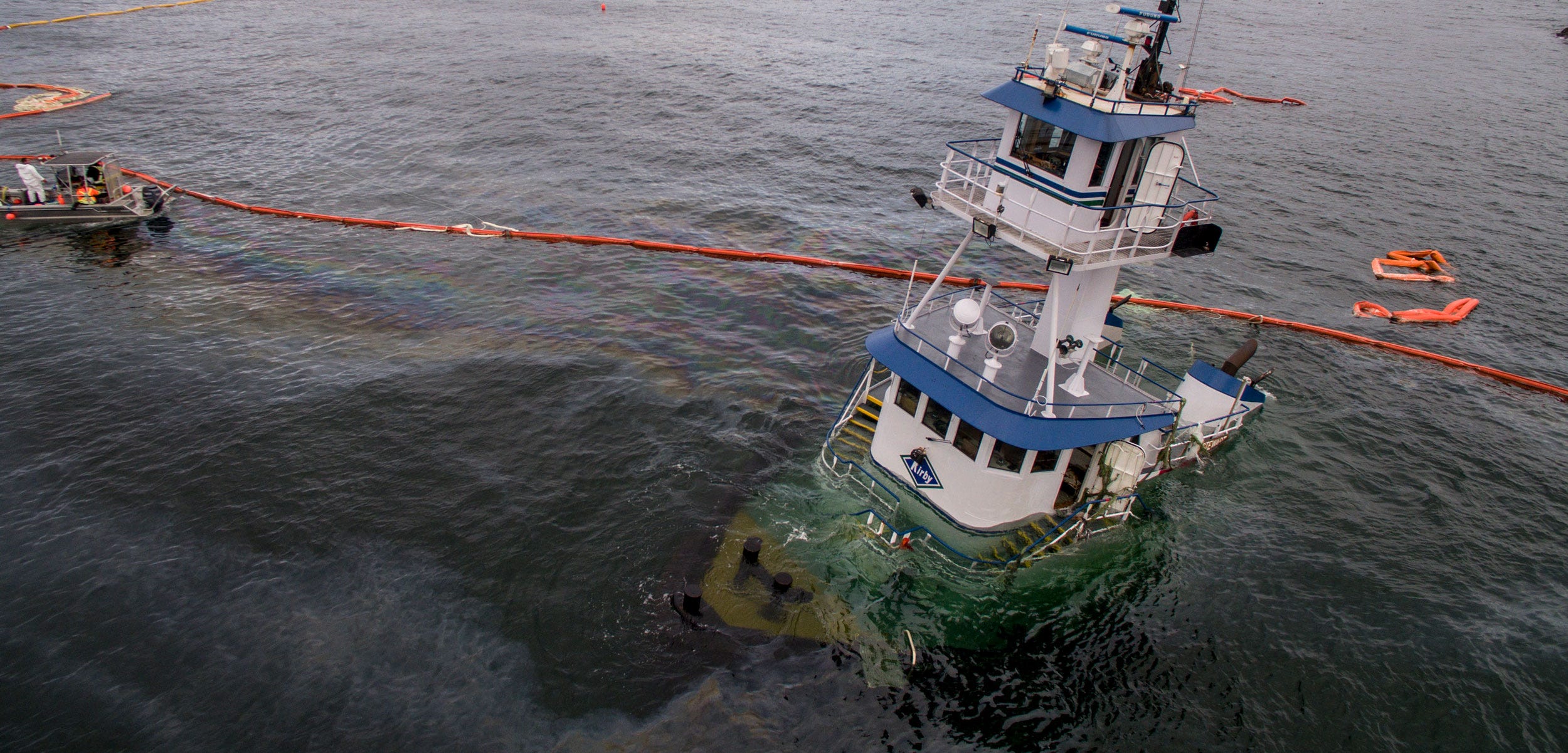
Canada has been against tankers going down its West Coast for decades. The Exxon Valdez spill in 1989 validated the concern and the Exclusion Zone. The 2016 Nathan E. Stewart tugboat that spilled 110,000 litres of diesel on First Nations fishing grounds just west of Bella Bella motivated the Act.
Under international law, the right of innocent passage, Canada had no teeth to enforce it. TEZ is voluntary but highly successful as no violation happened in years. It is also US tankers-focused and doesn’t apply to tankers travelling from and to Canadian ports. But Canada can decide legally who loads and unloads at our ports.
Bill C-48 complements TEZ. The Zone keeps American tankers transiting, and Bill C-48 removes any commercial reasons for a laden tanker to approach the north coast at all by making it illegal to load or unload there. One relies on goodwill, the other on statute.
Canada, Liberals, slammed the door on our own economic opportunity and, in the process, killed off the Eagle Spirit Pipeline and put the final nail in the Northern Gateway. Massive, ideologically driven mistake that lost Canada tens of billions of dollars. This is why the Parliament is needed, and no Party will ever get rid of it, no matter who says what, but there are opportunities for amendments and carve-outs.
Kitimat was never going to have an oil export port. I’ve made that position years ago, not sure why so much money and time were wasted on trying to argue against it to no avail. You just have to sail that area once and realize that a route via Douglas Channel and over to and across Hecate Strait makes no sense. Too long and way too risky.
Prince Rupert, however, is a different story. It already is a major container port and grain terminal because it is one of the deepest natural harbours in North America. It essentially sits on the open ocean’s doorstep, and tankers don’t need to go through Hecate Strait, like many try to claim – American tankers don’t either. The great circle route to Asia runs through the Dixon Entrance and straight out into the Pacific in a matter of hours. It’s Canada’s closest port to Asia.
The Act contains the openings: a ministerial exemption power for individual vessels, a schedule of “persistent oils” that the cabinet can amend by regulation (narrowing what counts as banned cargo without touching the statute), and geographic boundaries that Parliament could redraw. Like carving a corridor through the Dixon Entrance to serve a Prince Rupert terminal.
The waters off Prince Rupert are the heart of the Skeena salmon system and a number of First Nation territories. It won’t be easy, and I get it, as I think the Great Bear Rainforest region is one of the best places on earth, but I think we need to catch up with the times and make it happen.
Oil tankers these days are double-hulled, with segregated ballast tanks and state of the art collision-avoidance technologies and redundant systems. Transportation via oil tankers is one of the most successful and secure modes of transportation, with a yearly 99.9997% accident free success rate. Tankers will have an escort regime.
The opportunity that such a project will bring to the smaller communities in that part of British Columbia would be transformational. The infrastructure that would be built can be collaborated to benefit the mining industry, trying to unlock the Golden Triangle, creating a substantial multiplier effect. I estimate an additional $100B+ to the economy.
For now, a new pipeline along the TMX route and dredging of Burrard Inlet, allowing Aframaxes to be fully loaded, will suffice. After all, the Oil Tanker Moratorium Act ban doesn’t include that part of the coast.
The new project is expected to take nearly ten years to complete. Let us learn a lesson and start planning for our future sooner.