

Some things are easier said than done. Pivoting Canada’s export industries and Canada’s economy away from the US is one of these things. The cavalier approach doesn’t make up for realities or the past 10 years of economic neglect. Now we have to deal with actuality.
Canada’s trade relationship with the United States is not only our largest but also deeply embedded in the structures, industrial organization, regulatory systems, and supply chains. These are all good things to have with the largest economy in the world, besides the convenience of it being next door.
The US is Canada’s largest foreign direct investor, and Canada is among the largest foreign direct investors in the US. It is rather natural as 2/3 of Canadians live within 100 kilometres of the American border. We can do major business and have access to different supply chains within a short drive. It is no surprise that just over 10% of jobs in Canada are dependent on the US.
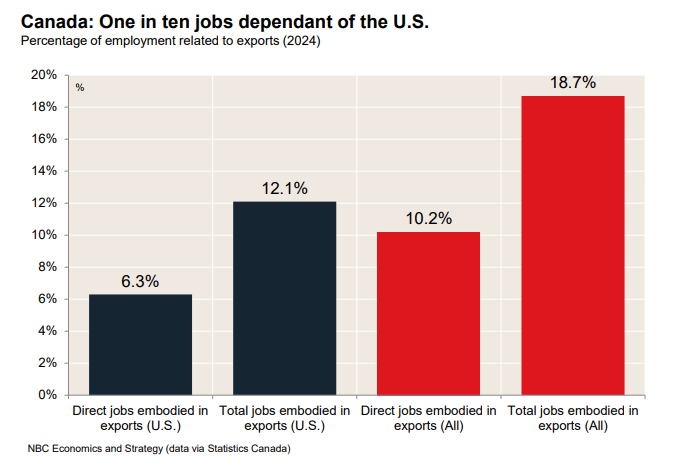
Both countries have benefited tremendously from the relationship. No matter the headlines and the political outrages. Canada is the biggest trading partner of over half of the US States. Many parts cross the border numerous times before they are manufactured into a final product. The energy industry is dependent on each other. It is a reflection of geography and decades’ worth of work building on it.
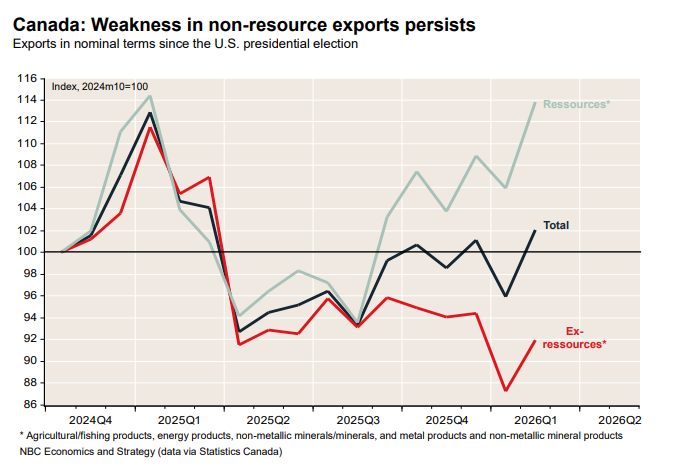
The risk for Canada isn’t tariffs; it’s that the smallest pivot away from us will cause Canada a recession, and US industries can pivot much quicker than Canada can react. We also leaving hundreds of billions of dollars on the table by not manufacturing more for others or more in general. It’s an economic necessity; besides resources, Canada’s exports are weak.
The other major issue is the divergence between our economies; US and Canada. The US is all in on tech and innovation, with hundreds of billions worth of CapEx being invested in everything to pioneer new industries with massive productivity opportunities and energy upscaling.
Meanwhile, Canada is lagging badly in productivity, adding different taxes and red tape, and as a result, having a hard time attracting investment. It is becoming harder to rationalize investing in Canada, as industries are falling behind and our own governments are having hard time navigating the red tape they created.
The government cannot mandate diversification. It is not a matter of signing new treaties or MOUs. Canada functions as an extension of the North American production system. Many Canadian companies succeed because they operate within North American value chains rather than because they independently dominate global markets.
We we have very few domestic mature manufacturing industries with a broad scope across sectors. Part of the reason is that we don’t have our own major conglomerates. Our auto industry manufactures things for US and Japanese brands. Emerging sectors, such as space, are barely a rounding error in Canada and are dependent on the US. Even a big portion of the tech industry are satellite offices for US companies.
Our economy is dependent and not independent. It has to do with scale but more so with the fact that our policies and rhetoric have been anti-entrepreneurship. To pivot and increase our exports with diversification, we must build our businesses. The solution has to come from changing Canada’s landscape to one that attracts risk-taking and enables growth.
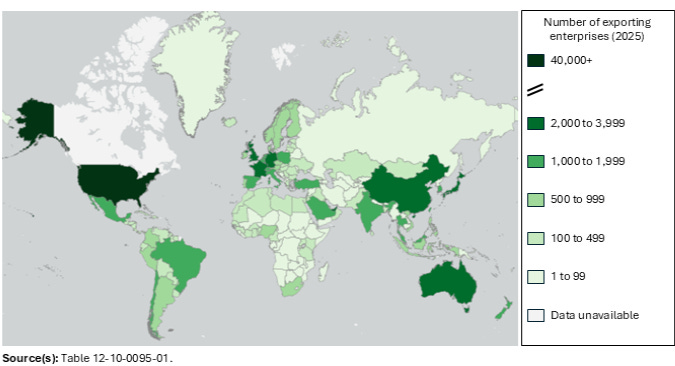
Canada’s challenge is not finding customers outside the United States. The challenge is that the entire architecture of the Canadian economy was built around the American market. Diversifying export markets is expensive and requires companies to have the scale and capital to take on new market requirements, regulations, packaging, shipping, legal frameworks etc. We simply don’t have enough companies that can do it.
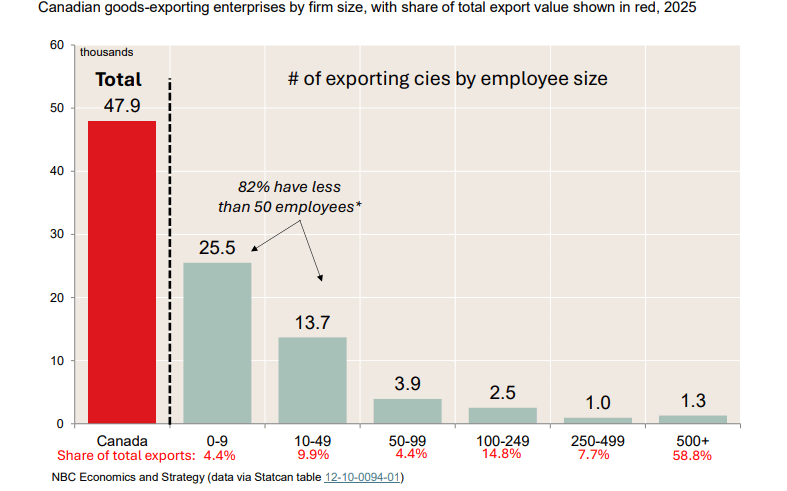
Most of our exporting enterprises are tiny. 82% of them have fewer than 50 employees. Only 23% of them sold to multiple partner countries. 45.8% of medium-sized businesses exported to multiple countries. 48.3% of large businesses exported to multiple countries. The US market dominates at every level.
We have whole sectors that barely even export to any other country. Only 6.7% of exporters in the agriculture, forestry, fishing and hunting industry exported to multiple countries. Only 35.1% of our manufacturing exporters export to multiple countries.
The problem becomes even more apparent when we look at the export dollars of Canadian exporting enterprises.
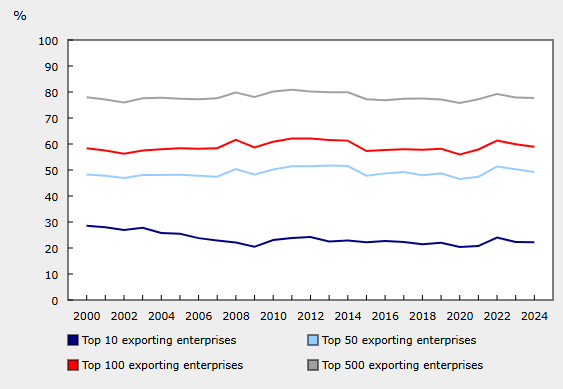
In 2024 (most recent and accurate data), the top 50 exporting enterprises generated just under 50% of all Canadian goods exports. Overall, 84 enterprises each exported more than $1 billion worth of goods.
The top 500 enterprises, representing roughly 1% of all exporting enterprises, were responsible for over three-quarters (77.7%) of exports. Each of these enterprises exported over $100 million worth of goods.
In 2025, small enterprises that employ fewer than 99 people accounted for 42,931 out of the 47,948 exporting enterprises. Their percentage share of total export values is just 13.3%. 35,909 firms exported less than $1 million worth of goods individually in 2025. While they make up 74.9% of all companies.
The headline export dollar values are driven by natural resources and automotive, 95% of which goes to the US, and masks the foundational issue we keep coming back to in Canada: we don’t have enough companies, and we don’t have the environment to grow them.
No photo ops can make up for this. We need to stop vilifying success and entrepreneurship. The main focus of our economy should be attracting talent, fostering growth, promoting innovation and radical industrial transformation. This requires a different approach from one that our governments at all levels are taking.