

One of the most fundamental social contracts in our evolution as humans and as a society is to leave our children, our future generations, in a better position for stability and success. Success encompasses prosperity, career, economy, and affordability, among others. For the first time in modern history, a generation is on track to be financially worse off than their parents.
Youth giving up on their future is disheartening. It means somewhere along the line, we built more fear than hope into them. More handicaps than ambition and opportunity. It is easy to say to just toughen up and pull yourself up by your bootstraps, but the fact is, they are facing a drastically different world than previous generations, particularly in essentials.
Promises of capitalism and their lived economic experiences are diverging. Go to school, get an education and get a good job turned into debt that many can’t shake off and a job market that barely pays. If the job hasn’t been taken by a LMIA/TFW to begin with, and many places don’t want to train young people anymore.
Many jobs used to have a welcoming entry position that would help train and upskill workers; bakery, warehouses, plants, etc. Today, many entry-level jobs already require some kind of cost to entry in the form of education. This is called the Education Inflation, and it particularly impacted men.
Part of it is because the demographics within industries have been transforming. Instead of entering manufacturing and resource industries, more men are entering the service industries. A high school education isn’t good enough to start a career; the assembly line is gone due to innovation and the relatively shrinking manufacturing industry in Canada.
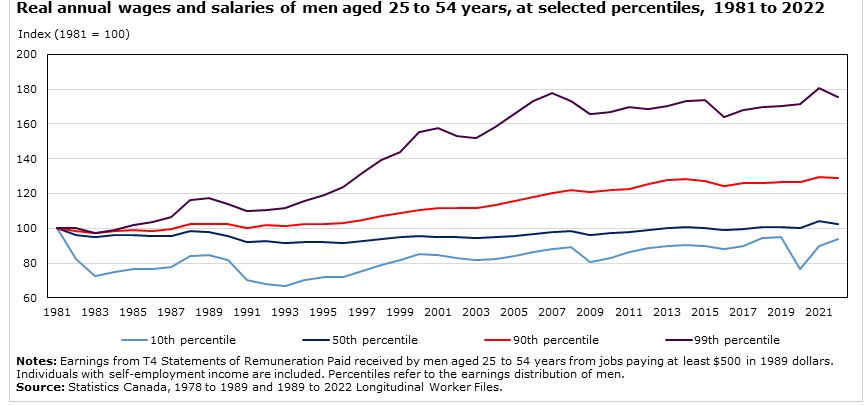
The earnings of core-aged men in Canada over the past 40 years highlight what should be an alarm and complications. The bottom 10% of earners make less than the bottom 10% did 40 years ago, while living in a much more expensive world. The 50th percentile has barely seen an increase in real wages in 40 years. Any progress the middle class had has been swallowed by inflation.
The other alarming part is the gaps between the 50th, 90th and 99th percentile which keep increasing. This speaks to the difficulty in social and economic mobility and the lack of participation in the country’s economic success. This is exactly what causes political and social tensions.
The days of one middle-class salary affording a house and raising a family are long gone. Today’s youth spend a bigger share of their salary on rent than previous generations. That means that it takes much longer to save towards housing at the expense of other savings like retirement or a family. The ones who do buy a house do so at a much older age on average than before.
Between 1976 and 1981 (census years), with 1981 being a particularly strong year for home ownership; 41% of Canadians under 35 owned a home. A home meant an actual detached home. That average house cost in today’s dollars was around $260,000, and it took 5 years to save for a down payment. Both stats have grown by 3x to today. Vancouver and Toronto have some of the oldest first-time home buyers in the world.
The interesting part is that between the pandemic years and 2023, the homeownership of under-35-year-olds jumped with the support of their parents, and the attraction of the low interest rates that the Bank of Canada touted will stay low for a long time. Median net worth of a homeowner under 35 is 10x that of their peers who rent. It is becoming classism.
Previous generation homeownership makes the kids twice as likely to own a home as the kids whose parents didn’t own a home. With the current generation less likely to own a home, this creates a snowballing effect into the future that will drastically impact prosperity and stability. RCMP even put it as a warning in a report to the federal government. Reminds me of a slogan: “You will own nothing and be happy.”
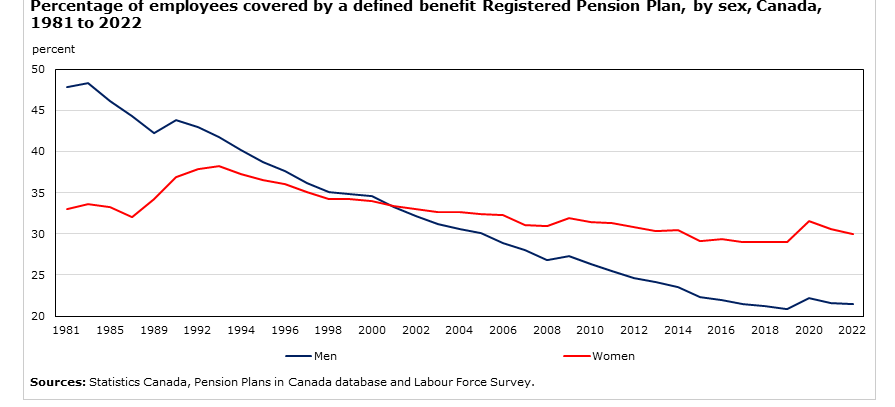
Home ownership – the primary wealth accumulation vehicle and defined benefit pension plans, which have been declining for decades, together make up the majority of the net worth of older generations. In fact, the highest median net worth in the 55 to 64 age group has both assets. These options are all but gone for most young people, so telling them to pull up their straps isn’t exactly fair.
Young people are responding to economic conditions, whether we like it or not. Capitalism no longer commands the automatic allegiance of younger generations. It is our duty as society to address this and not let the sentiment grow but also because we want them to fundamentally have a better life.
Capitalism is a belief in hyper-individualism, but when practicality doesn’t materialize, the natural correction is collectivism. Young people, who are more connected than ever, find each other and organize, looking for other systems than the one they perceive as having failed them. Disenfranchisement is the response, and it will be taken advantage of.
The new Mayor of New York City Zohran Mamdani, who ran on probably the most explicitly socialist platform that anyone has run on in years, said this in his inauguration: “replace the frigidity of rugged individualism with the warmth of collectivism.”
Zohran tapped into that sentiment unapologetically and with full commitment. Others will as well. This is what we are against. It doesn’t take long to destroy things and we must respond. That response, however, must enrich the upcoming generation in every sense of the word and have them meaningfully participate. They will one way or another as they will soon be the biggest voting demographic.