

Canada is becoming a confusing place where we have record food bank usage, the government needs to send over 12 million people a few peanuts to afford food, insolvencies are growing, and yet expensive restaurants are busy, and million-dollar-plus homes are moving.
Canada’s economy grew at a 3.3% annualized pace in the second quarter of 2026. That was the fastest in more than three years, and it ended the spring’s recession talk. In that same quarter, 37,523 Canadians filed for consumer insolvency. That is the most in any quarter since 2009.
Both numbers are correct. The gap between them is the story. A K-shaped economy is now a reality in Canada, and this is a very dangerous and highly unfortunate road that we shouldn’t be on.
Gross domestic product is indispensable for measuring economic activity. It tells us how much the economy produces, adjusted for price changes but it does not tell us how that production is distributed, whether household purchasing power is improving or whether businesses can obtain the financing they need.
Canada’s economy does not have to enter a recession for a growing number of Canadians to feel that it is going backwards. Nor does a rising stock market necessarily mean that the average household is becoming better off. Larger corporations and higher-income households remain relatively resilient while younger households, small businesses, renters and heavily indebted borrowers face mounting financial pressure.
The rich are getting richer. There is nothing new there but what is happening in the other quintiles is what is alarming. Top 20% of Canadian households hold 65.7% of Canada’s wealth. The bottom 40% hold just 3%, that is shocking. And it gets worse: the average household in the bottom 20% owes more than it owns. Last year, the top 20% grew their net worth by 6.0%. The bottom 40% managed 2.1%.
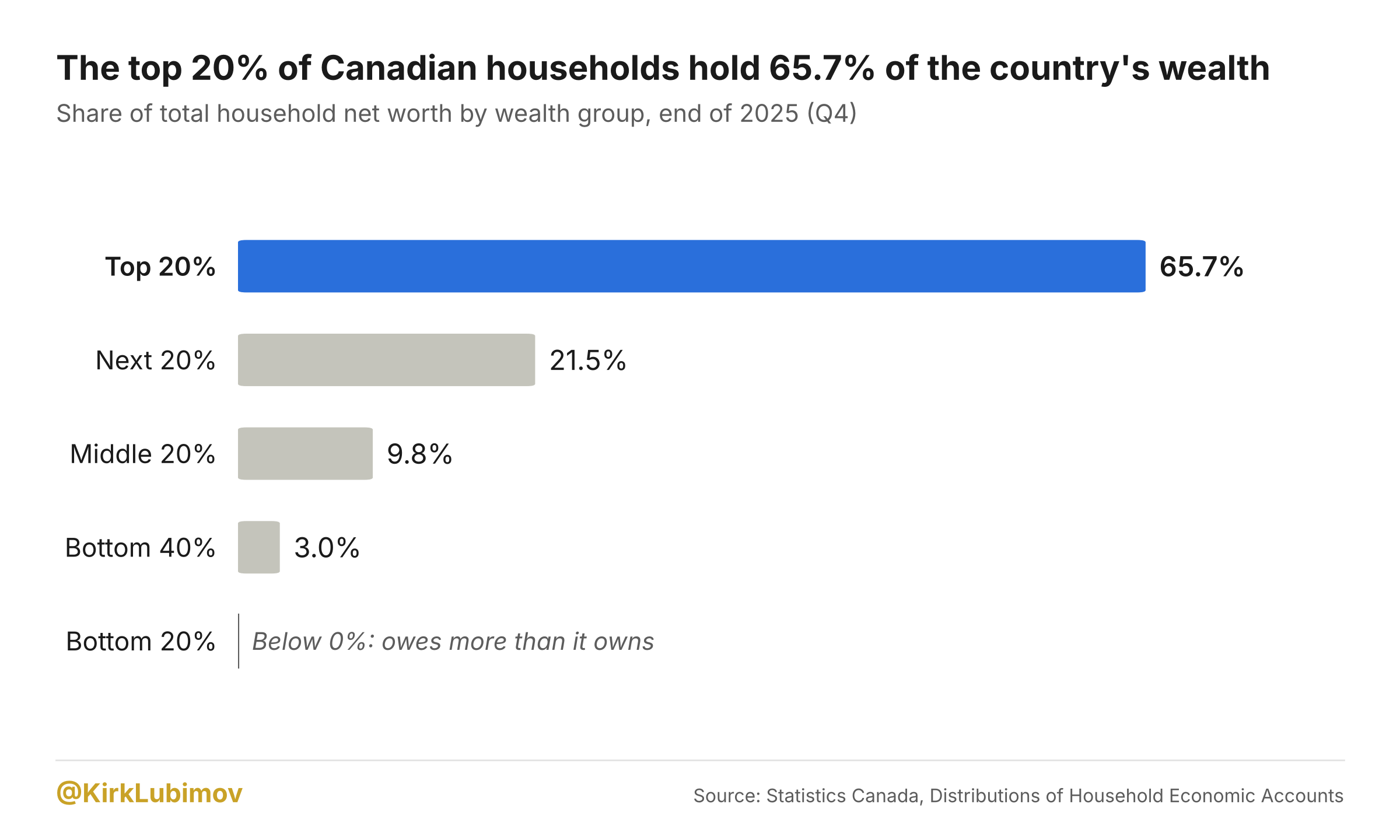
The net worth of the top 20% is growing 3x faster than the bottom 40%.
A household with a substantial investment portfolio can draw on savings when income falls. Someone who owns a business may have access to retained earnings, property equity or other sources of capital. A household with little liquid savings may have to borrow, defer bills or reduce consumption when confronted with the same shock.
This matters because saving is more than money left over at the end of the month. It is the financial buffer that allows a household to handle a car repair, an unexpected medical expense, a period of unemployment or an increase in housing costs without immediately resorting to borrowing.
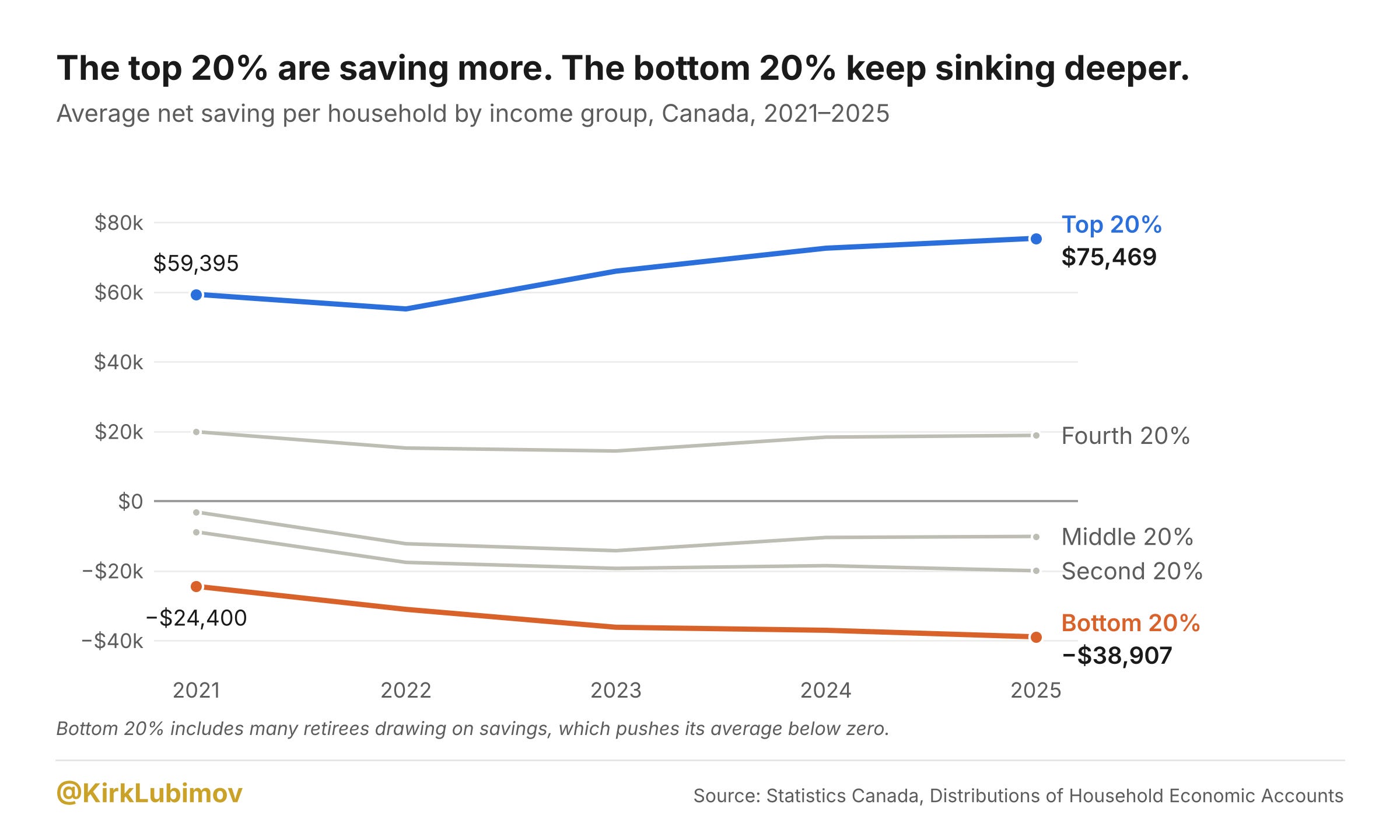
Only the top 40% are saving. The bottom 60% are spending more than they take in. Canada costs too many Canadians more than they earn, and they are borrowing the rest. The bottom quintile includes retirees drawing on savings. This number will only increase, and a social risk we are already starting to see, with more seniors trying to get back to the workforce, and too many end up homeless.
The group above tells the same story. In 2025, income for the second-lowest 20% of Canadian households rose 2.3%. Their spending rose 3.8%. The gap came straight out of savings, which fell 7.9%. This wasn’t vacations and new trucks either.
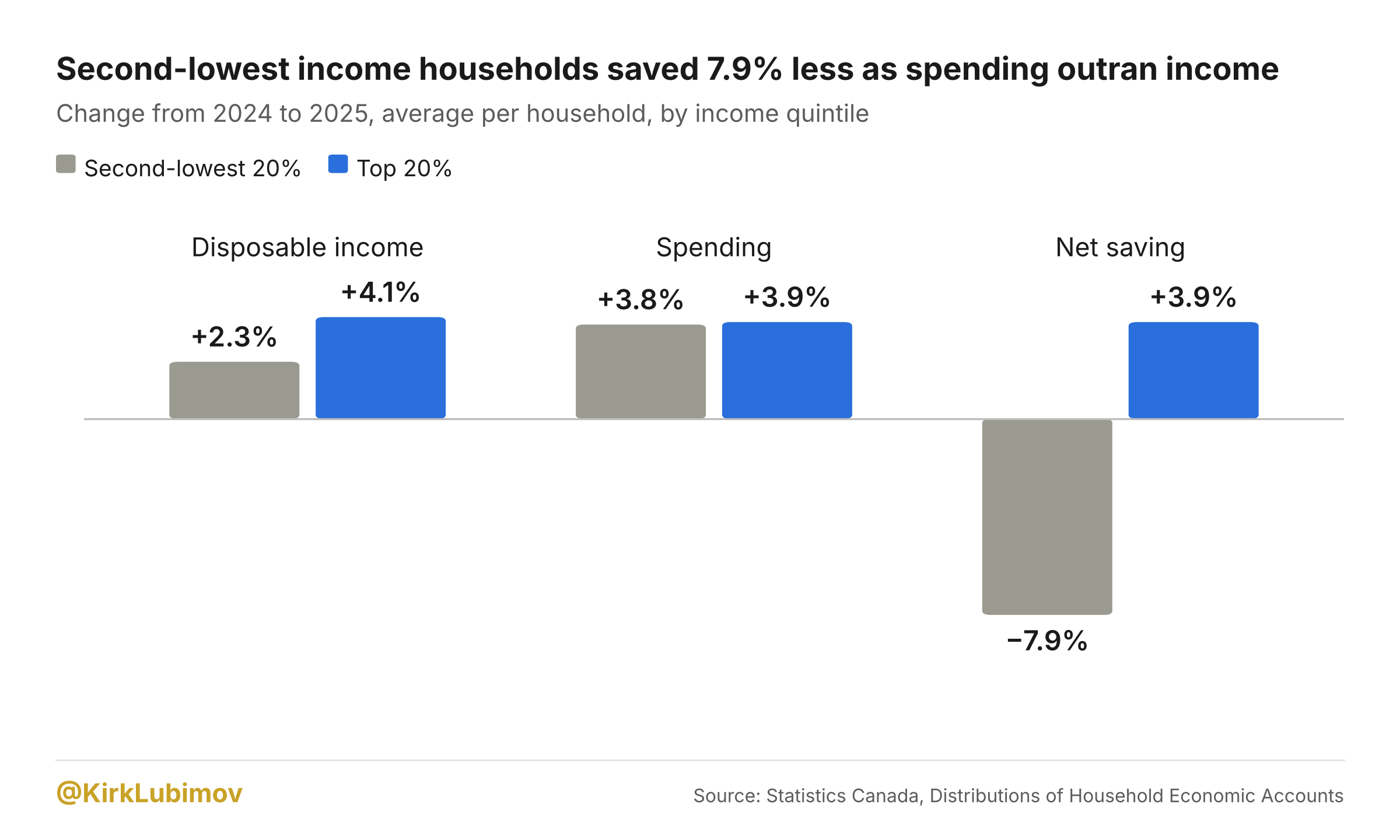
The spending growth for lower-income households came mostly from housing and utilities, insurance, and transportation. The bills you can’t skip. Meanwhile, the top 20% saw income rise 4.1% and spending 3.9%, and their savings grew 3.9%.
One group is burning through its cushion. The other is still building one.
So how are they covering the gap? If you strip out every household whose main earner is 65 or older, you are left with working-age Canadians. The answer: debt.
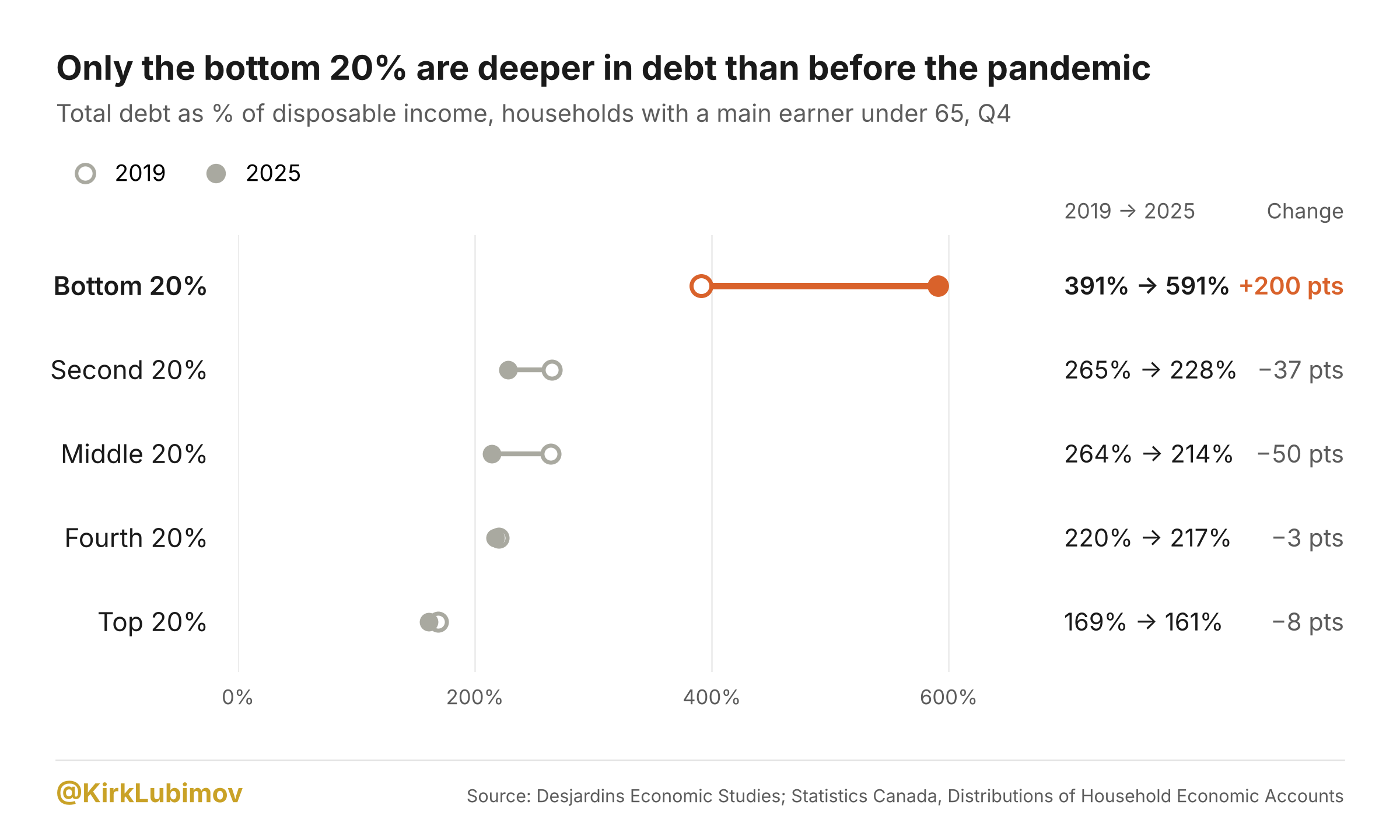
For every $1 of after-tax income, working-age households in the bottom 20% now carry $5.91 of debt. In 2019 it was $3.91. The top 20% carry $1.61. Every other income group has less debt per dollar of income than before the pandemic. The bottom 20% is the only one with more, and it’s not close. The poor are getting deeper in debt.
The group with the lowest income has seen its debt grow fastest relative to what it earns. But the strain doesn’t stop there. The middle 20% of households ran a savings deficit of $10,092 each last year. Equifax says the share of Canadians 90 or more days behind on their debts rose in every age group except 18-to-25-year-olds. Even homeowners are slipping: in Ontario, the share of mortgage holders seriously behind on their other debts jumped 27% in a year.
When that strain turns into giving up, it shows up in the insolvency numbers. And those don’t sort people by income. They count everyone.
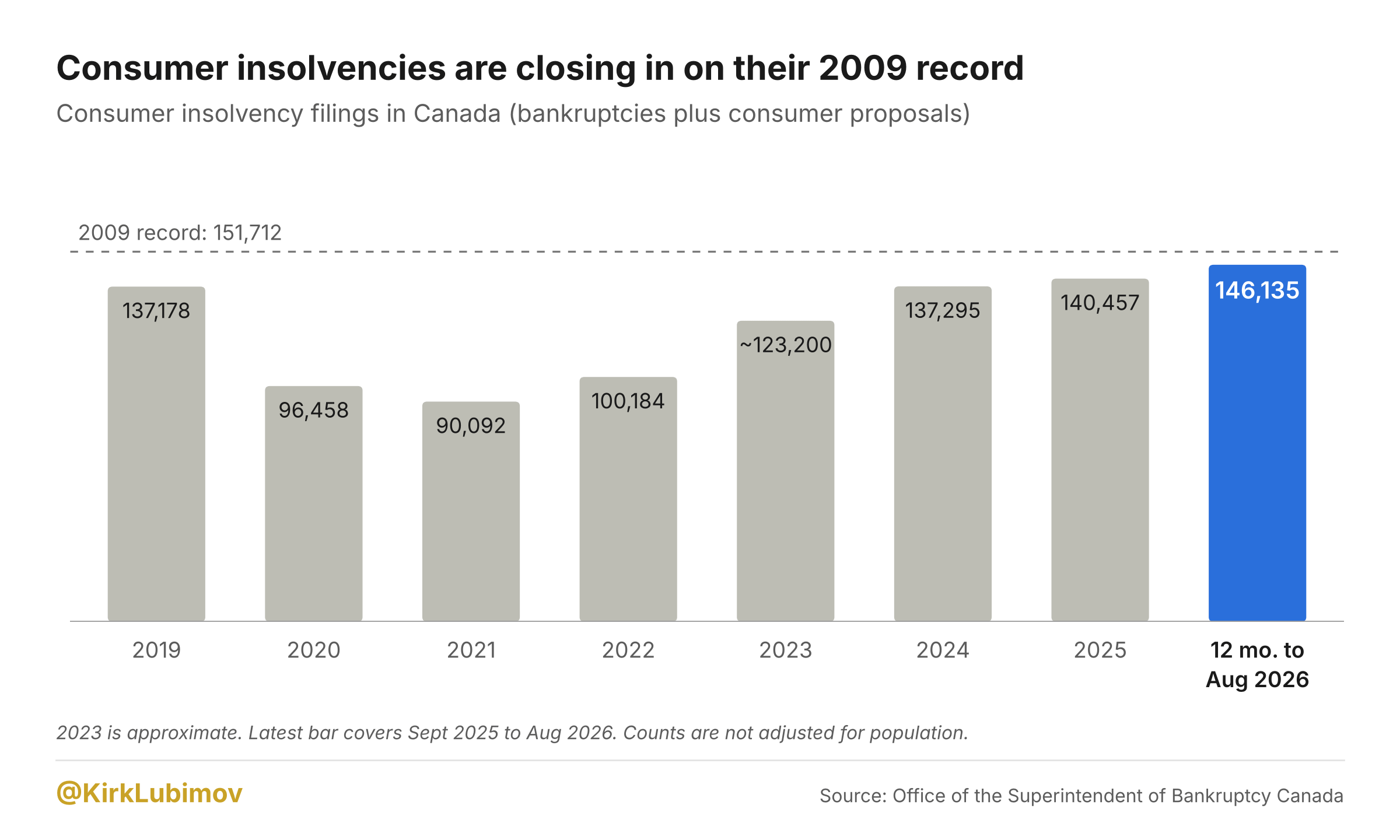
Consumers filed 140,457 insolvencies in 2025, the highest total since 2009. The pace hasn’t slowed in 2026. The second quarter’s 37,523 filings were up 6.9% from a year earlier and were the most in any quarter since 2009. The latest monthly data shows it still climbing: 146,135 consumer insolvencies in the 12 months to August 2026, up 5.8% from a year earlier and closing in on the 151,712 filed in 2009, the worst year on record by raw count.
The “squeeze” part is about who can still get credit. Lenders aren’t shutting off credit. They’re re-sorting it. Equifax says new credit card openings fell to a four-year low in the first quarter, partly because lenders tightened standards as missed payments rose. Lenders cut average limits on new cards for higher-risk borrowers by 15% to 20%. Borrowers with high credit scores got modest increases.
That is a K inside the credit system itself. Credit gets cheaper and easier for the people who need it least and gets pulled from the people already leaning on it.
The problem with Canada’s economy is that there is very little opportunity for economic mobility, and unaffordability is eroding the most ambitious savers’ chance to climb up. Saving for the bottom 20% to join the middle 20% households used to be very doable. It isn’t anymore.
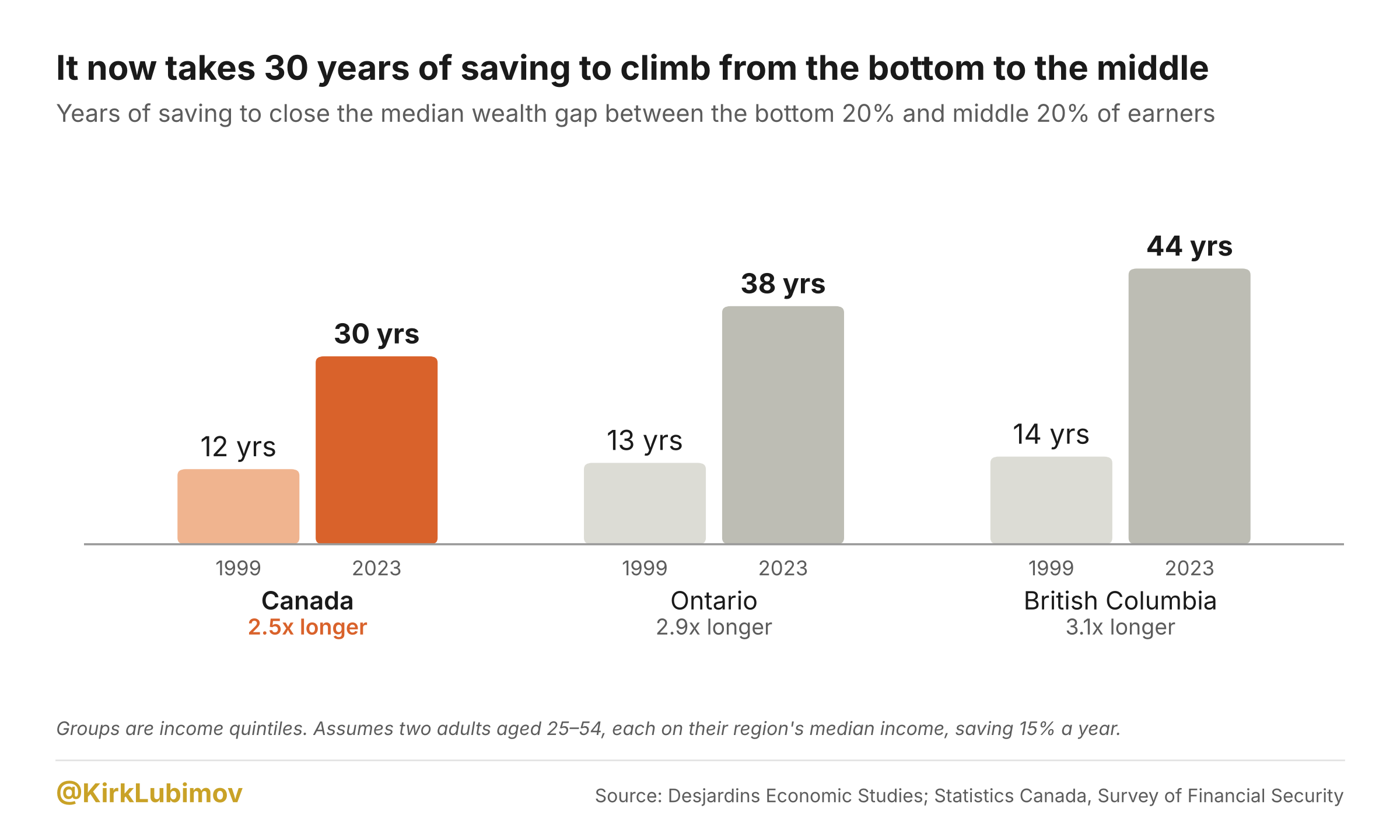
Desjardins worked it out for a couple on median incomes, saving 15% a year. In 1999, that climb took 12 years of saving. By 2023, it took 30. In Ontario it’s 38 years. In B.C. it’s 44. Getting from the middle to the top now takes 116 years, up from 56. Desjardins’ research notes that these are rough figures, comparing a stock of wealth with a yearly flow of savings. But the direction is unmistakable. For a young couple starting from nothing, that isn’t a ladder. It’s a wall.
The long-run data on mobility says the same thing. Statistics Canada followed children into adulthood and compared where they ended up with where their parents were.
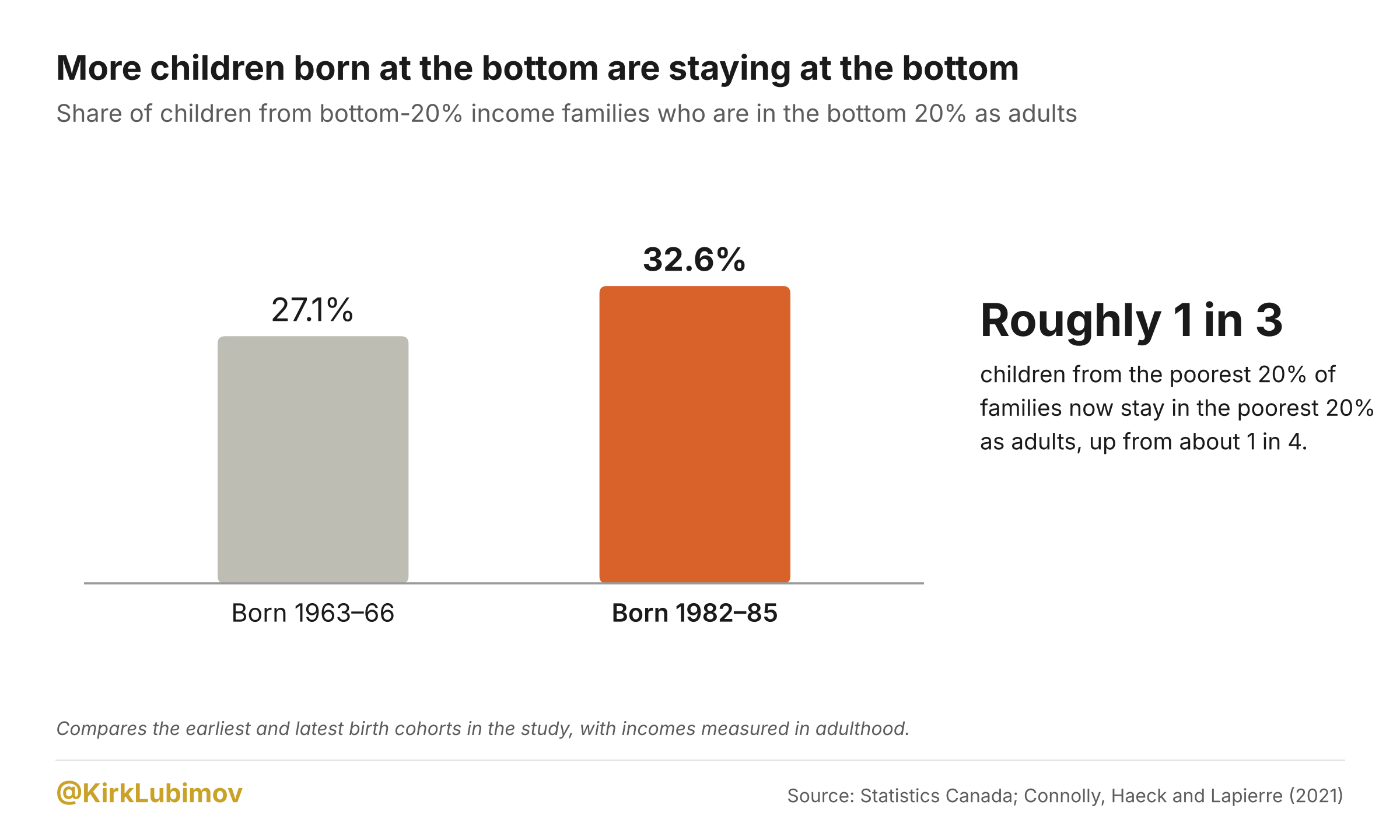
Of children born to the poorest 20% of families in the mid-1960s, 27.1% were still in the bottom 20% as adults. For those born in the early 1980s, it was 32.6%. Canada has become a place where where you start matters more than it used to. Classism.
The numbers for people born in the 1990s and 2000s, who hit the job market and the housing market at the worst possible time, aren’t in yet. Everything suggests they are starting from further back, unless they get substantial help from their parents.
The bottom arm of the K are young Canadians and renters. Those two groups overlap a lot: close to two in three Canadians aged 15 to 29 rent. Young Canadians don’t have the opportunity for work which leads to a lower chance to build disposable income.
Teen unemployment hit 20.3% in the second quarter of 2026. The teen employment rate fell to 36.6%, the lowest on record outside the pandemic. Young people aren’t being laid off. They can’t get hired: falling job-finding rates explain about 90% of the increase.
Then income. After inflation, the average household with a main earner under 35 had 7.2% less disposable income in 2025 than in 2021. No other age group lost as much. Households 65 and over gained 10.6%. Even measured from 2019, before the pandemic, young households had the smallest gain of any age group.
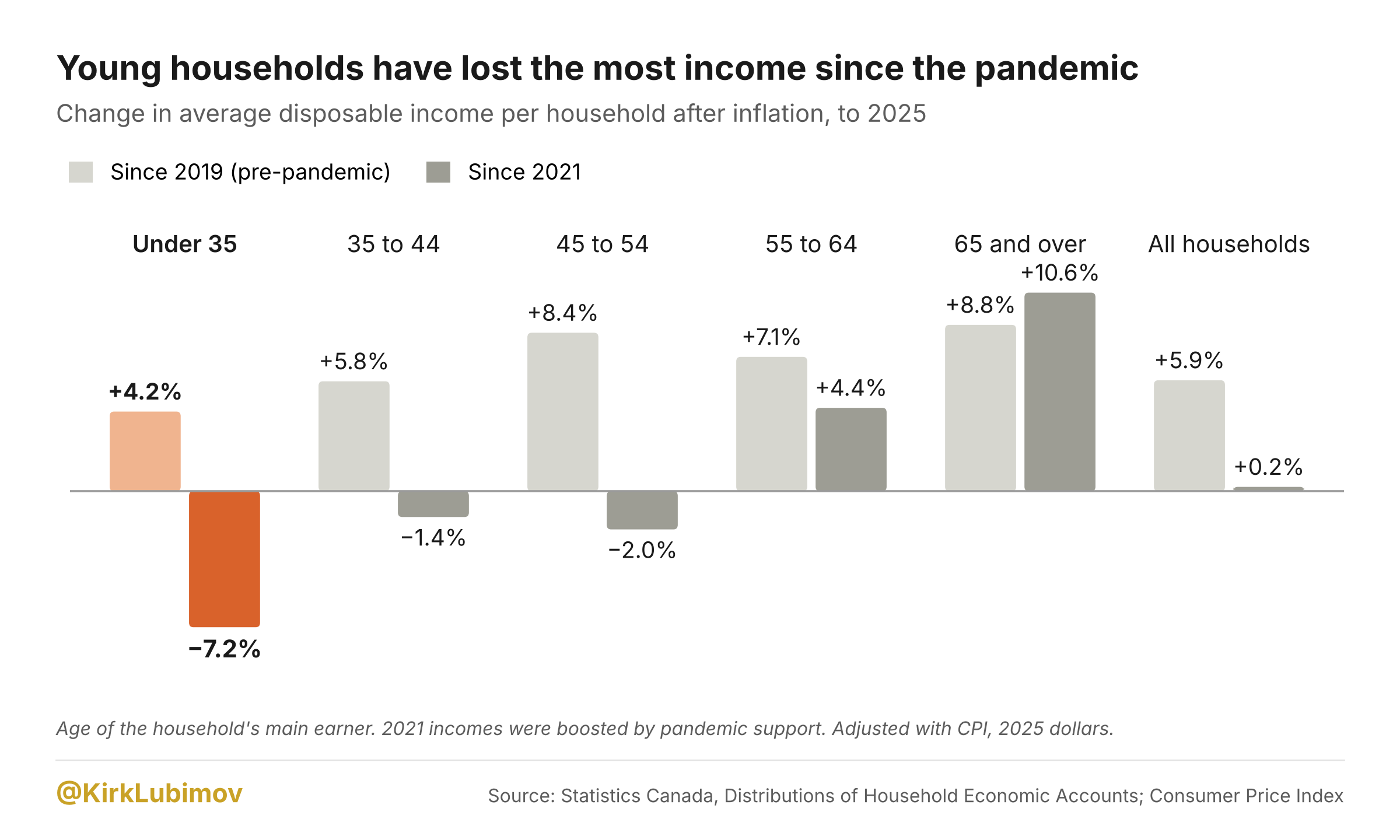
Young households got squeezed from both sides. The pandemic benefits ended, and the interest bills arrived. The average under-35 household paid $9,205 in interest on mortgages and consumer debt in 2025. That’s double the $4,522 it paid in 2021, and more than the average Canadian household pays, on less income. Their paycheques grew just 1.3% after inflation over the same four years. That doesn’t come close to covering it.
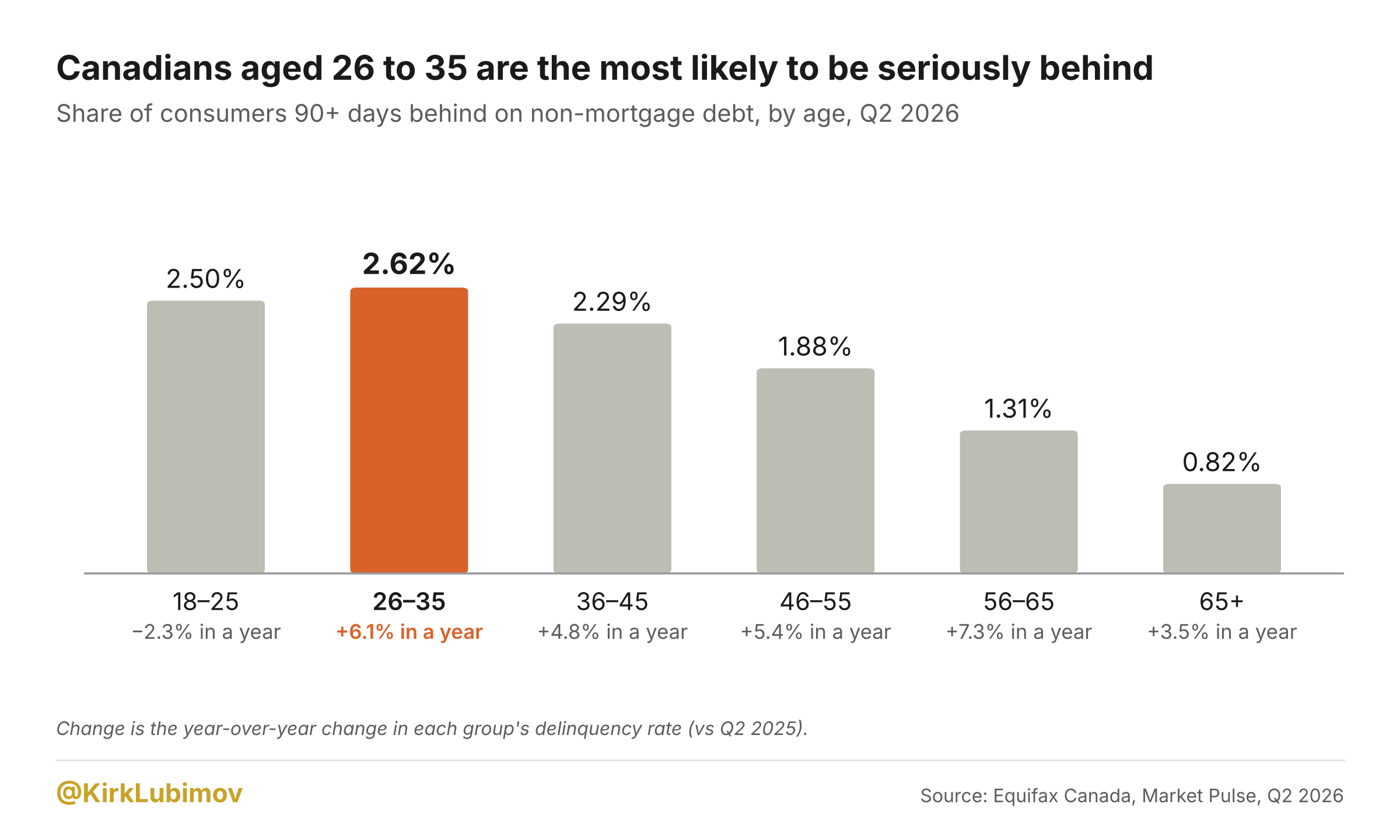
Then credit. Canadians aged 26 to 35 now have the highest rate of serious missed payments of any age group: 2.62% are 90 or more days behind on their non-mortgage debts, up 6.1% in a year. This is the age when people are supposed to be building toward a first home.
And fewer of them are getting there. Between the 2011 and 2021 censuses, the homeownership rate for Canadians aged 25 to 29 fell from 44.1% to 36.5%. For those aged 30 to 34, it fell from 59.2% to 52.3%. Across all households, the drop was only 2.5 points.
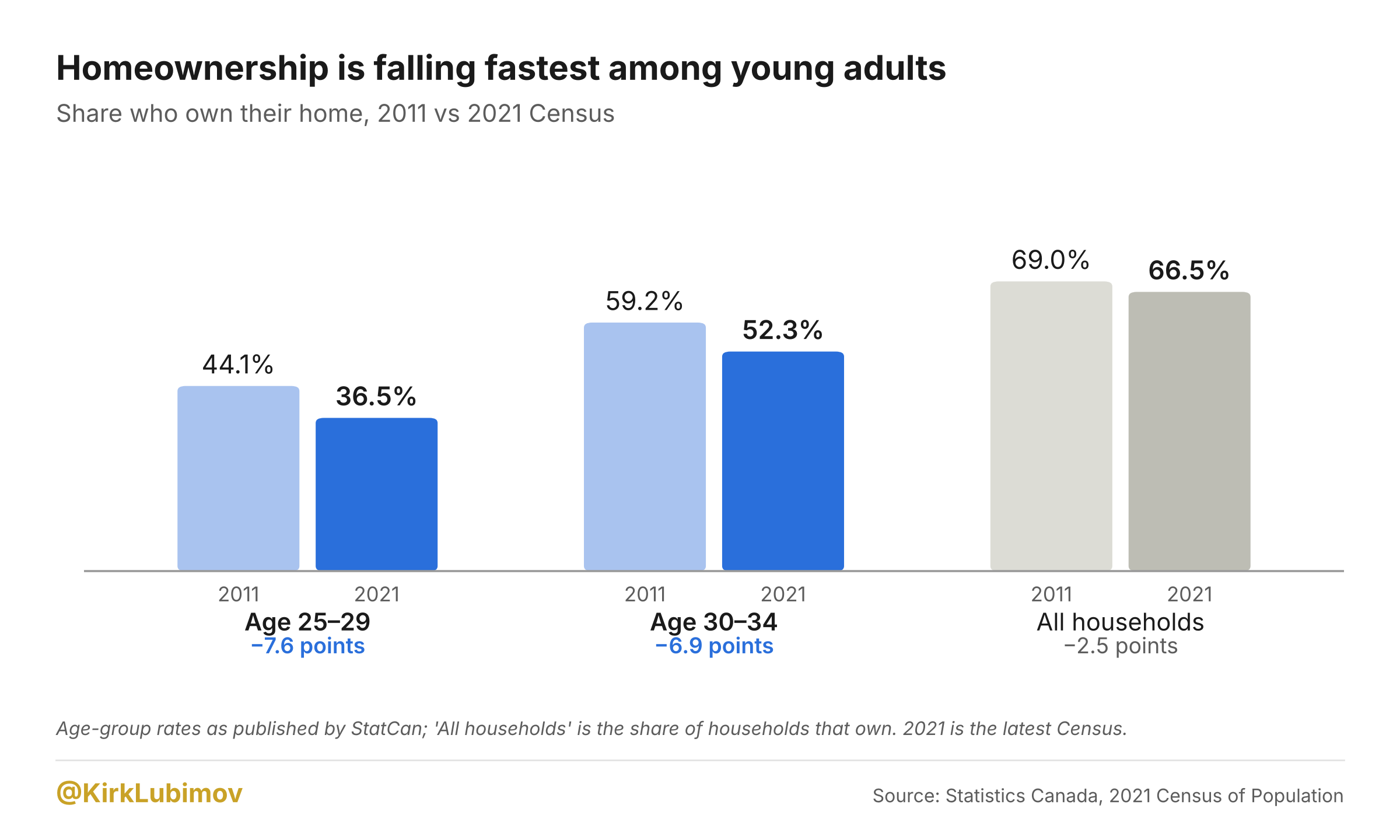
That matters because in Canada, owning a home is the main way ordinary families build wealth. The split shows up clearly in the numbers.
Among families whose main earner is under 35, homeowners had a median net worth of $457,100 in 2023. Those who didn’t own had $44,000. That’s more than 10 times as much. Both groups gained since 2019, but the dollar gap grew from about $297,000 to $413,100. Another class is being built as the average age for first-time homebuyers in Canada is moving to 41.
Households with a main earner under 35 carry 17.8% of all household debt in Canada. They hold 8.3% of the wealth. For every dollar of assets they have, they owe 27 cents. Across all households, it’s 15 cents.
Renters hold 10.3% of household wealth and just 3.1% of the real estate, even though about a third of Canadian households rent. In a country where home equity is how most families build wealth, that 3% says it all.
This is the real cost: a generation that can’t climb because the country works against them. We can’t build a successful country that isn’t being successful for our next generations. A country that isn’t working for its next generation isn’t working. Right now, Canada isn’t.
Canada hands out billions around the world to various causes while the well-being of our population declines. Instead of encouraging hiring locals and upskilling our youth, the government opened the floodgates for cheap foreign labour.
There are barely any policies that have a goal of fundamentally transforming the foundational viability of Canada for Canadians. The government keeps talking about “focusing on what we can control”; well, it’s time to actually do that and focus on making Canada work for Canadians. Unapologetically.
This is one of our biggest opportunities for GDP growth, cost cuts, and a much better country for all.