

Canada is the only G7 nation that lacks domestic, sovereign space launch capabilities. That may finally be changing. The introduction of the the Space Launch Act, Bill C-28, to create the regulatory framework and first steps to get the ball rolling and join one of the most competitive and fastest-growing sectors out there.
I view this decision as about time. It is so overdue. What most people don’t know is that Canada’s involvement in space goes back decades, even well before the creation of the Canadian Space Agency in 1989. There is a lot to be proud of here with a very rich history.
Canada was just the third nation to design and build its own satellite, and fourth to operate one. In 1962, Alouette I, a scientific satellite that studied the ionosphere, was launched. The project was a result of an invitation from NASA. It took just a few months for John Chapman and Eldin Warren, scientists at Canada’s Defence Research Telecommunications Establishment (DRTE), to submit a proposal. This was the start of Canada’s space research programme.
Project Mercury was America’s first human spaceflight program. When the Canadian government cancelled the CF-105 Avro Arrow, it was a huge blow to Canada’s engineering talent in this industry. Avro’s Chief Engineer Bob Lindley and Chief of Technical Design Jim Chamberlin contacted NASA’s Bob Gilruth, who ran the Special Task Group, to see if they needed any talent. They did. NASA sent out 32 offers, 25 were accepted, and 12 of them were to Canadians. This was probably one of the earliest prominent examples of brain-drain from Canada to the US.
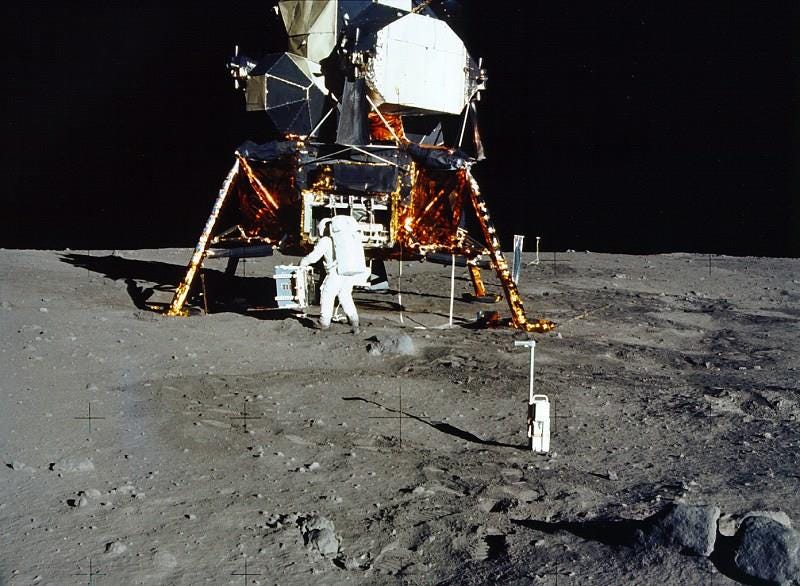
The same Jim Chamberlin was one of the people behind the proposal of using Lunar Orbit Rendezvous as the best option to land a crew on the moon, and the method was used by Apollo missions. Calgary’s Dr. Bryan Erb was behind the ablation shield of the Command Module. Apollo’s landing gear was built by Héroux Aerospace of Longueuil, Quebec, which has been specializing in landing gear for over 80 years.
In 1972, Canada launched the Anik A1, which was the world’s first commercial, domestic geostationary communications satellite. It brought TV, radio, and telephone services to remote Canadian communities. Canada-wide connectivity was being established by Canadian technology.
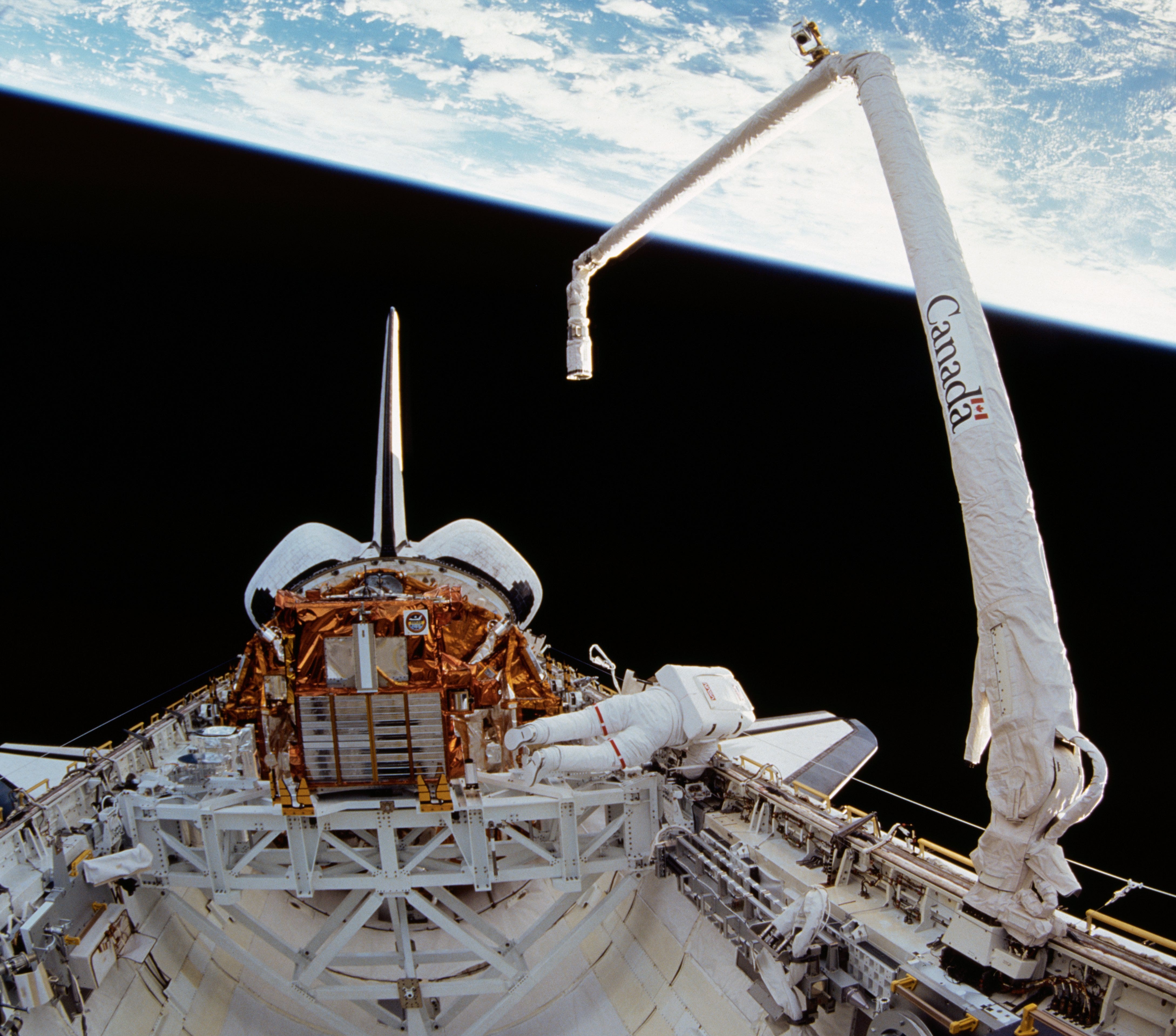
Once again, Canada was invited by NASA to participate, and this time in the Space Shuttle Program. A manipulator system was needed, and a Canadian company developed a robot to load fuel into CANDU nuclear reactors. That attracted NASA’s attention. Canadian companies developed the Shuttle Remote Manipulator System aka Canadarm. It was used for 30 years in 90 space shuttle missions. Canadarm2 is now being used with Canadarm3 in development.
The space industry is now seeing a resurgence and really transitioning from exploration and research to functionality. Not participating in this sector isn’t an option. There will be whole economies built on this. Once again America is leading the way but this time we don’t need to wait for the invitation.
The opportunity we have here is complete design, development, testing and launching domestically. If we take a couple of steps back, we also have all the natural resources to build every single component we need. Canada could be the only nation on earth to do so, and unleash another domestic manufacturing sector.
Our geographical advantage is not in launches for Geostationary (GEO) orbits, but is optimal for Polar and Sun-Synchronous Orbits, launching the “mega-constellations” of small satellites that power modern communications, Earth observation, navigation augmentation, and next-generation connectivity services.
Canso, Nova Scotia’s strategic location at approximately 46 degrees north latitude, offers one of the widest ranges of launch trajectories in North America; from about 44 to 105 degrees inclination. Even some access to some equatorial orbits over the Atlantic Ocean. Norway's Andøya Spaceport made exactly this pitch to Europe.
The government-owned WildFireSat mission, which will provide wildfire detection and monitoring for Canada, is a perfect example of a microsatellite project in which Canada has an advantage and can be completely done internally.
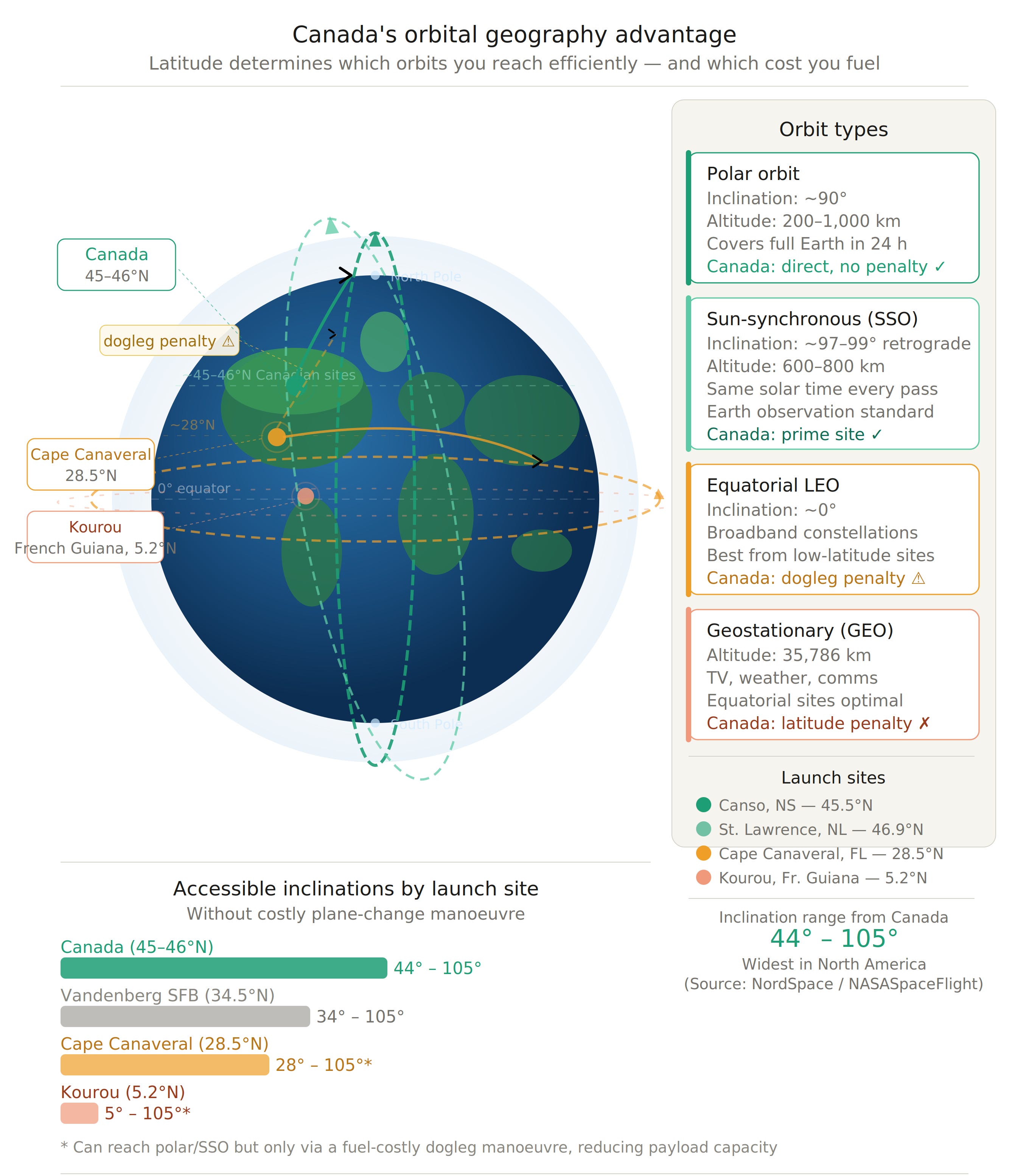
These are arguably the most commercially and strategically valuable orbital paths in today's space economy. This sector is expected to grow to $1.5T over the next 10 years. The potential for the Atlantic provinces to become “Silicon Coast” hubs for aerospace and the extension of the innovation happening in the Montreal and Ottawa areas.
Large portions of the Canadian economy depends on satellites, including banking systems, communication networks, and transactions. Monitoring Canada's vast Arctic territory, which is becoming more and more strategically important, requires polar-orbiting satellites that we must be able to deploy without foreign dependency, and on our own schedule.
Deploying our own Arctic and coast-focused satellites gives us an incredible economic advantage in resource exploration, empowering our companies with the ability to do more and faster locally. Value-added economic activity is exactly what Canada needs and makes more of the country accessible.
However, a regulatory framework - which I hope they will get right, isn’t enough. We need alignments of Federal and local policies to grow a brand new industry. Capital markets and attracting new investment will be critical to grow domestic pre-revenue space companies.
The government needs to show a willingness to move at the same speed and change policies that they have been dragging their feet on and historically got in the way of Canadian innovation and capital formation . This is our moment, let’s not squander it.