

Canada’s dairy supply management is becoming so symbolic for a planned economy system, one where Canadians pay more on purpose, that we have politicians actually consider it to be a part of our culture.
It is hard to gauge how much support it has from Canadians but it is a system this country is willing to put far bigger trade values at risk for, and it is also making Canadian groceries more expensive. That should tell you how powerful the dairy lobby is in Canada, and it is protected by every party in Parliament.
Producers, aka farmers, must hold a permit referred to as a quota. Without it, they can’t sell their product. This paper is the foundation of supply management in Canada, which is a regulatory framework operating by: production control, pricing mechanism, and import control.
National production is set to match projected domestic demand. For dairy, the Canadian Milk Supply Management Committee, chaired by the Canadian Dairy Commission, with representation from every provincial milk board and provincial government, sets the total. That total is divided among three regional pools: the Eastern Canadian Milk Pooling Agreement (the “P5”: Ontario, Quebec, New Brunswick, Nova Scotia, PEI), the Western Milk Pooling Agreement (BC, Alberta, Saskatchewan, Manitoba), and Newfoundland and Labrador separately. Provincial boards then allocate to individual farmers as quota.
The Canadian Dairy Commission runs an annual review using the National Pricing Formula, which weighs farmers’ cost of production against the Consumer Price Index. Provincial boards then negotiate class-specific farm-gate prices with processors. Effective February 1, 2026, the CDC raised farm-gate prices by 2.3255%, about two cents per litre, citing feed and labour costs. Retail prices are generally not regulated, with Quebec is the main exception, which regulates fluid milk at retail
To fully grasp the import control aspect of the system, you need to understand why this 55-year-old agricultural policy keeps finding itself at the centre of trade negotiations and disputes. How we got here is the important part of the story.
The first attempt at national agricultural marketing regulation was R.B. Bennett’s Natural Products Marketing Act, 1934, part of his belated New Deal. British Columbia challenged it, and on January 28, 1937, the Judicial Committee of the Privy Council in London struck the whole Act down as ultra vires.
The reasoning mattered enormously. The Act swept in transactions completed entirely within a province, which fell under provincial jurisdiction. Parliament could not acquire authority over local trade by bundling it together with interprovincial and export trade in a single scheme. The whole thing was void.
This produced Canadian agriculture’s defining constitutional bind:
Provinces can regulate production and marketing within their borders but cannot control what crosses provincial lines or arrives from abroad.
Ottawa can regulate interprovincial and international trade but cannot reach into a farm gate in Perth County.
Neither level of government, acting alone, can run a supply-managed system. Both are required. The 1949 Agricultural Products Marketing Act offered a partial workaround by letting Ottawa delegate federal powers to provincial boards, but the fundamental problem remained: any national scheme would have to be a negotiated federal-provincial construction.
Everything awkward about supply management’s governance today traces to a 1937 ruling by a court in London. Canada is a mess but this was a good ruling.
After WW2, as world trade largely collapsed, in an attempt to bring everyone back to the table, including the free trade and protectionism camps, the General Agreement on Tariffs and Trade was signed by 23 countries in 1947. It created international trade rules that included agriculture, but with important agricultural exceptions.
Those exceptions became the whole game.
The next decade brought significant volatility to dairy prices. The Agricultural Stabilization Act of 1958 required the federal government to support the price of nine named commodities, butter and cheese among them, at not less than 80% of the average price over the preceding ten years. Support came through offers to purchase surplus product or through deficiency payments. Cash subsidies flowed to the dairy industry. Import controls on dairy had already been in place since 1951.
The subsidies didn't fix anything. Postwar technology, better genetics, mechanized milking and improved feed, pushed output well past what Canadians could consume. Surplus skim milk powder piled up in government-financed storage with nowhere commercially viable to go, and the support bill climbed every year it sat there. Ottawa was buying the problem rather than solving it.
Meanwhile the provinces were building their own machinery. Ontario passed the Milk Act in 1965, following a 1963 provincial study, creating the Ontario Milk Marketing Board, a single body that bought all milk produced in the province and resold it to processors. Its first chair, George McLaughlin, ran it until 1977, imposing mandatory production quotas, quality standards, and negotiated farm-gate prices across a patchwork of regional milksheds. Quebec’s industrial milk producers federated in 1966; fluid milk producers followed in 1970. The provincial boards that still allocate quota today were built in this window.
Prices for milk weren’t improving, and subsidies couldn’t go on forever. The Canadian Dairy Commission Act was passed in 1966 and went operative in 1967, with a mandate to give efficient producers a fair return on labour, investment and to provide consumers a continuous supply of quality product. It is a Crown Corporation that is still running the show today.
This is what no one mentions: the first form of supply management, introduced in the late 1960s, did not limit production at all; it limited access to subsidies! Eligibility for payments under the Agricultural Stabilization Act was capped based on a farm’s historical production. Minimum production thresholds excluded the smallest and least efficient farms from subsidies entirely. Those farms were instead offered payments to exit the industry.
That’s right. The policy now defended as the shield of the Canadian family farm began by paying small dairy farms to shut down. Consolidation was an explicit design objective at the outset. In the early 1970s, those limits on subsidy eligibility were converted into limits on actual production and marketing. Quota was born as a subsidy ration and became a production licence.
In 1971 the Farm Products Marketing Agencies Act was passed by the House of Commons. Interestingly it was introduced by an Alberta MP and Agriculture Minister H.A. “Bud” Olson who lost his seat right afterwards. Olson, by the way, crossed the floor to join the Liberal Party, supported Pierre Trudeau’s leadership candidacy and the last Liberal to be elected in a rural riding in Alberta.
The Act created the National Farm Products Marketing Council, renamed to Farm Products Council of Canada, authorizing the creation of national marketing agencies and empowered to restrict production and allocate production quotas among provinces. By 1974 all provinces except Newfoundland signed on. This added eggs, turkey, and chicken into the quota system. Dairy stayed separate under the CDC. This direction has officially become Canada’s strategy.
The basic reality is the Canada is blessed with vast, highly productive farmland, and because in that period of time the production quantities were so high it was keeping prices down. Besides trade policy, it is just supply and demand. Provinces were seizing each other’s farm products at the border. The government intervened in the market with pricing and production quotas.
Why is the General Agreement on Tariffs and Trade (GATT) important? It allowed the control of foreign competition, aka imports, in Canada. Its key provision was Article XI:2(c). It permitted certain quantitative restrictions on imports of agricultural products when those restrictions were connected to domestic measures restricting the production or marketing of the corresponding domestic product.
GATT allowed Canada to wall out foreign dairy imports if it capped our own farmers as well.
Canada couldn’t restrict its own farmers from producing an unlimited supply while allowing unlimited imports, so it had to restrict how much foreign dairy enters Canada. The system doesn’t work otherwise and would collapse. It is still the principle of the facts today. GATT was the international environment in which Canada was doing this.
By the 1980s, agricultural protectionism became a major international trade issue. In 1984, the European Economic Community introduced its own milk quotas, having watched Canada run the model for a decade. Furthermore, the US and Europe were locked in an export subsidy war, dumping surpluses onto the world market to undercut each other. World trade was a complete mess.
In 1989, the Canada-United States Free Trade Agreement (CUSFTA) took effect. Its Article 710 preserved both countries' existing GATT rights and obligations on agriculture wholesale, so supply management came through 1989 essentially untouched. Canada conceded only marginal increases in access.
In 1986, the Uruguay Round launched in an attempt to bring agriculture fully into the international trading system. It was the eighth and last round of multilateral trade negotiations held under GATT. It was the largest trade negotiation in history, involving over 120 countries and concluded in December, 1993. It gave birth to the World Trade Organization, a permanent institution with actual enforcement capabilities.
Along with the WTO, the negotiations also resulted in the Agreement on Agriculture, which was built on three pillars: market access, domestic support, and export subsidies. Canada campaigned aggressively to strengthen and clarify Article XI:2(c), it was pretty much alone in doing so and took it on the chin.
Canada could no longer block dairy imports because it restricted domestic production, and with AoA it was required to move to tariffication. Quantitative restrictions converted to tariffs. Let’s remember the new agreement was based on market access, but Canada took a defensive position to protect its quota system. It accepted the tarifficiation then set tariffs high so nothing changes in practice. That’s the origin of the 298.5% on butter and 250.5% on yogurt tariffs, and the triple-digit numbers you hear Donald Trump refer to. New walls under a new name.
More specifically, the new agreement created minimum access opportunities, which is a guard against countries setting prohibitive tariffs and calling it a day. It wasn’t much, as it required access to expand to roughly 5% of domestic consumption. It’s called the Tariff-Rate Quota, which is the mechanism Canada still uses today. Canada set minimum import volumes to satisfy the requirement, then cranked tariffs up beyond that.
The AoA forced Canada’s federal dairy subsidies to be wound down and eliminated. The Uruguay Round made the old subsidy illegal but the cost didn’t disappear; it shifted entirely to consumers through administered farm gate prices. That is why "Canadian dairy farmers get no subsidies" is technically true, and why it is less flattering than it sounds. It directly comes from your wallet.
NAFTA didn’t renegotiate Canada-US agriculture at all. Annex 702.1 incorporated the CUSFTA agriculture provisions by reference, including Article 702, the snapback mechanism permitting either country to apply a temporary emergency duty, and Article 710, which had preserved the GATT carve-out. Canada–Mexico agriculture was negotiated separately, and dairy, poultry, eggs and sugar were excluded there too.
The fight came in 1995, when Canada converted its import quotas into tariffs of 200–300%. The US argued this breached NAFTA's prohibition on raising tariffs; Canada argued the Agreement on Agriculture, negotiated after NAFTA, authorized it. A Chapter 20 panel found for Canada in December 1996.
There is a paradoxical relationship here. GATT gave Canada the legal space for the import control pillar. The Uruguay Round then constrained the same pillar. Canada then pivoted to high tariffs, and exports effectively became subsidized. That was the only thing to do with excess domestic production: dump abroad.
Countries were not happy. The U.S. and New Zealand challenged Canada’s special milk classes as disguised export subsidies. A panel upheld the challenge in October 1999; Canada changed its program; a compliance panel ruled against it again in April 2001, and again in June 2002; a settlement followed in May 2003.
That was a comprehensive and structural loss for Canada.
How milk is priced to begin with is important to understand to reconciling trade disputes, as it is not that simple. Canadian processors do not all pay the same price for the same milk. They pay according to what they make with it:
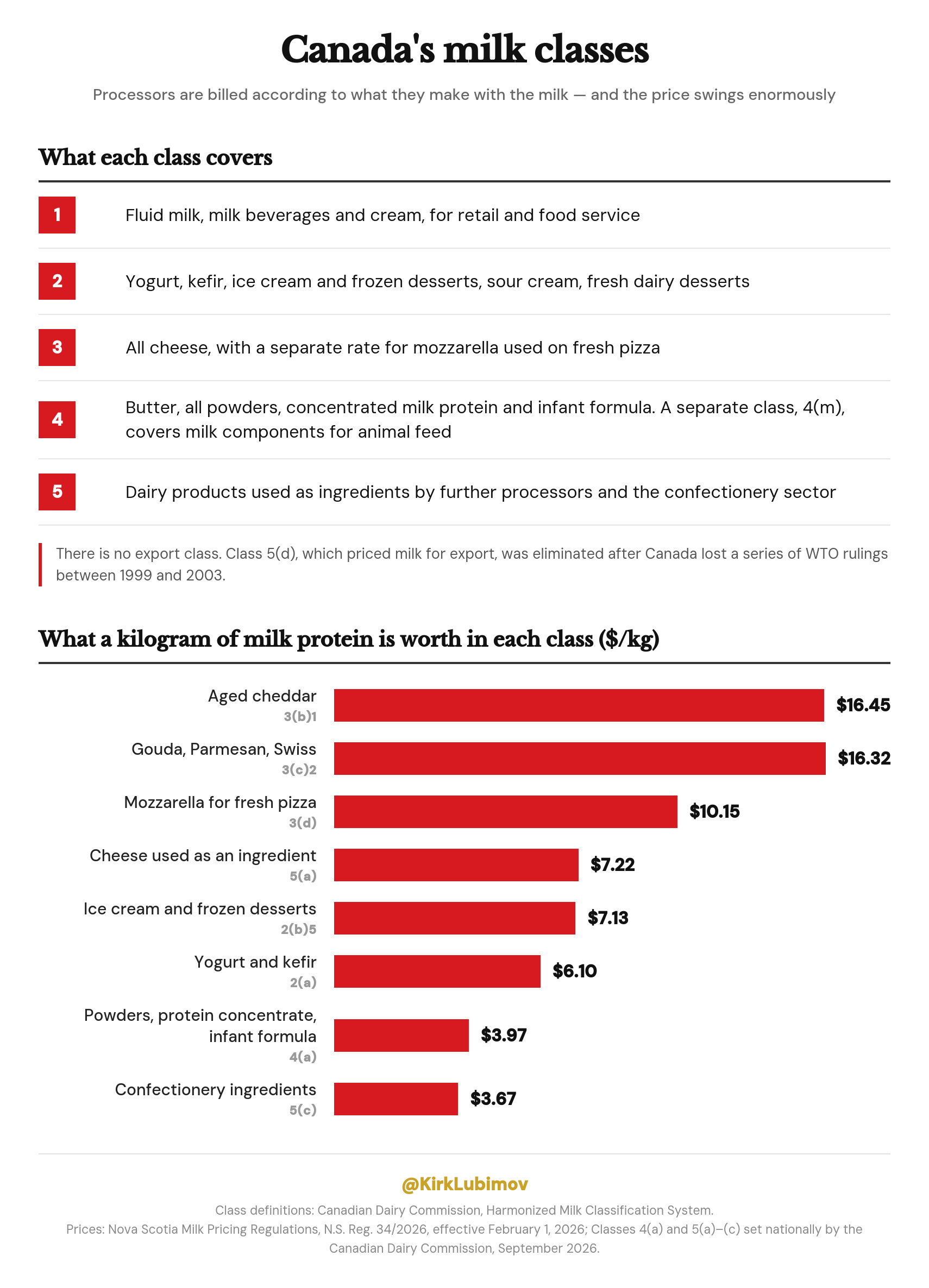
The revenue goes into provincial and regional pools, and farmers are paid a blend price reflecting the mix. The logic is ordinary price discrimination, and the spread is enormous but not where most people assume.
The entire hierarchy lives in protein, and there it is dramatic. Protein destined for aged cheddar costs a processor $16.4503/kg. The same protein going into powders, protein concentrate and infant formula costs $3.9747/kg. Cheese can carry a high price because cheese is where Canadian protein has real value. Powder cannot, because powder competes with Wisconsin and New Zealand. Butterfat is priced almost flat across the industrial classes.
A litre of milk is butterfat plus solids-non-fat; cream and skim. They arrive together, and you can’t make a cow produce one without the other. Quota is measured in butterfat. Canadian demand has shifted steadily toward butterfat: butter, cream, cheese; while fluid milk consumption falls (2.91 billion litres in 2014 to 2.71 billion in 2024).
Produce enough butterfat to meet demand, and you necessarily produce skim solids nobody in Canada needs. Canada therefore runs a structural surplus of solids-non-fat. It is arithmetic, not mismanagement, and no policy change makes it disappear.
That leftover skim is the whole story. Everything else is countries arguing about what to do with it .And look again at where it lands: $3.97 a kilogram, the bottom of our own price structure.
Then a new leak opened. Ultra-filtered milk entered Canada duty-free because customs classified it as a protein substance rather than as milk. Wisconsin and New York built plants specifically for that market, and by 2017 it was giving the US a roughly $475 million dairy surplus with Canada. Canadian processors, including farmer-owned co-ops, bought it enthusiastically because it cut their costs.
Canada closed this loophole with two new cheap rungs added at the bottom of the ladder: Class 6, then Class 7.
In 2016, the Ontario Milk Ingredient Strategy created Class 6, pricing Ontario ingredient milk at levels competitive with world protein prices. Processors now had a commercial reason to buy Ontario milk instead of American ultra-filtered milk.
The International Dairy Foods Association estimates the Ontario measure alone cost Wisconsin and New York companies around $150 million in lost ultra-filtered milk sales.
In 2017, Ontario’s approach was then scaled up as the National Ingredient Strategy. Class 7 covered skim milk solids used for milk protein concentrates and isolates, skim milk powder, whole milk powder and related ingredients.
The pricing, as described by its American critics, pegged Canadian solids-non-fat to the lowest of the U.S., EU and Oceania price, locked in for seven years.
It did two jobs simultaneously:
Import substitution. Canadian ingredients now undercut American ultra-filtered milk. The loophole closed without a single tariff changing.
Export enablement. The structural skim surplus finally had a price at which it could move on world markets as powder.
It was very successful protectionist move for Canada, while driving our own prices up. It had a direct impact on the Americans. Grassland Dairy immediately dropped about 58 Wisconsin farms, with farms in Minnesota and New York also taking a hit.
This was a strategic miscalculation on two fronts and what led to today’s escalations.
The Export enablement aspect of it, from Washington, looked exactly like the export subsidy Canada had already lost three WTO rulings over. Canada voluntarily had returned to the one patch of ground where its record was worst.
Politically, it produced the image of a Canadian decision destroying American family farms in a swing state, three months into a new presidency.
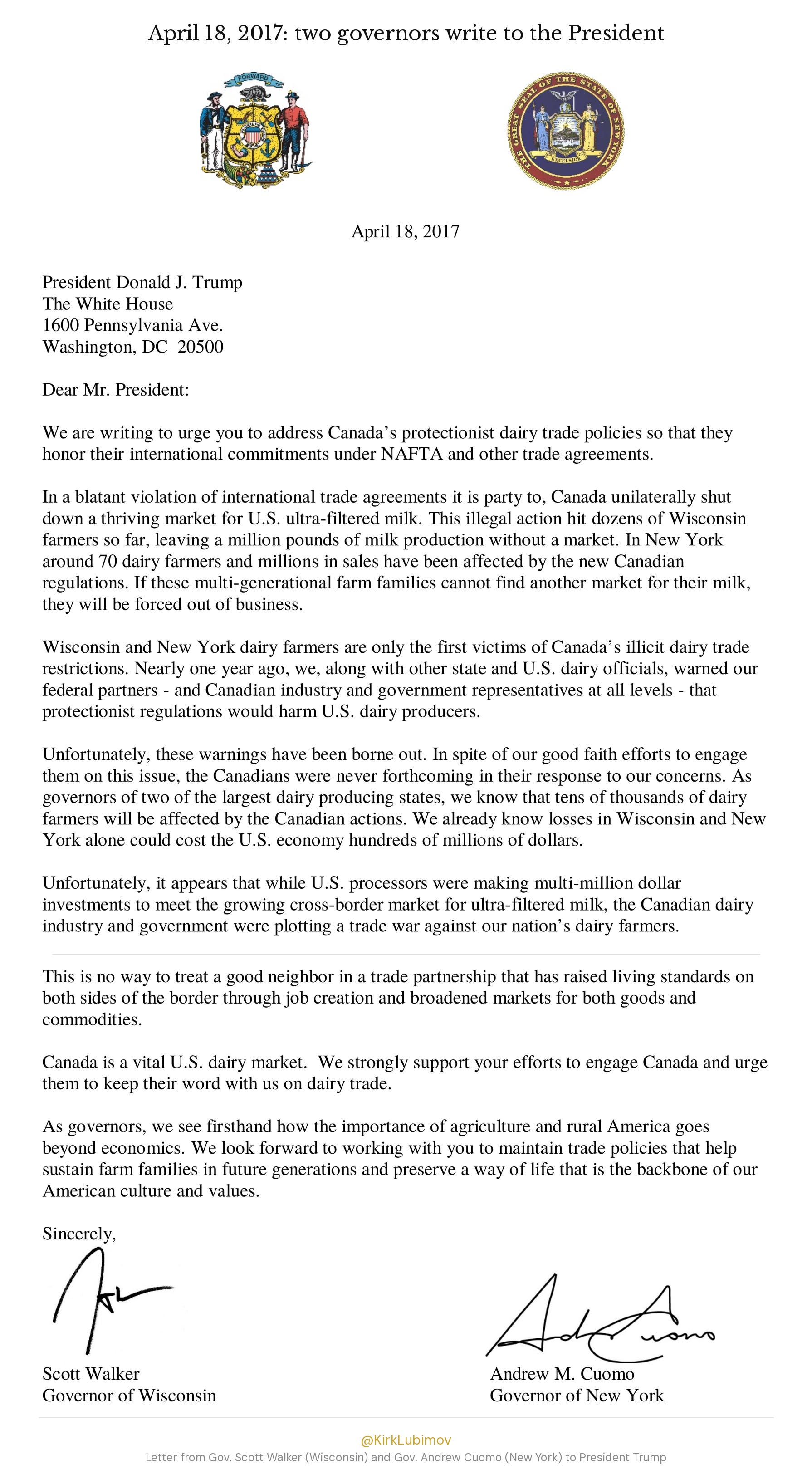
Wisconsin Governor Scott Walker and New York Governor Andrew Cuomo, Republican and Democrat, signed a letter to Trump asking that he address Canada’s “protectionist dairy trade policies.” The governors said they wanted Canada to “honor their international commitments under NAFTA and other trade agreements.”
That same day, Trump was in Kenosha signing his "Buy American, Hire American" executive order, telling the crowd that in Canada "some very unfair things have happened to our dairy farmers" and calling NAFTA a one-sided deal. Agriculture Secretary Sonny Perdue would later brand Class 7 an underhanded circumvention of WTO rules and say scrapping it was the quick win.
A domestic pricing decision, taken by provincial boards and processors to solve a domestic surplus, detonated in an international negotiation that nobody in that room was accounting for. A combination of complete incompetence and ignorance.
Abolishing Class 7 became a formal U.S. objective in the NAFTA renegotiation. The U.S. demanded that Canada abolish supply management outright. Canada refused, and the system survived but not without substantial concessions. Relatively.
Just under 3.6% of the Canadian dairy market, through US-exclusive tariff-rate quotas. The US opened reciprocal ton-for-ton first-come-first-served quotas to Canadian product.
Classes 6 and 7 abolished, effective June 1, 2020. No replacement class was created; the products were folded into Class 4(a), priced on a formula benchmarked to the USDA nonfat dry milk price.
Canada must publish milk class pricing information; components, processing margins, yield factors, and report MPC, SMP and infant formula exports monthly at tariff-line level. It must also discuss any matter related to the export mechanism on U.S. request.
The genuinely unprecedented part: Canada agreed to limit its exports to third countries. 55,000 tonnes of skim milk powder and MPC in year one, with a C$0.54/kg surcharge above it; infant formula capped separately.
A trade agreement normally governs what moves between its parties. Here the United States obtained a binding limit on Canadian sales to countries neither party controls.
What Canada surrendered was not the pricing tool but the discretion over it. US effectively acquired standing inside Canada’s domestic price-setting. It’s a huge point, and almost never mentioned.
With Class 7 gone and access fixed by treaty, the only remaining variable was who receives the import licences. That is where the fight moved right after signing the CUSMA free trade agreement and where it remains.
In 2021, the first CUSMA panel found Canada’s practice of reserving TRQ pools for processors inconsistent with its obligations. Canada revises its allocation by May 2022, ending processor-exclusive reservations and opening industrial cheese quotas to distributors.
In 2023, a second panel, on the revised measures, rules largely in Canada’s favour, finding the U.S. had not established inconsistency. Washington publicly disagreed with the outcome.
In 2023–2025, New Zealand wins a parallel CPTPP challenge on the same allocation question; Canada amends again in April 2024; the two settle in July 2025 on transparency and underfill mechanics, with no change to access levels.
Washington’s explanation for the underfill is that Canada allocates most dairy TRQ licences to processors, who have no commercial interest in importing products that compete with what they make from Canadian milk. It also notes that Canada lets EU cheese be imported directly by retailers under CETA while generally excluding retailers from comparable CUSMA allocations.
Canada’s answer is that it has complied with every ruling, and in November 2023, a panel agreed.
The crux of the American grievance is narrower than the rhetoric: certain specific quota lines go substantially unfilled, and the U.S. argues the reason is how Canada hands out the import licences rather than any lack of American appetite to sell.
For the 2024–25 dairy year, the CUSMA milk TRQ allowed 50,500,000 kg. U.S. exports filled 8,648,640 kg, a 17.3% utilization rate. CPTPP milk utilization was 0.1%. By contrast, chicken and cheese TRQs run above 80%, sometimes above 95%, and butter approaches 100%.
It is a patchwork: some lines saturated, a few barely touched. And a substantial share of the American growth has come in categories that either fill their quotas completely or sit outside the TRQ system altogether.
Here is what is never mentioned: US dairy exports to Canada have doubled in 4 years.
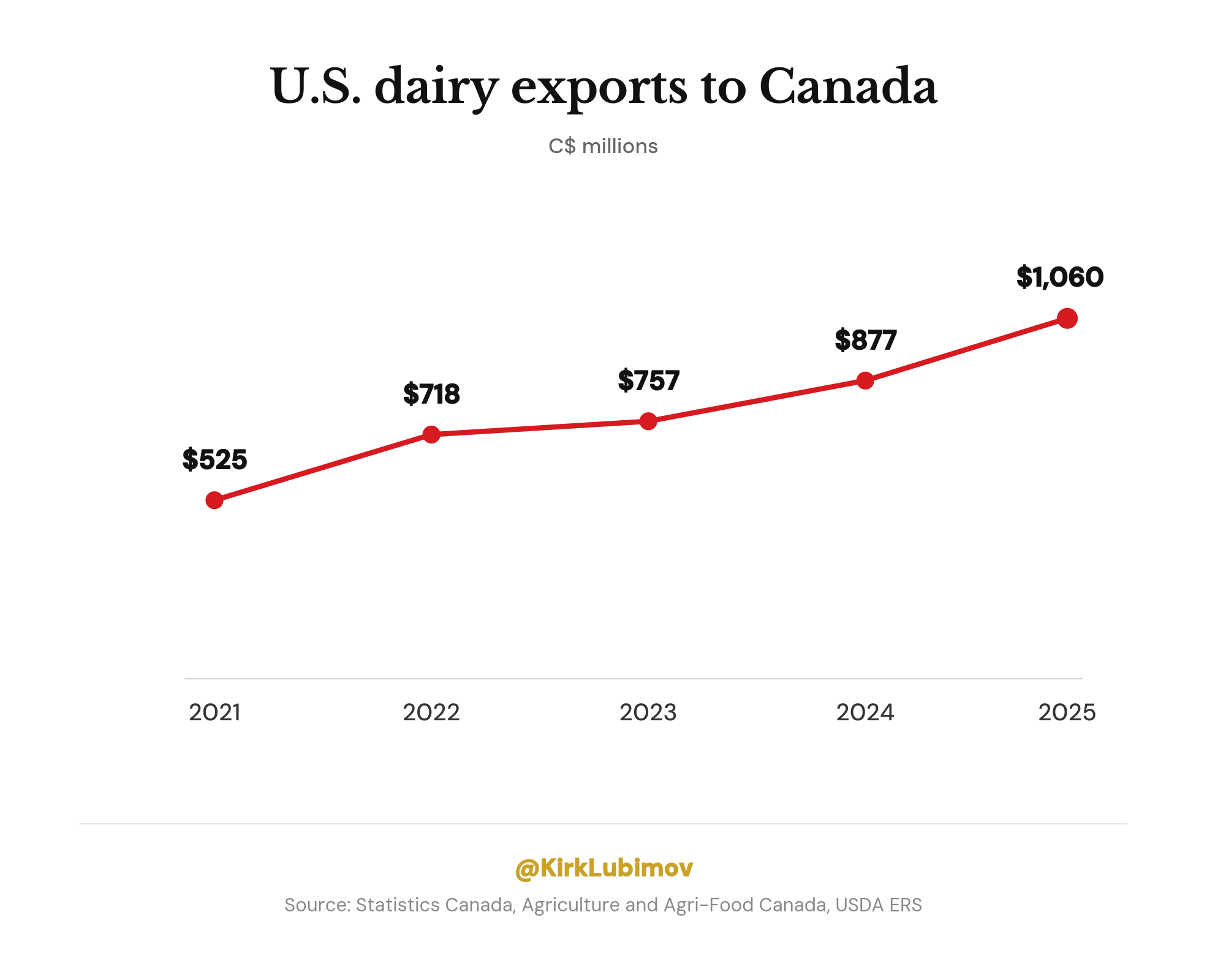
The US now supplies roughly 55% of everything Canada imports in dairy, and Canada is the largest buyer of American butterfat in the world. The US has a dairy trade surplus with Canada, and Canada has a general dairy trade deficit with the world.
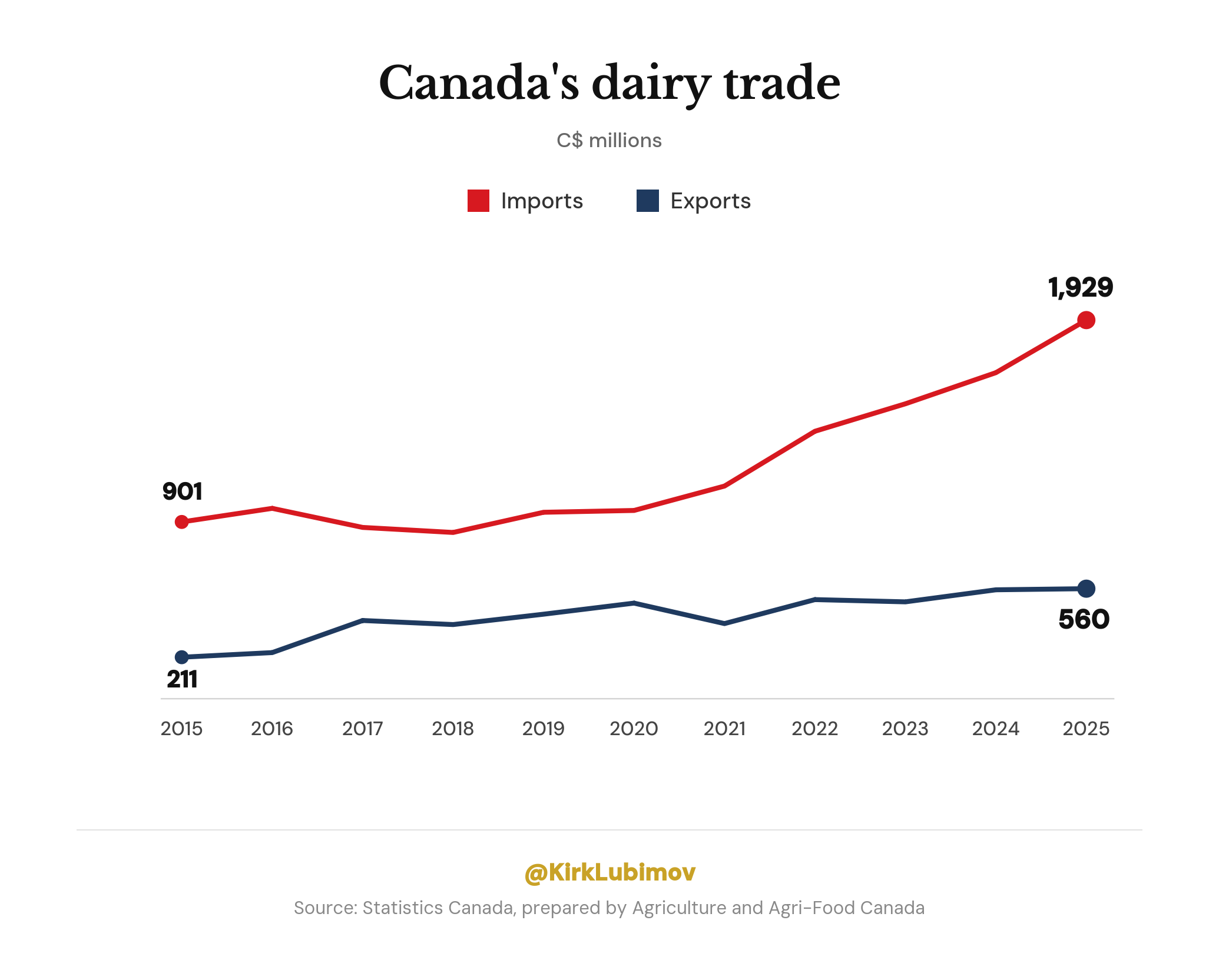
So the honest version of the American grievance is technical: not enough of the access we negotiated is reaching firms that want to use it. It is a valid argument.
The negotiations followed the same pattern for decades: US demands abolition, Canada concedes a slice, Ottawa compensates, then domestic mechanics blunt the concession. This is why the US gets mad again, resulting in grievances for the next round, which is now the CUSMA review.
The US declined to renew CUSMA on July 1st, 2026 for a further 16 years, converting a stable agreement into an annual renegotiation running to 2036. Supply management will now be on the table every 12 months. However, Canada made the first move here.
Bill C-202, a Bloc Québécois private member’s bill introduced by Yves-François Blanchet, received royal assent June 26, 2025, legally barring the foreign affairs minister from committing to higher TRQs or lower over-quota tariffs on dairy, poultry or eggs. It is a pre-commitment device, a deliberate destruction of Canada’s own negotiating flexibility, intended to make the concession impossible rather than merely unwelcome.
Every single Party voted for the Bill. It had unanimous consent with no opposition. It was the first bill passed by the 45th Parliament. Now you understand why the renegotiations are much harder, and some of the opposition talking points are not entirely upfront.
Canada removed its own ability to make small dairy concessions that would also make our prices cheaper, for something larger elsewhere. It is incredibly dumb. The Canadian Agri-Food Trade Alliance and Grain Growers of Canada warned about this as well.
Here we are today. Canada backed itself into a corner, and America’s politicians are overblowing this part of the situation.
The real problem with the dairy supply management system is domestic and foundational for the industry going forward.
Nearly 25% of the dairy farms have disappeared over the past decade. Supply management slowed the decline. It did not stop it. What it did build is about $45.9 billion in quota value, and that is what is really being protected now.
Getting into dairy costs roughly $2 million in quota before you buy a cow. Most young farmers get into it because it is inherited.
Dairy is back on the table every single year until 2036. Bill C-202 made the small concession illegal for our own negotiators to offer. The surplus skim that caused the Class 7 disaster is still there, because it was never a policy problem; it's arithmetic.
The longer we wait, the more expensive leaving becomes. That $45.9 billion is collateral against real farm debt, and it grows every year nobody writes a transition plan.
America’s issue with our dairy supply management system is really the least of our worries. The next ten years will settle it, and we have left ourselves almost no room to move. Canada either fixes this on its own terms, or has it done to us on someone else's. We built this system by paying small farms to disappear. Fifty-five years later it is still doing exactly that. We just call it heritage now.