

2025 was a transformational year for Canada in many ways, as the immigration levels were tried to be balanced and reduced, tariffs came and created more economic uncertainty than what was naturally happening. All on top of the low-productivity economy we have.
The decrease in artificial stimulus that came with the influx of people is starting to unravel, and fundamental issues in the economy are no longer masked. The labour market reflects much of the movement and reorganization that happens.
From December 2024 to December 2025, Canada’s labour force grew by 256.2k people. It grew by 878.8k since December 2023, so last year’s growth has definitely slowed down.
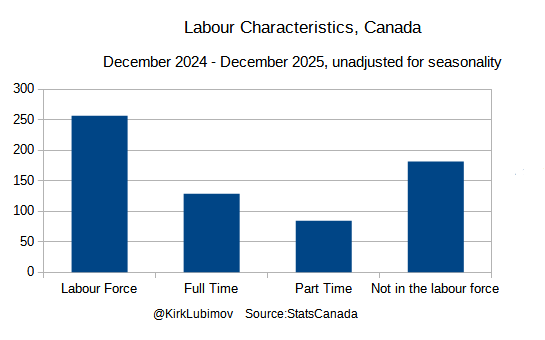
Out of the the labour force growth of 256.2k people, 212.8k found employment. 181.6k people haven’t even entered the labour force last year. Only 128.6k full-time jobs were gained. That is an alarming low number.
Canada is a big country and different regions have different economies. Not all provinces fared the same in 2025. PEI, Nova Socia and Quebec haven’t created a single new full-time job in one year, and actually lost them.
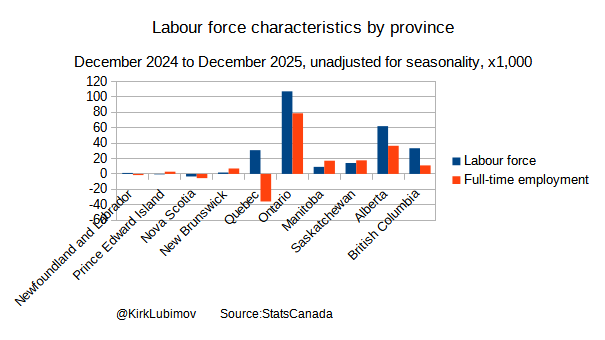
I like to look at how the provinces’ labour force is growing and how relatively their economies can place people into a full-time job. It helps highlight economic mobility part of interprovincial migration and how efficiently the economy is able to grow with the population.
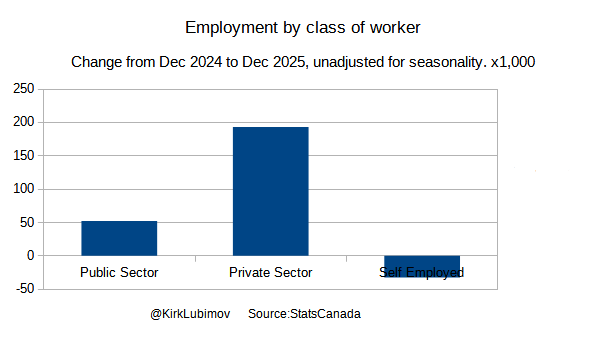
2025 was a brutal year for entrepreneurship as the country lost 32.4k self-employed individuals. This is highly unfortunate as this is the source of organic employment and economic growth. Canada needs to reward risk-taking and remove obstacles that hinder this growth.
The private sector grew by 193.1k jobs and the public sector grew by 52k jobs. For every 4 private-sector jobs created, there is 1 public-sector job. This ratio isn’t sustainable to pay for the public sector, and over 25% of employees in Canada now work for the government. Historically, this is a high ratio, and again, unsustainable.
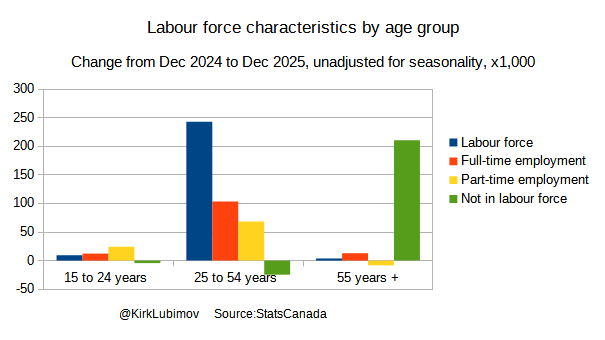
The over 55 age group didn’t gain a single part-time job in the past 12 months and saw many people leave the labour force. There is a combination here of people retiring but also lesser access to the labour market.
The core age group and youth had a good year in bringing people back into the labour force, even though youth had a hard time finding a full-time job. Labour force growth in the 25-54 age group was healthy, but the youth age group saw a decrease from previous years.
The big problem is that overall population growth in the youth years is stalling, which will translate into fewer people entering the core age labour market in the future. We are starting to see the impact of low birth rates at play. This should be really concerning and means we really have to increase productivity and automation levels in our economy. Out of everything in the past year, this is the most important data point.
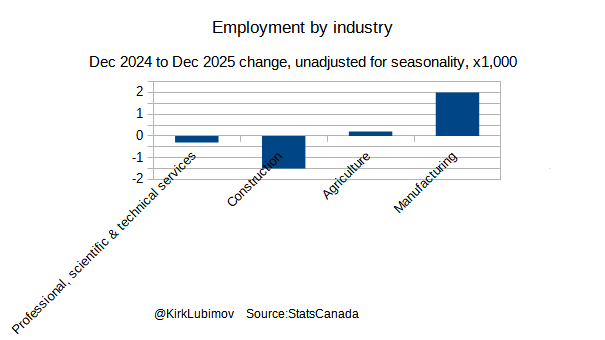
The problem Canada has specifically is making things and technical talent-oriented industry growth. Manufacturing only gained 2k jobs, agriculture gained 200 jobs, and construction and professional and technical services lost jobs. 2025 was a disastrous year for industries that Canada should be growing if we want an economic turnaround. Most of the jobs created were in the service industries: education, healthcare, and government.
From 2019 to 2025 the goods-producing sector grew by 221.6 employees, and the services-producing sector grew by 1.736M people. Investment-related industries are growing at a fraction of credit-dependent ones. All focus should be on how we can produce more. Export-related industries also have higher wages.
Average wages grew from $38.05/h to $39.34/h over the 12 months for full-time employees. Agricultural, cultural and recreational industries had their average wages drop. Employees with union coverage make more than those without one.
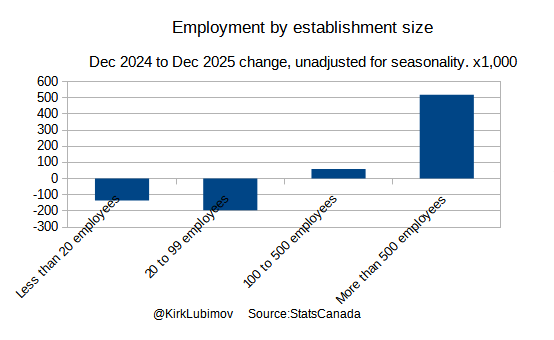
This is a heartbreaking chart. Most of the employment in the last 12 months was in large companies. Employment in smaller businesses, which are often your local community businesses, has collapsed. That speaks to business closures and lack of replacement by entrepreneurship. Goes hand in hand with the drop in self-employment we saw over the past 12 months.
Most of Canada’s employment is in the sub 100 employee size businesses. When we see these businesses disappear, it not only impacts our neighbourhoods but also an important stepping stone for future generations and the future growth of successful industries. Concentration growth in large conglomerates is never a good thing, especially in a vast country such as Canada.
We must restore the drive for entrepreneurship, investment and production back in Canada. It’s all internal issues and not external. We need policy and cultural changes to make it happen. Time to celebrate creators and risk takers. Support your local business.