

Somewhere between $45 billion and $113 billion is laundered through Canada every year. That’s the latest official estimate, and it’s from 2020. The $68B range should tell you how clueless our authorities actually are about what is going on in Canada. And the 2020 time stamp is before the peak auto theft, real estate boom, and the TFW/Student visa for sale scams.
How many record-breaking drug busts have we had in the past few years? No money laundering charges.
British Columbia casino investigations? Squirrel.
Project E-Pirate, an investigation most Canadians haven’t heard of, a Richmond-based Chinese-linked underground banking and money laundering operation allegedly laundered more than $1B annually. The prosecution fumbled it completely. Charges were stayed. Nobody was convicted.
The Financial Action Task Force report alleged the underground bank used B.C. as a hub to perform crucial drug-trafficking and global money transfer services for Chinese Triads, Mexican Cartels, and Middle Eastern organized crime groups. Nothing to see here folks.
The Islamic Revolutionary Guard Corps (IRGC) was listed as a terrorist entity under Canada’s Criminal Code since 2024 (finally). They have operated in Canada for decades; they still do. No financial institution has reported freezing any assets. Not one penalty was for failing to freeze terrorist money.
The U.S. Department of the Treasury’s Office of Foreign Assets Control (OFAC) designated 8 Canadian money services businesses under Operation Economic Outcast for allegedly assisting the Iranian regime with asset transfers, sanctions evasion, and cryptocurrency conversions. Not a word from the Canadian authorities.
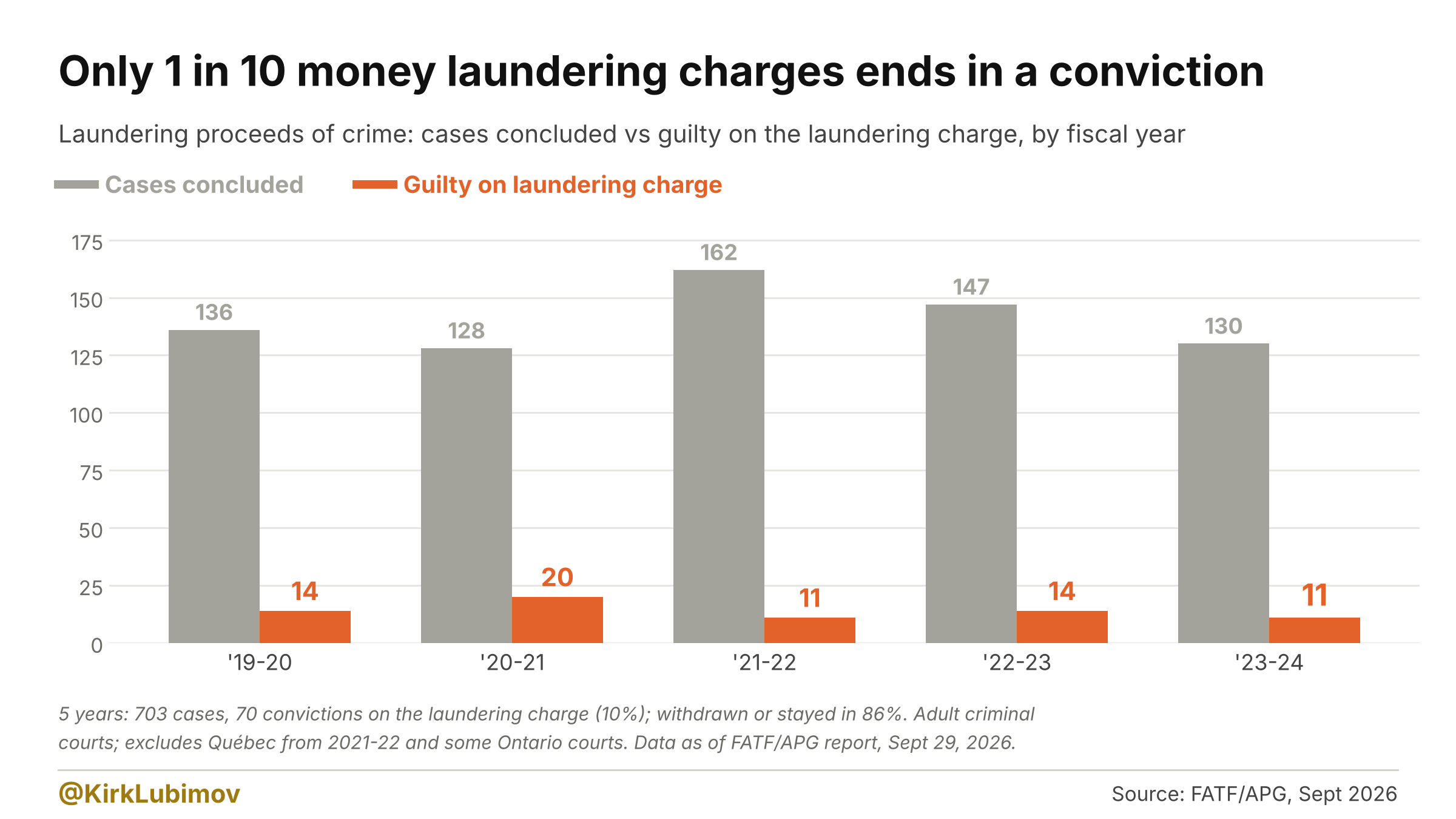
When things actually do go to court, the conviction rate and the actual number of cases are so pathetically low it is embarrassing. Then there are the type of cases.
Let me give you a perspective. As I said in the opening, the government's most recent estimate of the amount of money laundered in Canada is from 2020, and it's up to $113B. Police and prosecutors seized or froze about $203 million in proceeds of crime. Courts and provincial civil forfeiture offices took back about $76 million for good. Against $45 billion to $113 billion laundered, that's 0.07% to 0.17%, roughly $1 to $2 of every $1,000.
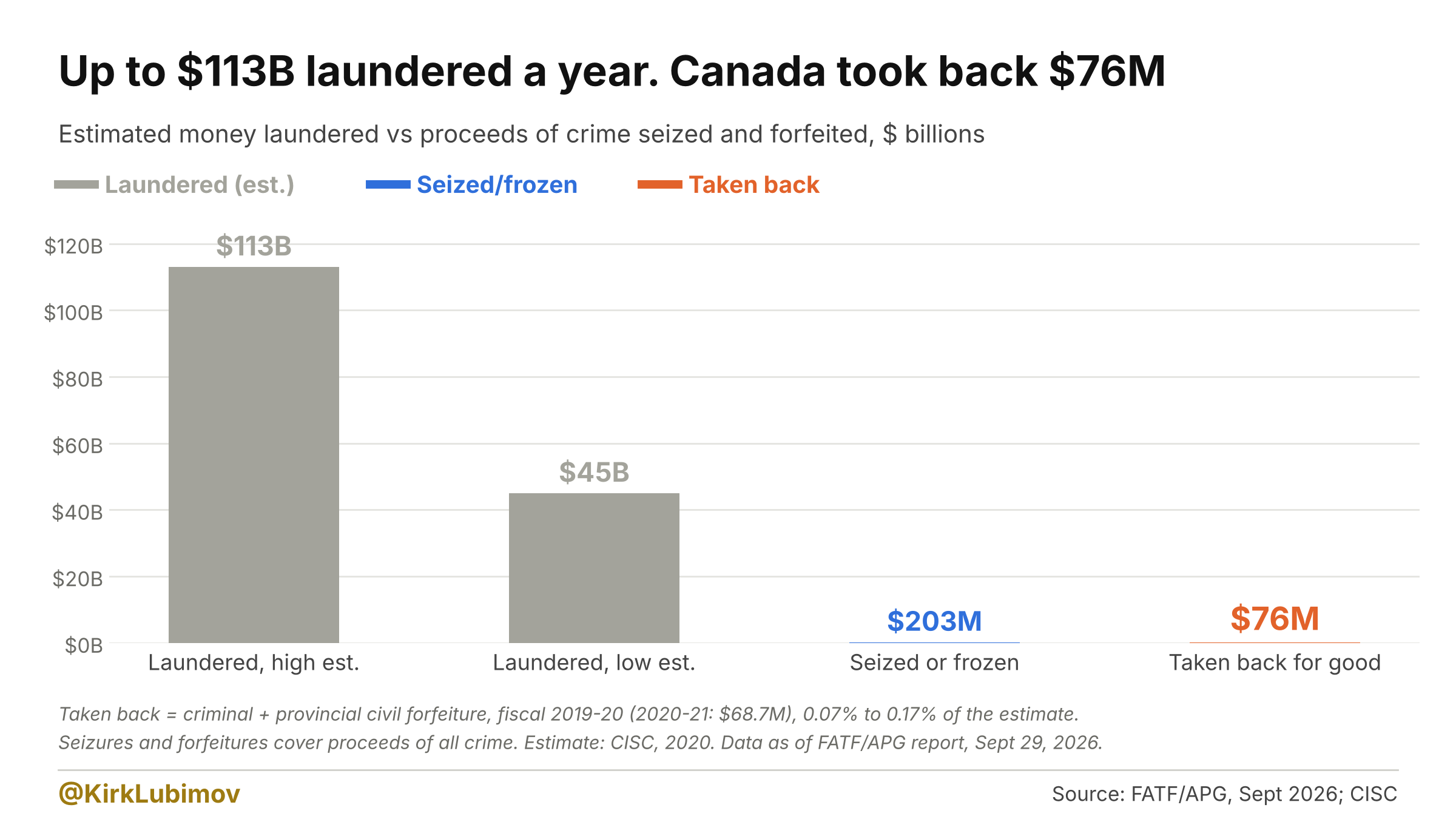
Basically a rounding error.
The agency that’s supposed to help stop money laundering is FINTRAC. It has two jobs: make sure banks, casinos, crypto dealers and mortgage lenders follow anti-money laundering law, and turn their reports into intelligence police can use.
The Auditor General tabled a scathing report. I read all of it. By the end, the amount of dirty money moving through Canada stops being surprising.
Police wait for months for answers
Three out of four FINTRAC disclosures start with police asking FINTRAC to search its database. From January 2023 to June 2025, it took FINTRAC an average of 112 days to send intelligence back.
Why? Working out that “John Smith” at one bank and “J. Smith” at a currency exchange are the same person, then mapping who sent money to whom, was still done largely BY HAND.
Analysts’ work wasn’t saved in a central system either. So one analyst could end up redoing a network another had already mapped. This is just the first glimpse into massive incompetence.
Three levels of sign-off before the intelligence could go out the door. This alone takes 37 days.
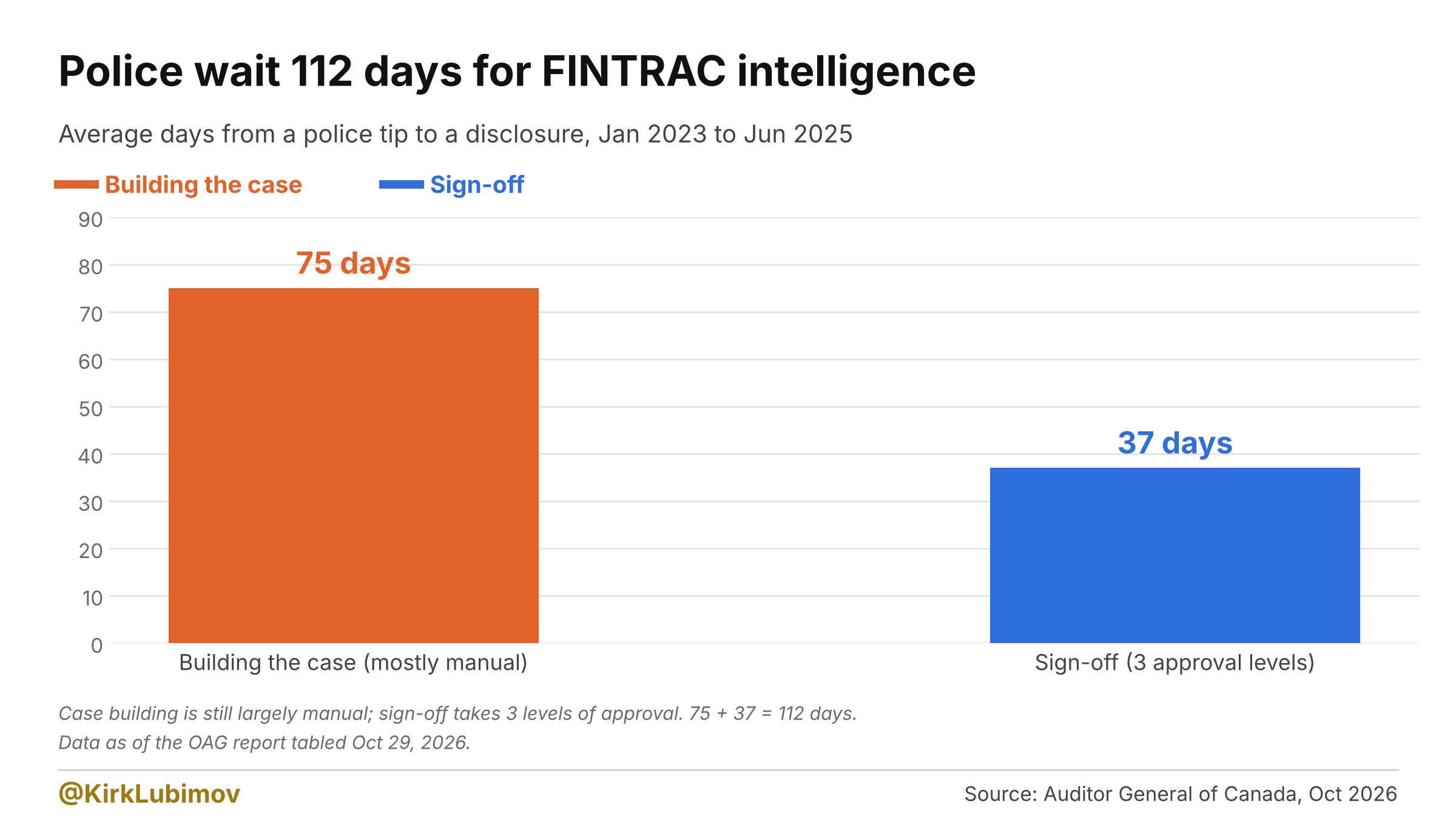
FINTRAC had no service standard for any of this. It didn’t actively track how long it took. Half of the police and agency respondents to the AG’s survey said the intelligence arrived too late to be useful.
This part of the audit is even more alarming.
FINTRAC sees what no police force can. Every suspicious transaction report filed in Canada, plus tens of millions of reports on large cash deposits and transfers. In 2024-25 it received more than 65 million reports, up 80% in two years.
That’s what makes its “proactive” intelligence so valuable. These are cases FINTRAC uncovers itself, about networks police don’t know exist yet.
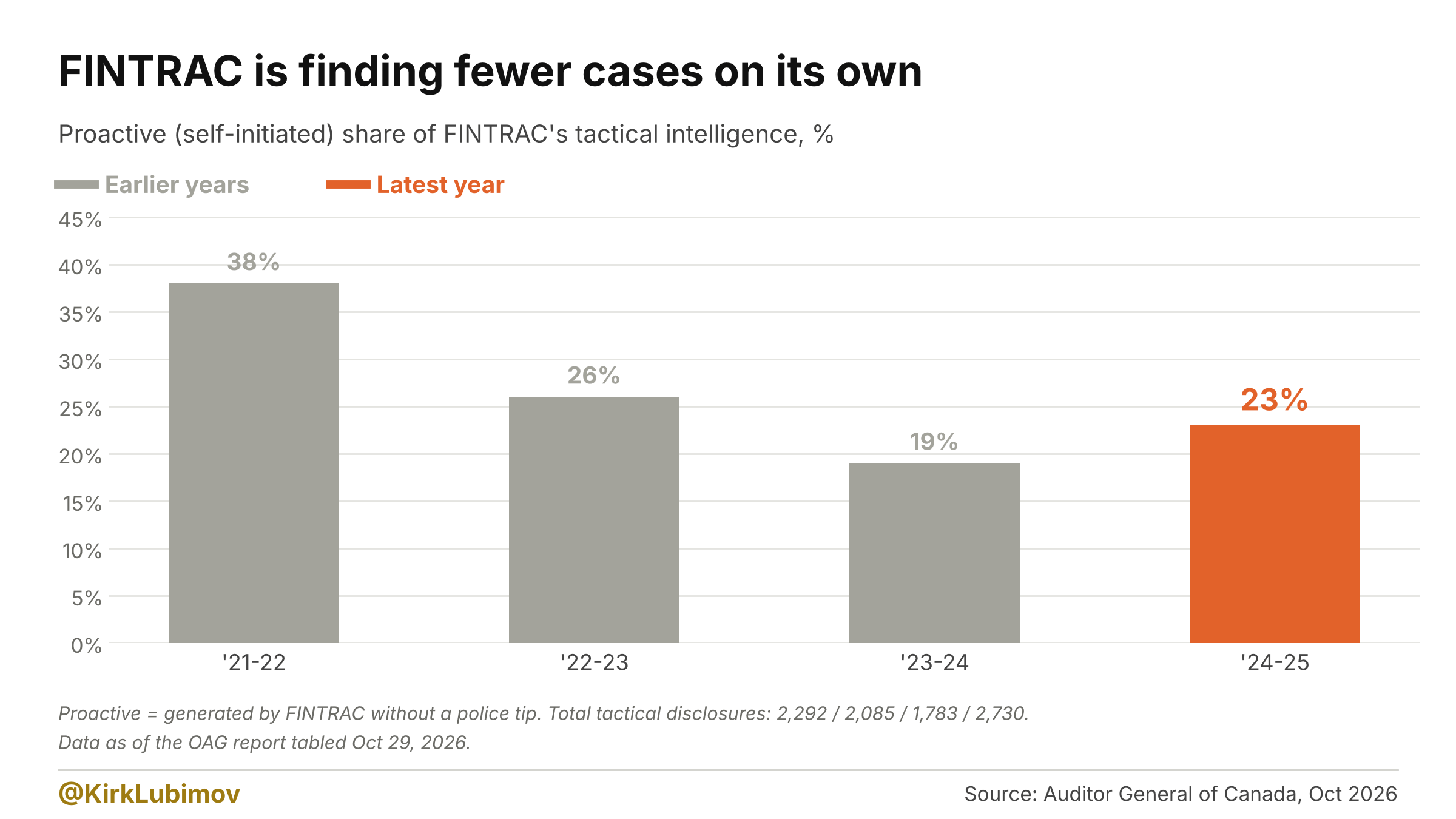
Share of FINTRAC’s tactical intelligence it generated on its own initiative:
2021-22: 38%
2022-23: 26%
2023-24: 19%
2024-25: 23%
More data than ever, and a smaller share of self-started cases than four years ago.
When it did go out, only 35% of survey respondents said proactive intelligence always or mostly led to new investigations. Mostly it confirmed what police already suspected.
The AG calls this “a significant concern.”
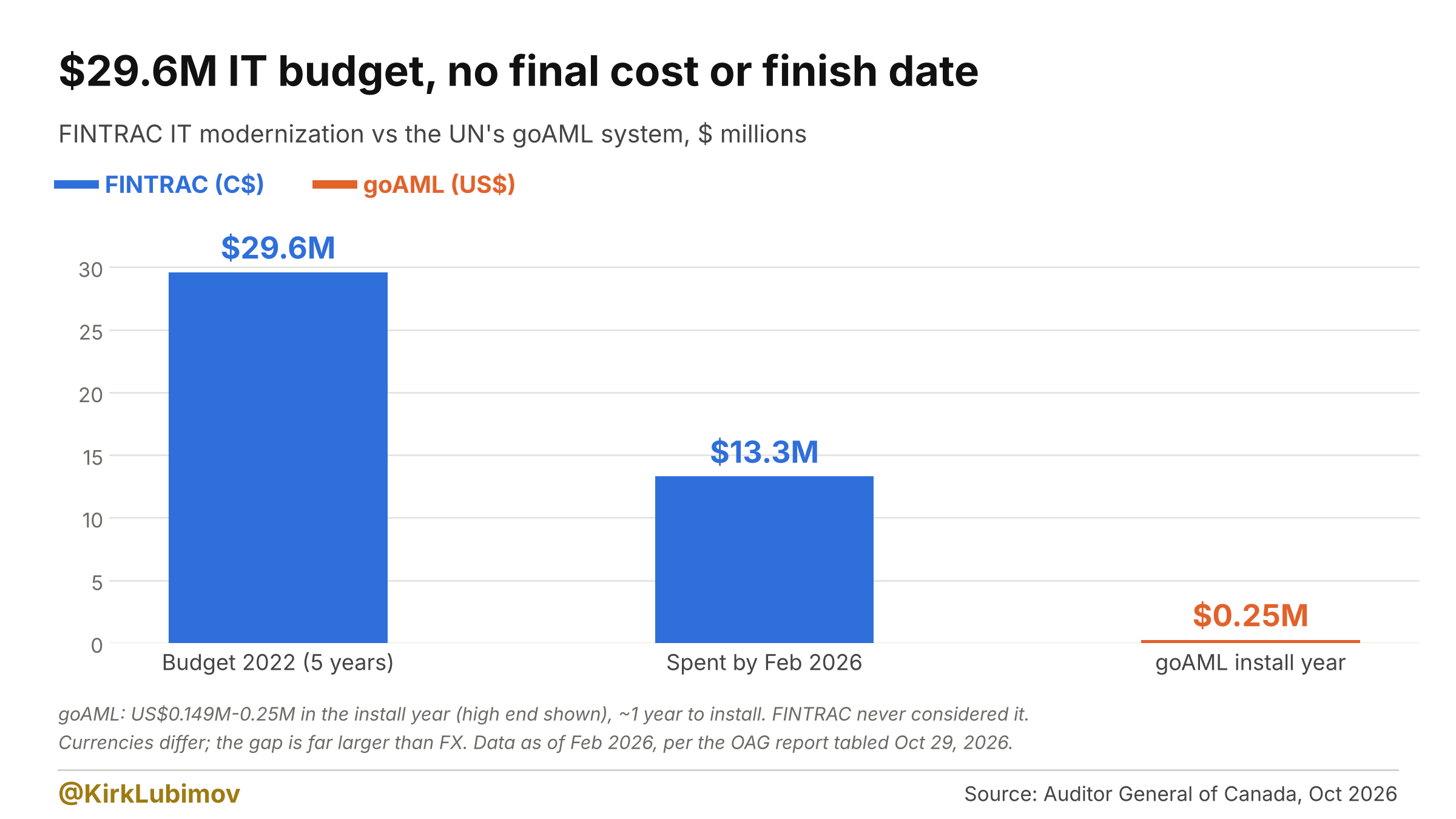
Budget 2022 gave FINTRAC $29.6 million over five years, then $2.6 million a year, to buy new analytics software. The kind that would do that “John Smith” matching automatically.
By February 2026, it had spent $13.3 million. It already expects to go over budget. Licensing and vendor costs were still unknown. FINTRAC could not tell auditors what the project will cost in the end, or when it will be finished.
Meanwhile, the United Nations built software for exactly this job. It’s called goAML, and over 70 countries use it, including Germany, Switzerland, Luxembourg and Five Eyes partner New Zealand.
UN officials told the AG what it costs:
US$149,000 to US$250,000 in the year it’s installed
US$100,000 to US$250,000 a year after that
About one year to install
The standard version already includes many of the features FINTRAC is trying to buy.
FINTRAC never considered it. It never even asked about it.
Its response: no one bid goAML in its procurement three years ago. It will now assess goAML by the end of 2026, and says the first piece of its own system goes live in winter 2026-27.
A registry that’s been broken since March 2024
Money services businesses are remittance shops, currency exchanges, crypto dealers and cheque cashers. They must register with FINTRAC and renew every two years to operate legally. Banks check that registry before giving them an account.
The report names these businesses as a common channel for laundering. Here’s what happened to their oversight:
March 2024: a cyber-incident forces FINTRAC to take its corporate systems offline. There is no backup system for registration.
May 17, 2024: 10 weeks later, FINTRAC starts offering workarounds. Mostly manual.
April 2025: businesses with expired registrations are allowed to keep operating, as long as they’ve applied to renew.
August 2025: 17 months after the incident, FINTRAC sets up a team to clear the backlog.
Now: about 2,500 requests are still waiting. FINTRAC clears about 150 a week.
2027-28: the new permanent registration system is expected.
Read April 2025 again. Businesses in a high-risk sector kept operating on expired registrations, and FINTRAC had no way to tell which ones no longer met the rules. The AG says the risk couldn’t even be measured until the renewals were processed. Can’t make this stuff up.
Supervision on the honour system
FINTRAC supervises about 36,000 businesses, and Ottawa keeps adding sectors. Crypto dealers in 2020. Crowdfunding and payment providers in 2022. Mortgage lenders and armoured cars in 2024. Private ATMs, title insurers, cheque cashers, financing and leasing firms and factoring companies in 2025.
To keep up, FINTRAC leaned on “light-touch” checks: self-attestations and risk questionnaires. In plain English, the business fills out a form saying it’s compliant. The AG says these rely largely on businesses providing accurate and honest information, and FINTRAC had limited ability to check.
FINTRAC reported 1,300 supervisory assessments in 2024-25, up 40%. That count treats a self-filled questionnaire the same as an in-depth examination.
Trust me bro continues into the next.
Grading its own homework
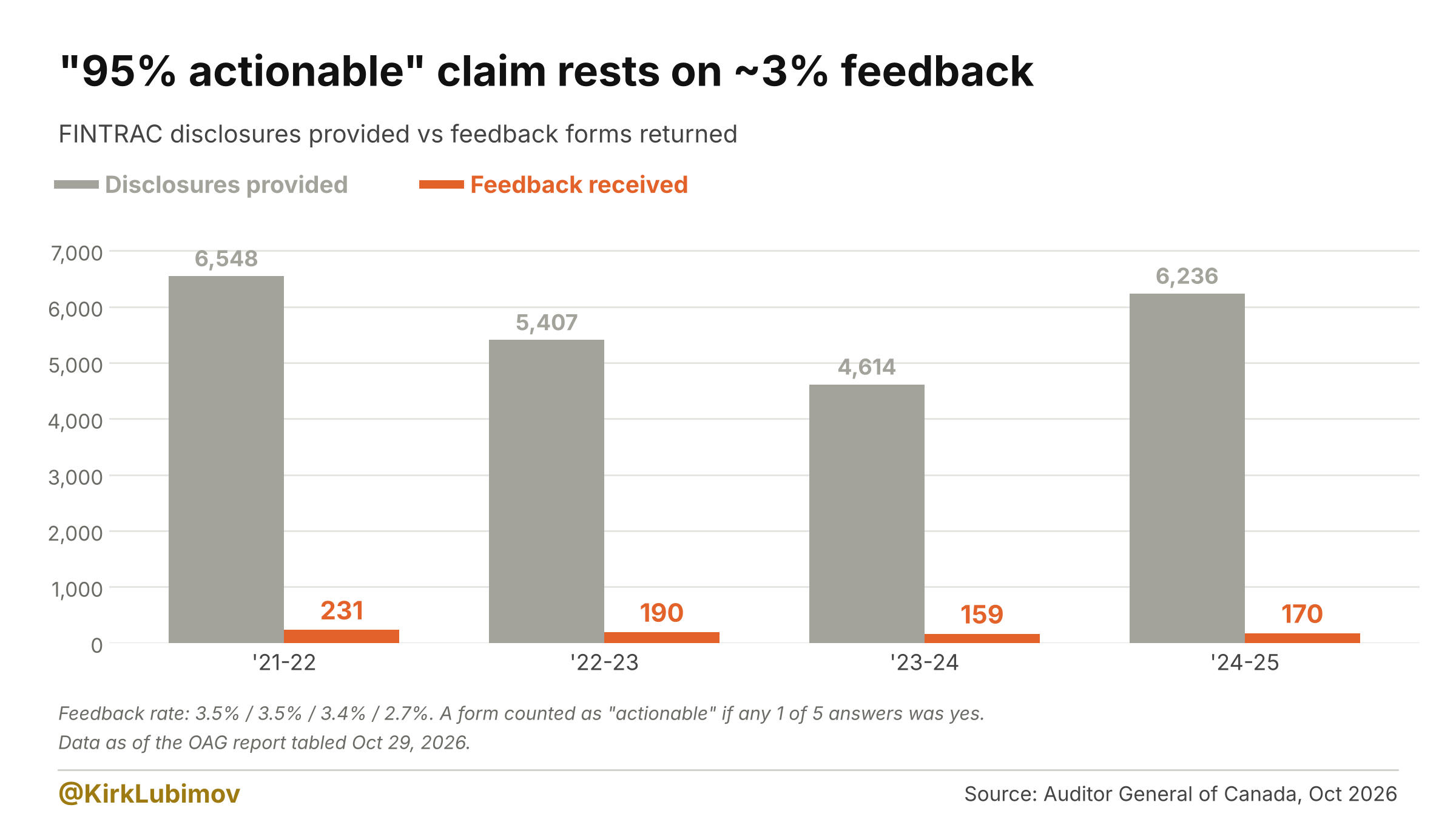
FINTRAC tells Parliament that more than 95% of its intelligence is “actionable.”
Here’s where that number comes from. Recipients can fill out a voluntary feedback form. About 3% do. In 2024-25, FINTRAC logged 6,236 disclosures provided and got 170 forms back.
A form counted as “actionable” if the recipient said yes to any one of five questions. FINTRAC ignored the written comments and didn’t consider timeliness. More like a doodle in a suggestion box.
The AG pulled a sample of forms. FINTRAC had rated 93% of them positive. Once the comments were read, the AG put it at 76%. Some recipients said the intelligence was hard to follow, too thin to support an investigation, or arrived after they already had the information. FINTRAC graded its own homework and still padded the score.
FINTRAC’s public reports mostly count activity: 2,730 disclosures, 1,300 assessments. They don’t say whether any of it led to an investigation, a seizure or a charge. From what FINTRAC publishes, Parliament can’t tell if it’s working.
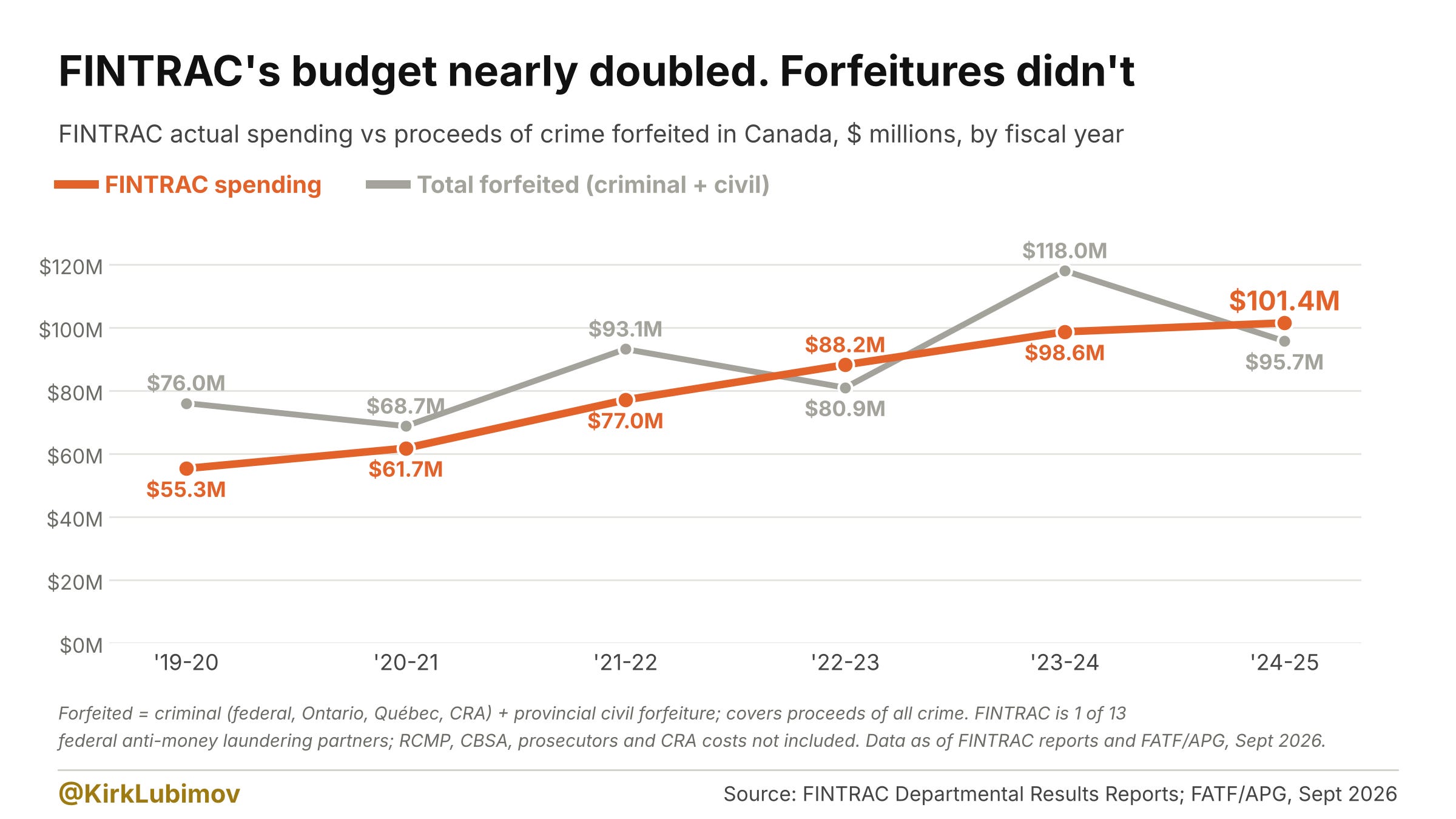
Here is the kicker: The watchdog costs more than Canada recovers.
FINTRAC alone spent $101.4 million in 2024-25. That year, every criminal and civil forfeiture in the country combined came to $95.7 million. FINTRAC’s budget has nearly doubled since 2019-20, from $55.3 million, while forfeitures have bounced around without a trend. Criminal forfeiture came in below FINTRAC’s budget every single year. Recovering assets is a job for police and prosecutors, not FINTRAC, and FINTRAC is only one of 13 federal agencies in the anti-money laundering regime. So the real cost of the system is far higher than this.
So up to $113 billion is laundered through Canada every year, by an estimate nobody has bothered to update in six years, and the watchdog meant to stop it costs more than Canada recovers.
Criminals don’t need to beat this system, they are using it. If you’re laundering money, Canada isn’t a risk. It’s a business plan. Until someone in Ottawa is held accountable for these numbers, Canada stays exactly what the launderers already know it is: open for business.