

Small businesses are the backbone of the economy, particularly in Canada. The data says something less flattering: Canada is a country where firms are born small, stay small, and the ones that don’t grow are the ones doing most of the work. This is a huge issue, and it has been mostly neglected from any meaningful conversations, especially in policy.
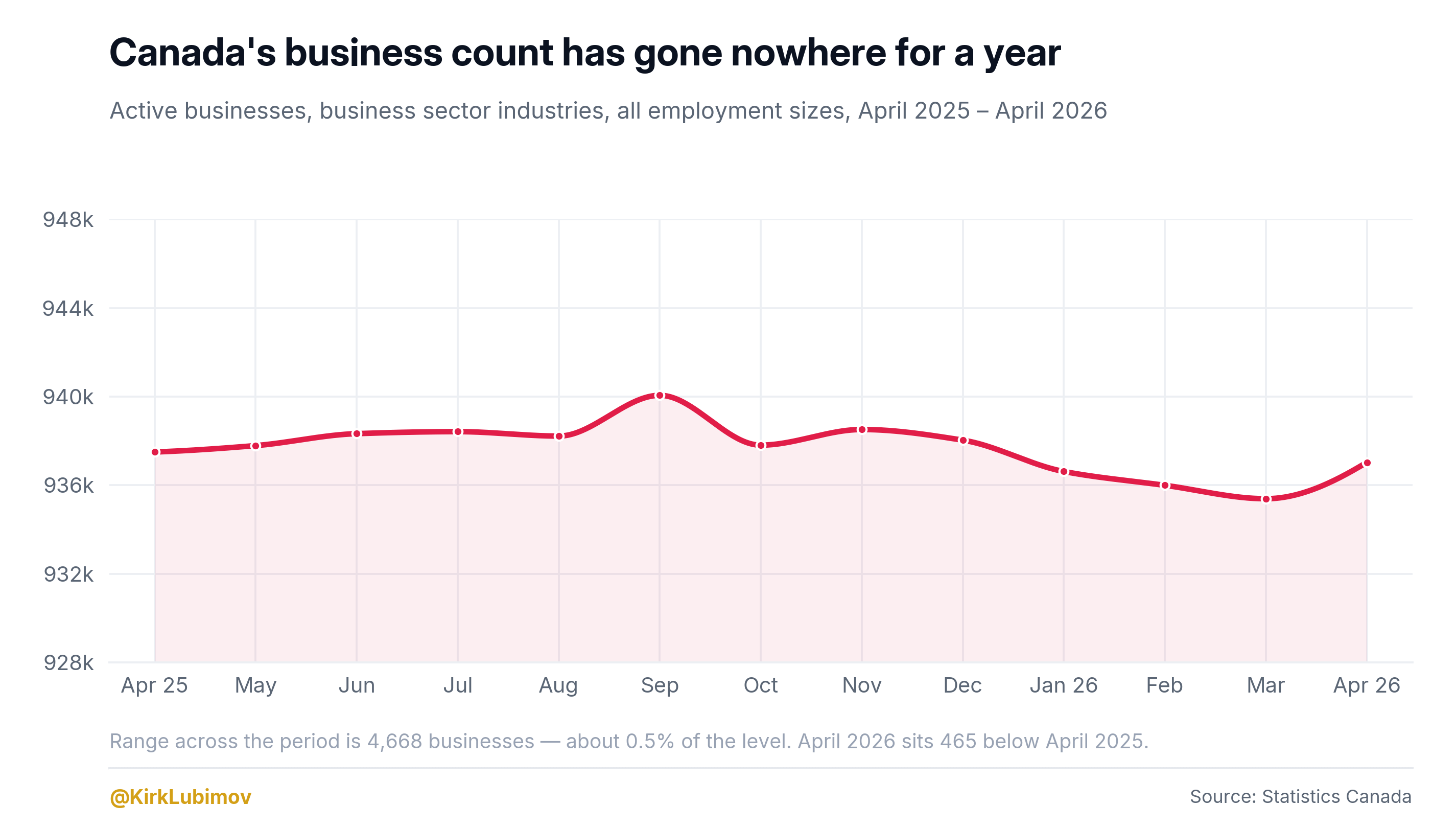
We first have to look at business growth, and that has been an overall challenge. Over the past year, according to the most recent data, Canada hasn’t grown the total number of active businesses. We actually lost 465.
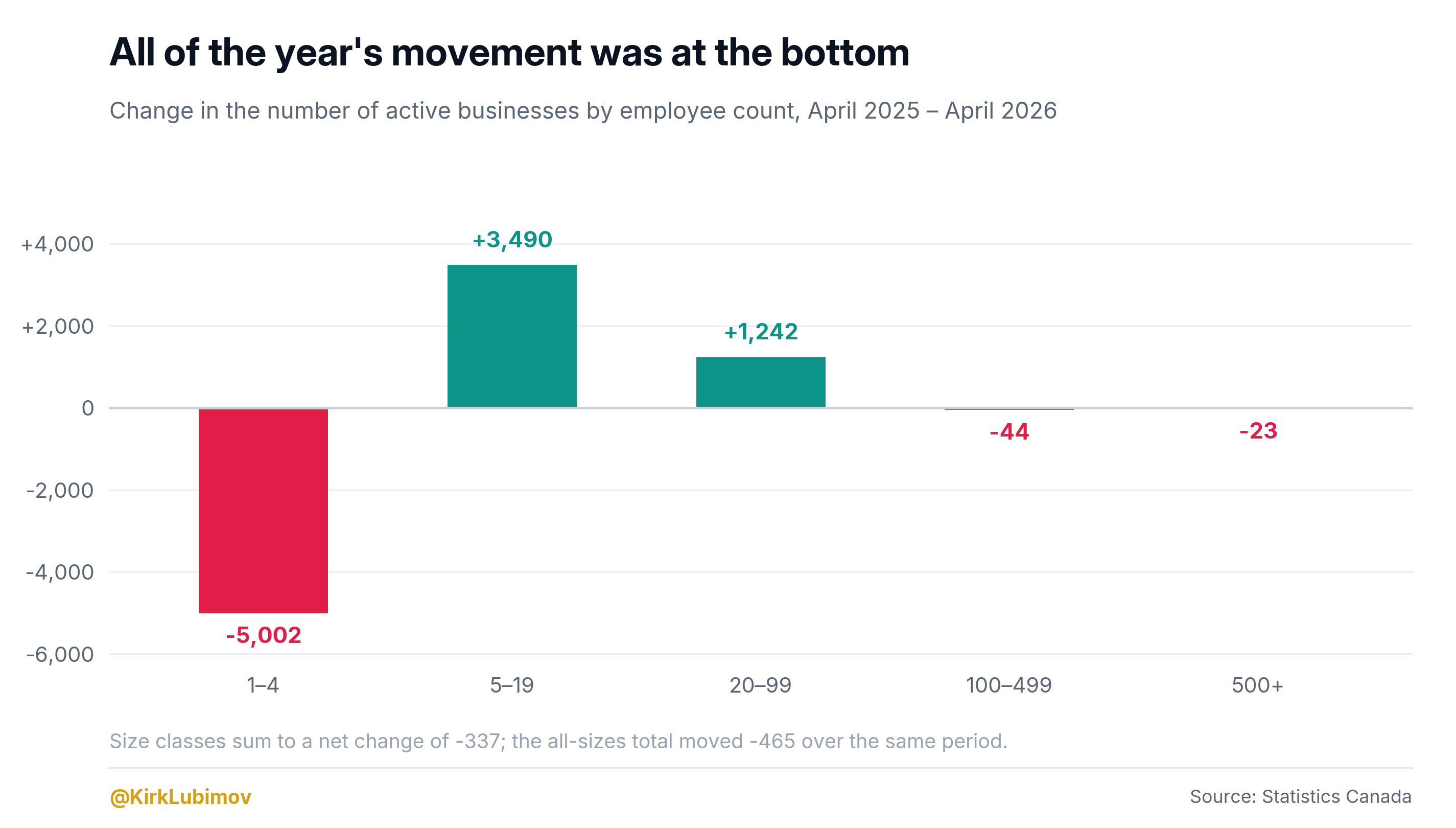
When we look closely into the numbers and dissect them by business size, we are starting to see what is happening in Canada. There is some healthy movement in the smaller business size of under 100 employees. It isn’t clear how many of the micro businesses grew but we see growth in the lower band range. Beyond that, however, there is a loss of medium-sized businesses and large corporations.
Canada’s business pyramid is what completes the story, and it is dramatic. 0.25% of Canada’s businesses are large corporations. 1.4% of Canada’s businesses are medium businesses and they do heavy lifting in our economy; we need more. What is important to notice is that 89.2% of businesses have fewer than 20 employees. We have a missing middle. We are missing scale.
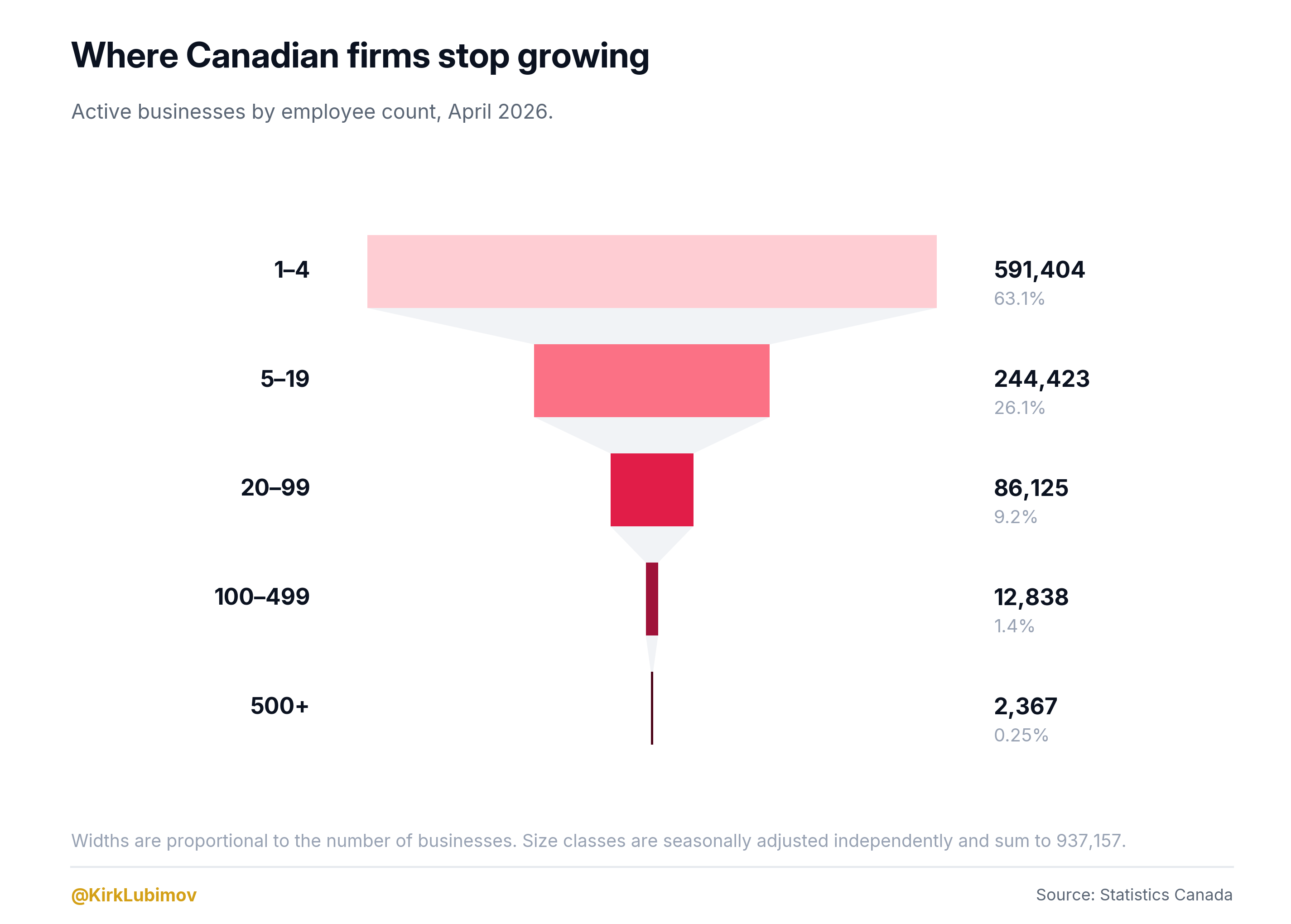
Canada has no shortage of entrepreneurs, small businesses, or talented workers. The problem is that too few Canadian companies successfully make the transition from small enterprises into globally competitive firms. We lack the middle layer of ambitious, scaled companies that drive productivity, exports, innovation, and national economic power.
Our most successful entrepreneurs are in the US and open companies in the US. More and more of our talent prefers to open businesses in the US. This should alarm policymakers. Canadian entrepreneurs abroad have created more jobs and created more value to the economy than our government can and have with debt-fueled spending.
There is no replacing organic growth. We keep hearing “we need to focus on what we can control” and “what we control is buy Canadian.” How is entrepreneurship and scaling companies not part of this focus?
Everything trickles down from here. Building exports is hard because we don’t have enough companies with size that can do that, as I pointed out in a previous article; Pivoting exports from the US, not so fast. A 15-person company may have an excellent product but may not be able to easily enter 10 foreign markets. A 1,000-person company can.
Furthermore, small companies have technology adaptation risk, which inhibits competitiveness, global scale and hinders survivability. They are more sensitive to price and inflation volatility. For the most part, the longer they stay small, the higher the risk. We need an ecosystem that encourages flourishing and growth.
Canada is overly dependent on retaining foreign companies to create jobs in Canada, particularly in manufacturing. Canada’s auto industry, which has no Canadian brand, is dependent on government cash injections to stay and grow auto sector innovation.
In other words, instead of developing our own companies to lead, we pay billions to foreign companies to operate and expand in Canada. That is the furthest from “buy Canadian” we can get. It is also a substantial risk, as we have seen some companies leave recently because of domestic policies in their home countries.
The part nobody mentions: our big firms aren’t good either. Let’s face it. Many of the big companies that we do have, like banks and telecoms, aren’t particularly good at much. They don’t innovate and just enjoy monopolistic protectionism that Canada’s landscape has. It allows them to charge Canadians more by nature.
So the picture is worse than “we don’t build big companies.” It’s that we don’t build many big companies, and the ones we do build are drifting away from the global frontier faster than our small ones are scaling up to it. Nearly every Canadian firm that reached global scale did it behind a moat: regulatory, geographic, or geological.
A scale-up agenda that graduates more firms into a stagnant large-firm tier just relocates the problem. This is the reality of the productivity gap, which even the Bank of Canada is now raising the alarm on, stems from not needing to compete. The protectionism we offer legacy players hurts entrance into the sector and growth in it. Stagnation by policy.
A healthy advanced economy requires a strong middle layer: companies with hundreds of employees, international customers, professional management systems, research and development capacity, export expertise and access to significant investment capital which reinvests into innovation.
Connectivity and AI is giving us a glimpse into what else is possible, with companies like Shopify starting to dominate at scale and creating much-needed conversation in Canada. It is exciting.
Building our capital markets and making changes to rules and taxes to encourage private investment and increase allowance for managed capital participation is paramount. It is the only way to mature self-sufficient growth opportunities quickly.
Large companies create ecosystems of smaller companies around them. Scaling companies is the ultimate economic cycle. Industrial development can not be done with red tape and dependent on government support. It can and should be done by passionate people building the future. Let’s stop window shopping and start getting behind our talent, before they leave.