

Budget 2026 is ambitiously named Masters of Our Destiny, which gives hope of a whole transformation, thinking of our kids, and responsible planning. It does so on some fronts and misses the opportunity completely on others. Let’s take a look.
It is Prime Minister Mark Carney’s second budget, and the first since the government’s Spring Economic Update in April. It comes at a pivotal time of tariffs, economic transformation, and I will give Carney credit for trying to shake off previous Liberal policies.
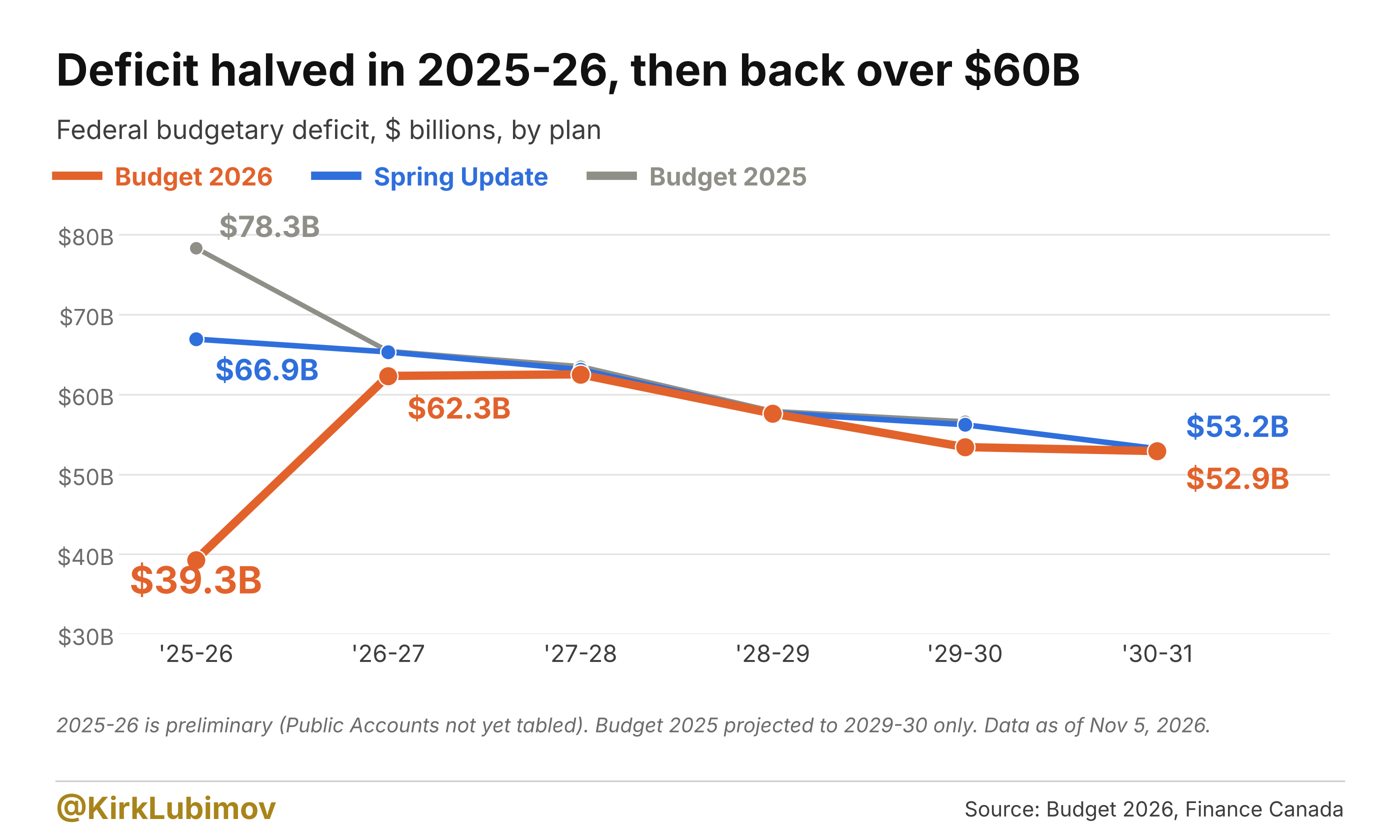
The books look better than they did a year ago, mostly because of last year. The 2025-26 deficit came in at $39.3 billion on preliminary numbers, half the $78.3 billion Budget 2025 had planned.
Looking forward, the improvement is small. The deficit is $62.3 billion this year, falling to $52.9 billion by 2030-31, barely below the spring plan.
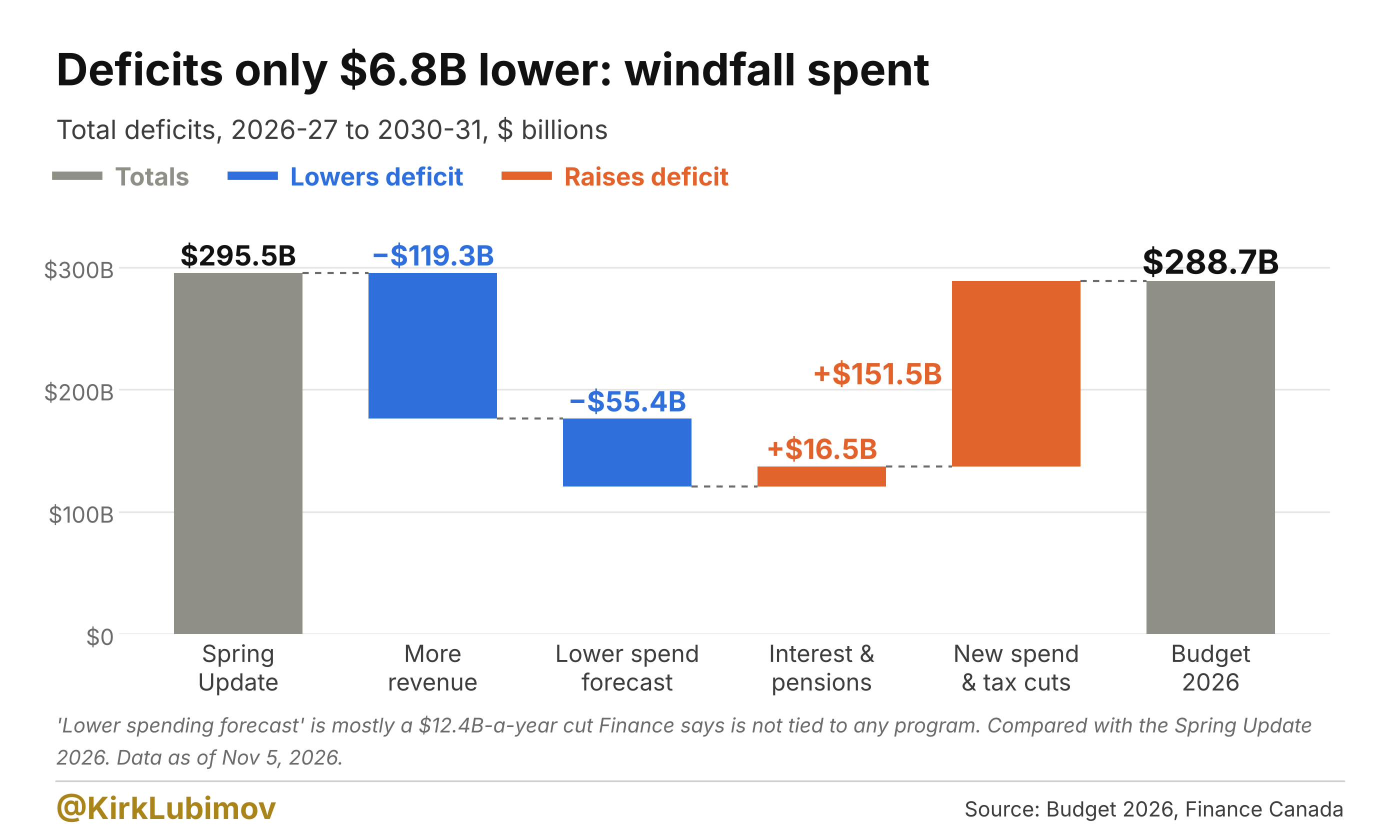
Since the spring, Ottawa’s outlook has improved by $158 billion over the five years from 2026-27 to 2030-31. Budget 2026 then committed $151.5 billion in new measures and policy actions. Total deficits over those five years fall by just $6.8 billion.
The improvement came from three places:
More revenue: $119.3 billion. Oil prices from the Middle East conflict, a strong second quarter and a bigger 2025-26 tax base lifted income taxes by $78 billion over five years. Nominal GDP is about $48 billion a year higher than in the spring, with GDP inflation of 4.6% in 2026.
A lower spending forecast: $55.4 billion. Most of this is a $12.4-billion-a-year reduction in expected direct program spending, because departments spent far less than planned in 2025-26. Finance says it isn’t tied to any program or decision.
Partly offset by $16.5 billion in higher interest and pension costs.
The headline “$34 billion lower deficits over six years” is real, but $27.6 billion of it is in 2025-26, a year that’s already over.
Compared with Budget 2025, Budget 2026 expects $85.7 billion more revenue over 2026-27 to 2029-30 and plans $72.3 billion more program spending. Deficits are only $7.6 billion lower in total.
Deficits: 2026-27 is $62.3 billion, against $65.3 billion in the spring and $65.4 billion a year ago. The later years are nearly the same in all three plans.
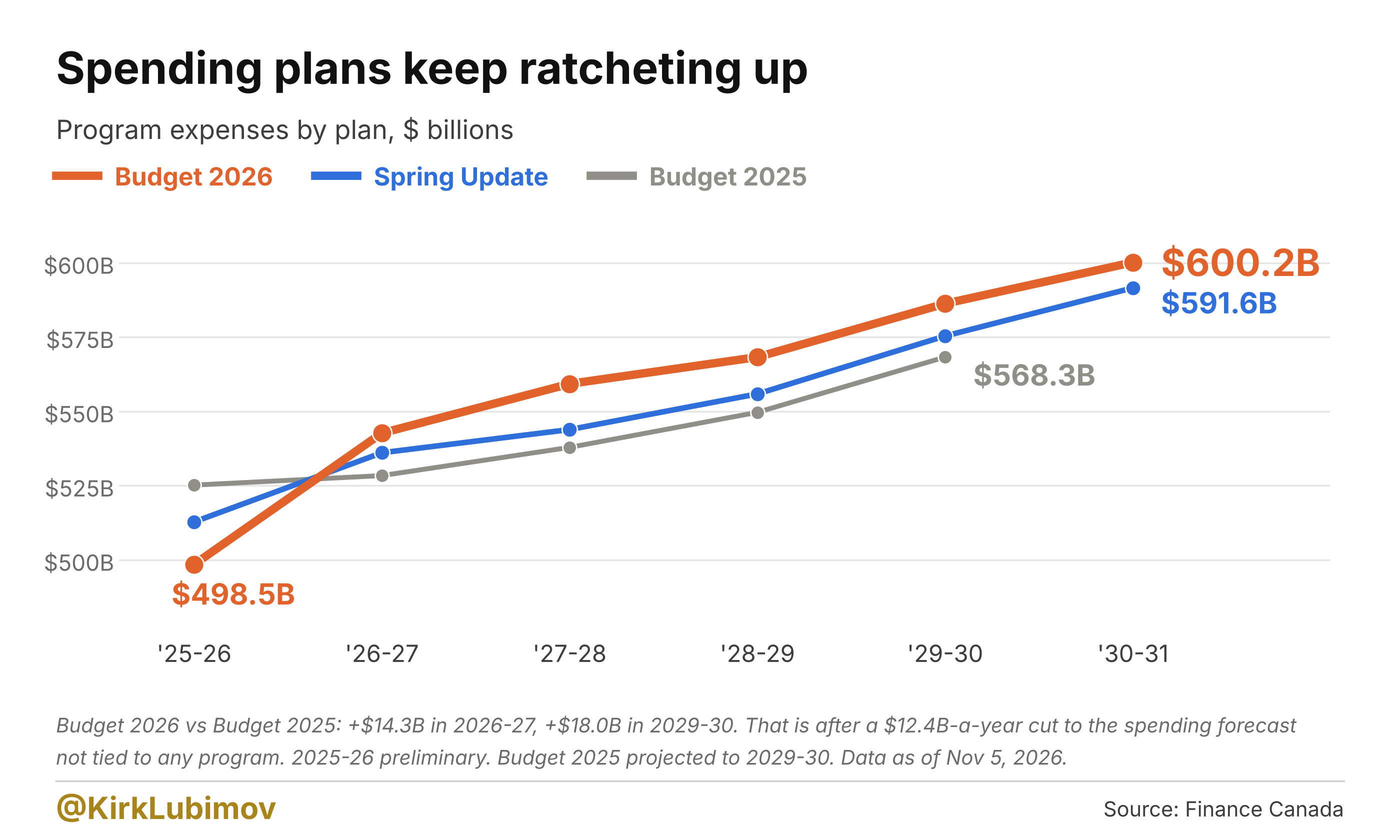
Spending: program spending is $14 billion to $21 billion a year above Budget 2025’s plan, even after the $12.4-billion-a-year forecast cut.
Revenue: up in every year, by $17 billion to $24 billion against Budget 2025.
Debt-to-GDP: about three points lower than Budget 2025 (39.9% vs 43.1% in 2026-27), but flat near 40% rather than falling. A bigger economy in dollar terms does part of the work.
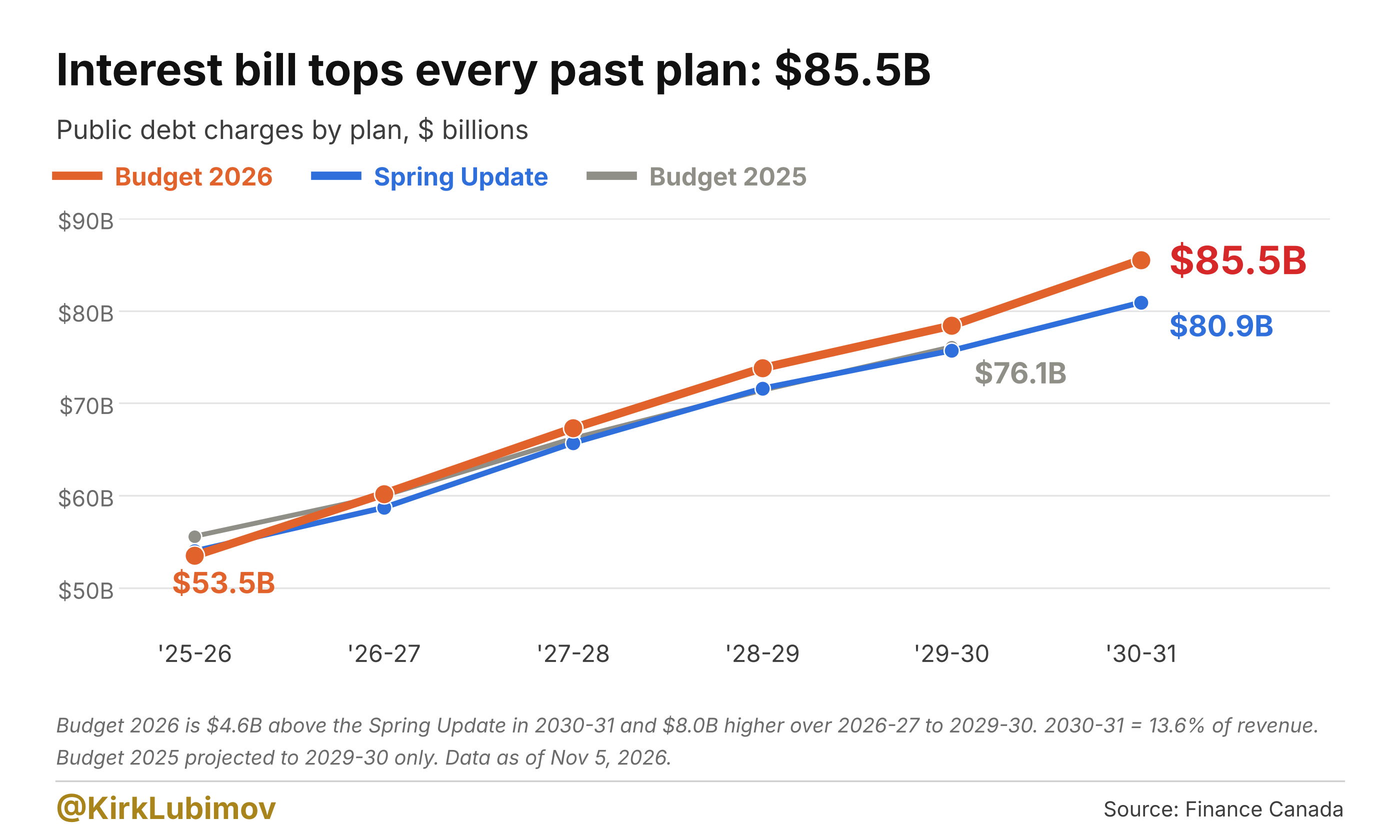
Debt charges: higher than both earlier plans in every year from 2026-27, reaching $85.5 billion in 2030-31, $4.6 billion above the spring forecast.
Growth: the 2026 real growth forecast has been cut from 2.1% (Fall Economic Statement 2024) to 1.2% (Budget 2025) to 1.0% (spring and now). Nominal growth went the other way, from 3.0% to 4.1% to 5.6%. The fiscal gains come from prices, not volume.
Public debt charges are a real big issue. It is the fastest-growing major expense, up 60% in 5 years beyond previous forecasts, and now at $85.5B by 2030-31. That is over $234M a day that taxpayers pay bondholders and get nothing in return. We are financing current benefits at the expense of our kids, and there is no plan to pay it off.
There are a few things that need further explanation and context.
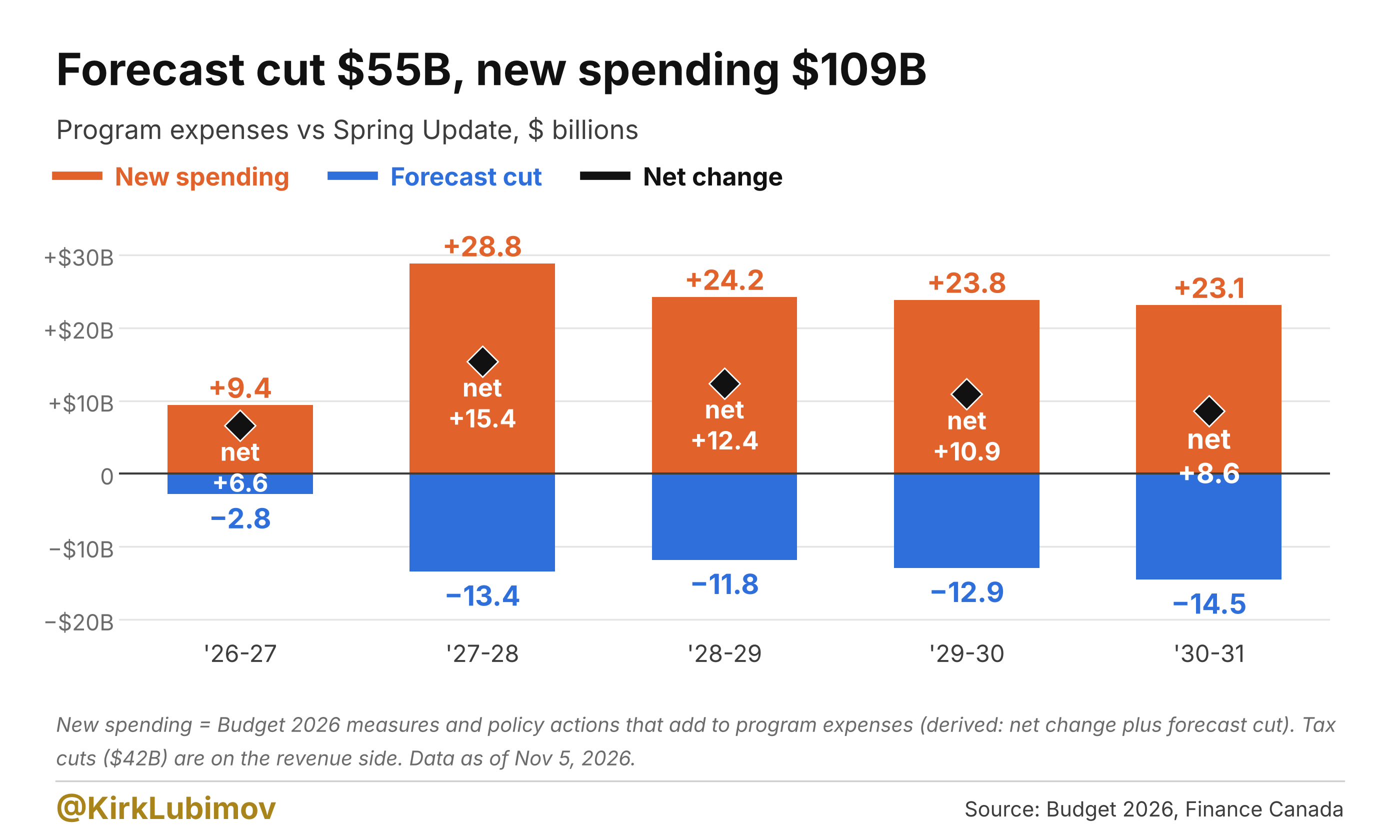
A spending “cut” that isn’t a cut. Liberals lowered their forecast of existing direct spending by about 4.5%, or $12.4 billion a year. It calls this an “aggregate forecasting adjustment” that is not tied to any department, program or decision, and doesn’t change approved funding. It bets that departments will keep underspending, as they did in 2025-26. Meanwhile, new spending adds $109 billion to program expenses, so program spending still ends $54 billion above the spring plan. If the underspending doesn’t repeat, the $55 billion comes back.
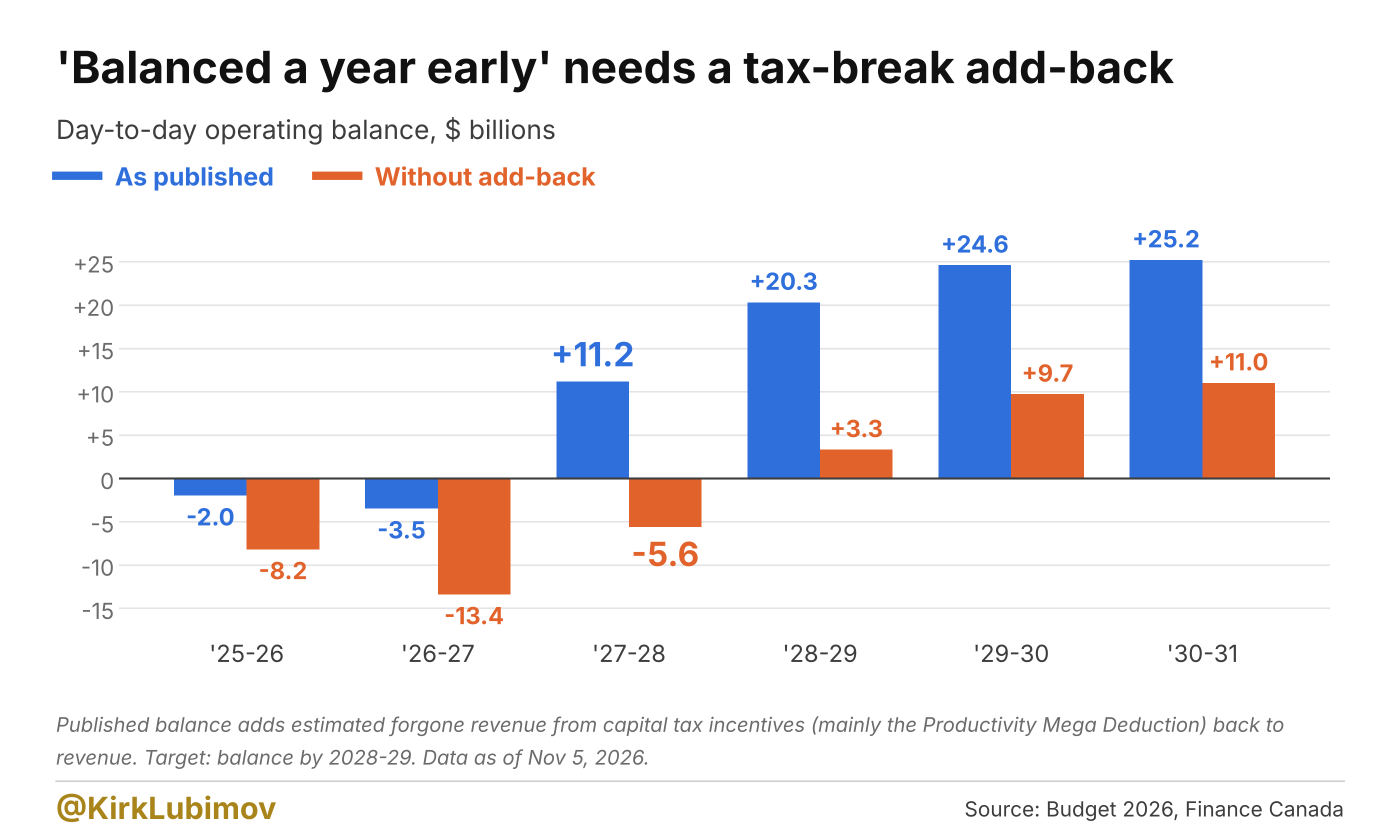
“Balanced a year early” needs an add-back. The government says day-to-day operating spending is balanced in 2027-28, a year ahead of its target. That counts $16.8 billion of estimated forgone revenue from capital tax breaks, mainly the Mega Deduction, back as revenue. Using only revenue the government expects to collect, 2027-28 shows a $5.6 billion operating deficit, and the balance arrives in 2028-29 (+$3.3 billion). That still meets the original target, just not a year early. Separately, the deficit-to-GDP ratio jumps from 1.2% to 1.8% before it starts falling.
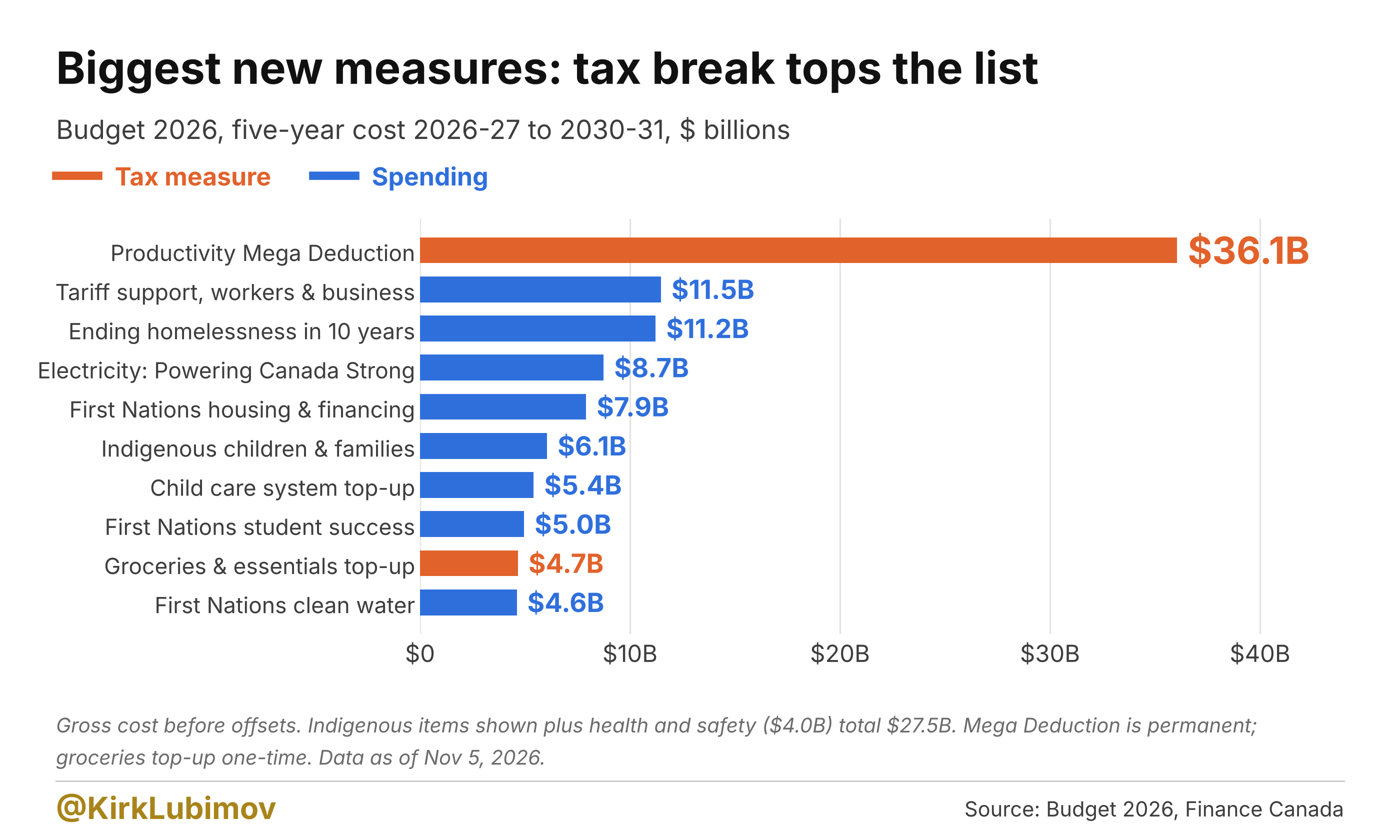
The budget’s centrepiece is a big, permanent tax break for business investment, the Productivity Mega Deduction. It lets businesses deduct the full cost of new equipment and other capital assets in the year they start using them. I completely support this and it will be incredible to attract CapEx investment into Canada.
It cuts the marginal effective tax rate on new investment from 13% to 6.4%, the lowest in the G7 and less than half the U.S. rate. Weak business investment is at the root of Canada’s productivity problem, and this goes straight at it.
Another great initiative is the Canada Growth Incentive, which exempts up to $15 million in capital gains per person on qualifying shares of Canadian startups, with an enhanced rollover for reinvesting gains in small businesses. It will make Canada one of the most competitive jurisdictions in NA on this front. Compared to other States.
The Indigenous portfolio gets an additional $27.5B plus $2.7B for emergency preparedness, with Mark Carney posting $50B on X. $27B of it falls after 2030-31, beyond the budget’s five-year plan. It’s never clear where all this money goes but always claims to be for clean water and housing, and yet we barely see any progress.
Budget 2026 has an ambitious plan to end homelessness. Ottawa’s 2019 Reaching Home strategy aimed to cut chronic homelessness by 50% by 2027-28 was a complete failure. The new plan allocates $11.2 billion over four years, plus $17.8 billion in later years, and aims to end homelessness within a decade. It includes a $1.8 billion Integrated Supports Fund that links housing with health and addiction care, and $3.6 billion for supportive and transitional housing through Build Canada Homes. The plan starts in Winnipeg with 2,000 transitional and supportive homes and a new Centre for Mental Health and Addictions.
This is really less of an actual plan to end homelessness and more of a funding mechanism for social services and nonprofits. The best way to reduce homelessness is to reduce costs for Canadians, increase job prospects, housing affordability and return people to the labour market. And yet we see very little focus on the fundamentals. Prevention is part of the solution to begin with.
After failing their own housing targets, Liberals give Build Canada Homes another $13 billion over ten years, bringing its total capital to $45 billion, with a goal of tripling non-market housing starts to 24,000 a year. Another $1.55 billion turns federal land and buildings into homes.
A number of lines regarding helping with the cost of living:
A one-time 50% top-up to the Canada Groceries and Essentials Benefit in early 2027. A family of four gets up to $2,570 within a year, counting the regular benefit.
The Canada Caregiver Credit becomes refundable, worth up to $1,260 even for caregivers who owe no tax.
The Canada Workers Benefit becomes the Build Canada Workers Benefit, worth up to $1,859 for singles and $3,143 for families from 2027.
Federal fuel excise relief is extended to the end of January 2027, worth $5.3 billion this fiscal year in total.
$5.4 billion over two years to keep the national child care system on track.
$2 billion to retrofit a million homes with heat pumps and efficiency upgrades.
It is disappointing that there isn’t more focus on cutting taxes, upskilling and connecting people with employers. Best thing we can do for affordability is create economic mobility and let Canadians keep more of what they earn.
Clean electricity and clean technology tax credits: extended to 2040, and high-voltage transmission within a province now qualifies. The extension and expansion cost $2.4 billion from 2027-28 to 2030-31 and $36.1 billion from 2031-32 to 2041-42. Most of the cost is beyond this budget’s window.
SR&ED: a $930 million expansion focused on commercialization. Mineral exploration credits: extended to 2032, with antimony added. Other business tax: interest deductibility rules eased for rental housing and public-private projects ($555 million); the journalism tax credit extended ($501 million). No tax increases: no rate hikes and no change to capital gains inclusion rates. All great housekeeping items.
Tariffs response:
Support for affected workers and businesses: $11.5 billion over five years, covering steel, aluminum, autos, copper, forestry and mining, with a $3.5 billion Rapid Response package. Support announced since the spring totals $16.6 billion, much of it as loans.
Counter-tariffs: assumed to stay in place into 2027-28. They have raised $5.2 billion net since March 2025.
Hopefully we will get a deal done with the US soon, as both sides are upbeat about the new talks, and it will be an easy win for Donald Trump to get Democrats off his back after the Midterms sweep.
There are some attempts to take on government and crown operations. I will give Mark Carney credit here, as the federal public service is down nearly 10% from its peak, to about 332,000. A little ahead of what was announced before, and a surprising announcement to keep, but that just shows you how inefficient the government was. Still is.
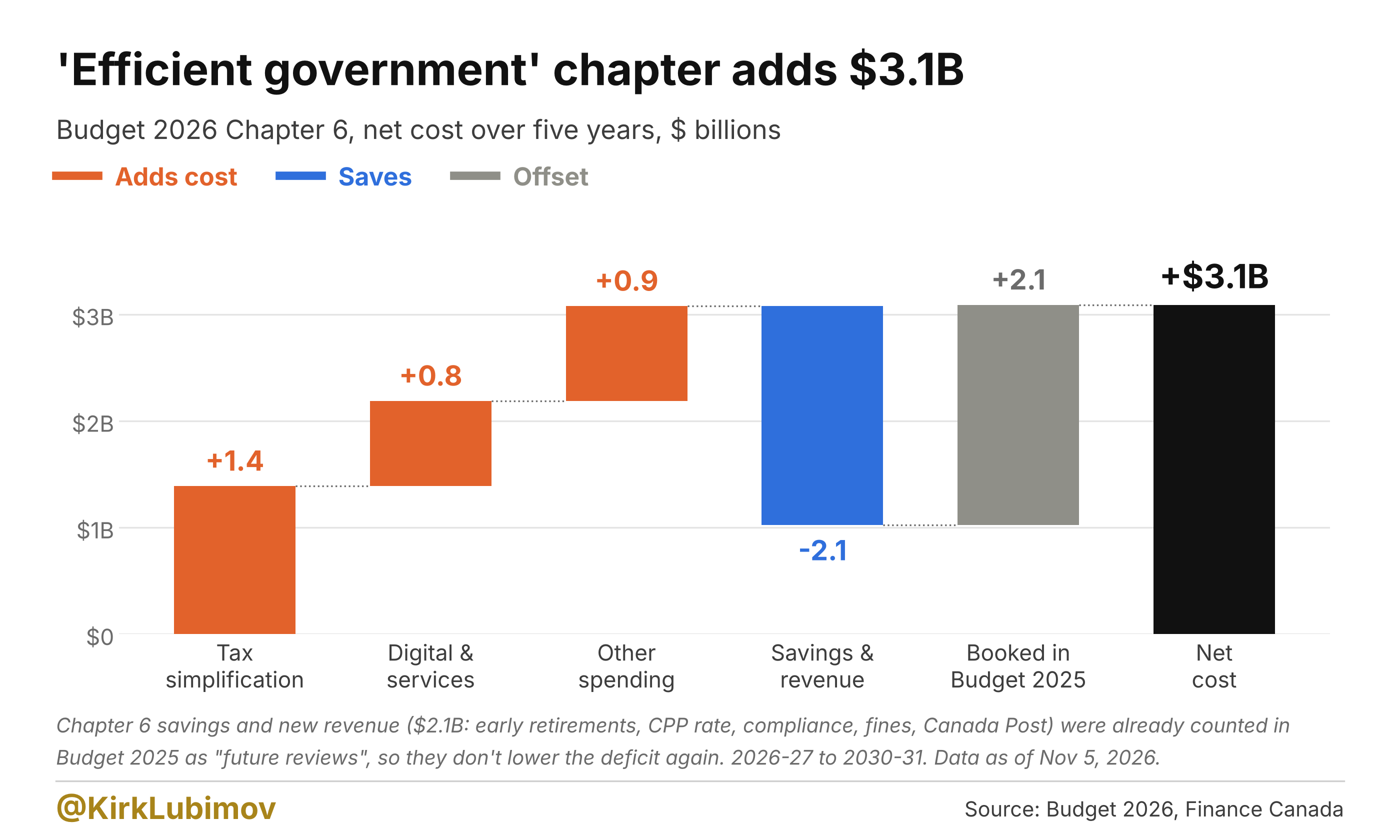
Chapter 6, “A more efficient government”, sets out the biggest changes to how Ottawa works. One number first: the chapter adds $3.1 billion in net costs over five years. Its $2.1 billion in savings were already booked in Budget 2025 as “future reviews”, so they don’t improve the bottom line again.
There is some reorganization of Crown Corporations. BDC and EDC will merge into a single development bank. The Canada Infrastructure Bank refocuses on loans and guarantees, and Canada Post gets a restructuring plan. Canada Strong Fund: Canada’s first sovereign wealth fund, seeded with $25 billion over three years and growing through reinvested returns. There is still a plan for Canada’s four largest airports, but it isn’t clear what it is beyond a move to 40- to 50-year concessions run by investors like pension funds, with the details on fees still to come.
There is a good attempt to simplify taxes for individuals with another package promised in the Spring Economic Update 2027:
RRSP-for-life: RRSP and RRIF rules would merge, so savers no longer have to convert their RRSP to a RRIF at 71. A surviving spouse or partner could take over the RRSP as successor holder. Minimum withdrawals after 71 don’t change.
Flat-rate claims, no receipts needed (mostly from 2027): $1,000 for moving for work or school, a one-time $1,000 for home accessibility renovations, $1,000 a month under the clergy residence deduction, $1,500 for tradespeople who temporarily relocate, $1,200 for adoption, $1,000 for gluten-free food for people with celiac disease, $2,000 for a service dog and $500 for incontinence products.
More time to object: most taxpayers get one year after a notice of assessment to file an objection, up from 90 days, with no need to request extensions. Individuals get until the later of that date and two years after their filing deadline.
No more instalments for many: besides the $7,500 threshold, self-employed people could make a single payment of two thirds of their tax by December 31. About 1.1 million individuals and 185,000 small corporations would stop paying instalments, from the 2028 tax year.
Northern Residents Deductions simplified and made more generous ($99 million over four years).
Family farms and fishing operations can roll over to nieces and nephews tax-free, not just children.
Volunteer firefighter and search-and-rescue credits merge into one credit.
RDSPs: a family member can permanently open an RDSP for an adult who can’t sign a contract and has no legal representative ($39 million over five years).
GST/HST: massage therapy becomes exempt, and certain cancer-treatment devices become zero-rated.
Benefits outreach: $22.3 million for the CRA to find people outside the tax system. About 150,000 more Canadians are expected to get benefits they’re owed, costing $312 million over three years from 2028-29. The CRA also plans pre-filled returns for about one million known filers from the 2027 filing season.
Tax debts reported to credit bureaus: the CRA could report unpaid tax debts above $50,000 once appeals are exhausted and after 30 days’ written notice.
The catch in the workers benefit: the Build Canada Workers Benefit lowers the earnings floor from $3,000 to $500 and adds $2.1 billion over five years. But advance payments are cut in half in 2027 and eliminated from 2028, which saves $3.1 billion. Net, Ottawa spends about $1 billion less, and workers wait until they file their taxes to get paid.
These changes will have a positive impact on people dealing with these line items.
CRA gets $116.5M to go after non-filers, trusts and improper corporate refunds, expected to bring in over $1.2 billion. Another $182.4 million targets tax evasion and money laundering. A headscratcher as Canada barely goes after money laundering to begin with.
Foreign buyer ban on existing homes extended two years, to January 1, 2029. New homes are exempted. I’m not happy about this exemption.
More competition in banking. OSFI (the bank regulator) gets a secondary mandate to consider competition. Applications for new banks get a one-year decision deadline. Foreign bank subsidiaries with under $8 billion in equity are exempted from the public-ownership requirement, to encourage mid-sized “challenger” banks. Troubled lenders get more options to sell assets to other institutions. This is a really promising update that shows Canada may open its doors to new entrants and startups in this sector.
Climate rules updated: the Clean Electricity Regulations will be updated to allow more flexibility, still aiming at net zero by 2050, and the industrial carbon pricing benchmark will be updated for “greater certainty”. A renamed industrial efficiency program (SHIFT) gets $400 million over seven years.
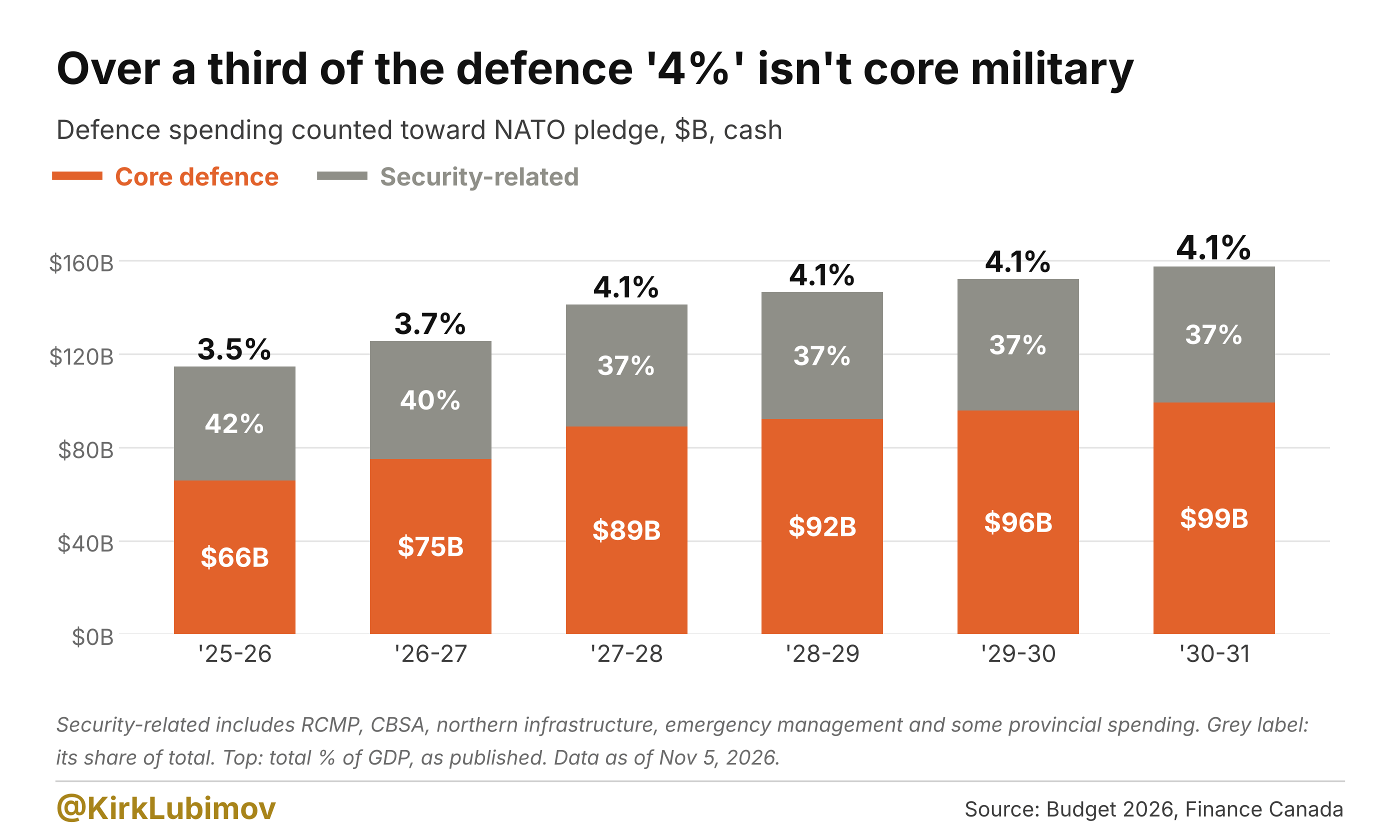
I would consider Defence as the 2nd biggest story of Budget 2026 after Productivity Mega Deduction. We have new obligations and a serious intent to modernize Canada’s Armed Forces capabilities.
Canada reached NATO’s 2% target in 2025-26, spending more than $65 billion. The budget sets out a “funded plan” to reach 4% of GDP by 2030, with more than $700 billion over five years on a cash basis ($722.7 billion by my count).
Two caveats. First, NATO’s pledge has two parts: core defence (3.5% of GDP by 2035) and broader “defence- and security-related” spending (1.5%). Over a third of Canada’s “4%” is the second kind: RCMP and CBSA hiring, northern infrastructure, emergency management and some provincial spending. Core defence climbs from $75 billion this year to $99 billion in 2030-31. Second, most of this budget’s defence items, like the expanded mission in Latvia ($7.0 billion), are paid for from money already set aside.
Already announced: a preferred supplier for the Canadian Patrol Submarine Project, $11 billion for six Coast Guard icebreakers, scaled-up drone production with Ukraine, and Canada as host of the new Defence, Security and Resilience Bank.
The 2027-2029 immigration level plan holds the line: 370,000 new temporary resident arrivals and 380,000 permanent residents a year. The new element is a one-time path for up to 200,000 temporary residents already in Canada to become permanent residents by the end of 2027. Combined, this would be a record year for permanent resident growth. Immigration is still out of control.
Budget 2026 has good policy in it. Many little changes that will save Canadians headaches. However, the real disappointment is that it all stopped short of big, ambitious, transformational change that the average Canadian needs to see now and not hope something works out in the future.
The fiscal story is weaker than the headlines. Ottawa got a windfall from oil and inflation and committed almost all of it, largely to permanent measures, while counting on a spending forecast cut that isn’t tied to anything.
The test comes over the next two years. If departments keep underspending and oil stays high, the plan holds. If either reverses, the new commitments stay, and the windfall doesn’t. And of course, we need to see ROI on spending and economic growth.