

Canada has over 180,000 farms that cover 62.2 million hectares of land. The primary agriculture industry employs 223,000 people and generates around $32B of GDP. The whole agricultural and agri-food system, however, employs close to 2.3M people and generates around 7% of Canada’s GDP.
We have been, historically, an extremely reliable trade partner in this sector and are known for high quality products. The Canadian yields are the gold standard of quality for global buyers. We should have complete pride in the work that has and is being done.
As resilient and hard working the farmers are, the industry is at a crossroads nonetheless. The total arable land is down because of urban development – it used to be over 67 million hectares of land just 20 years ago. The number of farms is shrinking because of retirements, consolidation and high entry costs.
It’s not an industry in decline, yet, but it’s an industry that is under utilized and has so much more potential. We also can’t afford for it to decline. I would consider it a national security matter, and with a decrease in farm land and out of control food inflation, you should as well.
We need to emphasize the protection for farmlands, make the industry more accessible for new entrants, and lean heavy into innovation. Innovation in our agriculture industry has been declining for years and taken another recent blow.
Mark Carney’s government announced that three Agriculture Agri-Food Canada research and development centres and four satellite research farms will close. Some of them have been around for decades and played a pivotal role in our industry. Research in this field is a long term game and these facility were doing science where the farmers are. There will be long term consequences here.
Spartan Apples where cultivated variety of apples developed in what was called the Federal Agriculture Research Station in 1936 in Summerland, British Columbia. Yukon Gold is a cultivator potato that was developed by the the Agriculture Institute of Canada with the University of Guelph in 1981 after 14 years of research. These are examples of products we all had, contribute a lot of value to our economy and developed by such institutions.
Canada’s Public agricultural R&D spending is the lowest among the top seven OECD agricultural producers. Public funding in R&D, which has one of the highest productivities, has declined by over 15% since 2010. Canada invests less than half of per agricultural GDP percentile into research as what Europe and high income Asian countries do. Private sector outsourced R&D to universities is down 77% over the past five years. The number of enterprises doing R&D has declined by 29% over the last 10 years. US AgriTech startups attracted 22x more investment than Canada’s over the past 5 years.
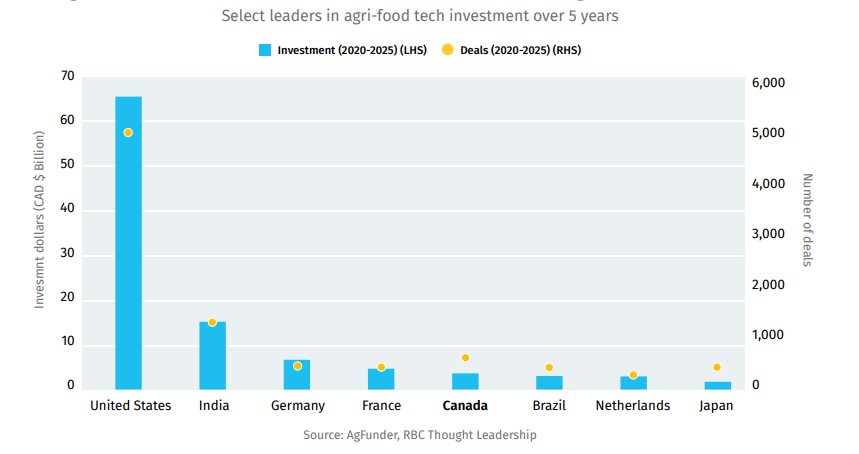
This decline in R&D and investment innovation directly results in the slow decline in productivity of our farming industry and in sector specific trade deficits such as pesticides and agriculture chemicals which has grown by 159% over the past 10 years.
Becoming innovative and technologically advanced isn’t just an option, it is a necessity. Half the farmers are over 60, and 1/3 of the farming jobs will be automated by 2035. We will need smart operations to take place just to produce the same amounts in the next few years. Drones and autonomous tractors will become a standard as the same level of human power won’t be applicable.
Technology will transform food production from traditional farmlands to enable much more productive greenhouses, and urban farming. Leamington, Ontario known as glass city because it has the largest concentration of greenhouses in North America, is a great example of a place embracing transformation. It has 2,000 acres “under cover” and grows fruits, and vegetables all year round using state of the art facilities with advance climate control, hydroponics, and nutrients – automated.
Labour costs in greenhouses is around 30% of the total expenses. As automation grows and the overall perfection of vertical farming, it will reconfigure the possibilities in the whole food supply chain.
Food will be able to grow much more closer to the plate and local. The type of produce we will be able to grow will be up to choice and not ability. We are basically there now with the intent from policy missing. Local greenhouses will be the local farmers market. Food will be so cheap to grow that local groups will be coming together for self sufficiency and it may even require government subsidy to grow at scale.
We should want the food to be as cheap as possible. This is our energy and health. It is the human foundation leverage to be able to do more. Abundance of nutrients has always been historically transformational for societies. It will also free up substantial resources towards our economy, including human capital.
The reason Canada’s food inflation is out of control is because of taxes, red tape, lack of energy strategy and refusal to have a technological driven focus. The longer we waste time the more it will cost and miss opportunities to develop future industries.
The smart agriculture industry is just around the $4.5B mark, which makes it in its infancy and has a a huge opportunity for growth. AgTech can add tens of billions to Canada’s economy while solving many of the issues we will start having.
To become food independent and not fall behind in the industry, we must start action right away. We have the home turf advantage to develop such crucial innovation and pioneer them for the world. We have willing Universities on the frontlines. Canada needs to become attractive to capital into this sector, and we have everything startups need to innovate in it.
Becoming Agri-Epicenter is low hanging fruit for Canada, let’s not let it wilt away. Federal and Provincial government must take measures, change policies, attract international cooperation. Let’s grow.